

Audio By Carbonatix
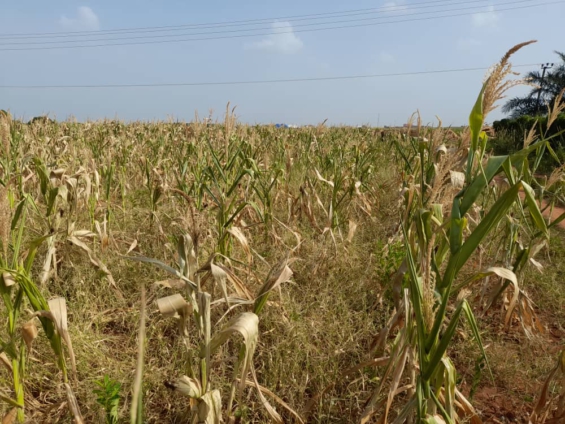
The Oti Regional Directorate of Agriculture (MoFA) has disclosed that about half of the crops planted in the region have suffered from drought due to irrational rainfall in the year.
Of the 127,920 hectares of land cultivated, 58,719 hectares suffered excruciating drought with farmers counting their losses.
The development has raised concerns about food security in the region, as the affected crops include maize, rice, yam, groundnut, soybean, millet, cassava, cowpea, sorghum and pepper, which are staple crops in the area.
Mr O'Brien Nyarko, the Oti Regional Director of Agriculture, who made these disclosures to the Ghana News Agency (GNA), said 76,016 farmers were affected by the recent drought, leaving farmers in the region to bear the brunt of the disaster.
These include 58,001 males and 18,015 females.
Mr Nyarko said the drought had a devastating impact on the region's agricultural sector with farmers, who relied heavily on rainfall, being left helpless.
He noted that the drought shows no signs of abating, further exacerbating the plight of farmers in the region.
Statistics available to GNA indicated that a total of 26,729 maize farmers have been affected, while 38,449 rice farmers have seen their crops wither away, yam farmers have not been spared either, with 6,933 farmers affected.
Groundnut farmers also suffered significant losses, with 3,397 farmers affected, while 280 soybean farmers have seen their crops devastated, millet farmers have also been hit hard with 37 affected, alongside 95 cassava, 32 cowpeas, 25 sorghum, and 39 pepper farmers.
The report ranked the districts based on the number of farmers affected, with Biakoye District emerging as the hardest hit.
A staggering 93,437 farmers in Biakoye District have been affected by the drought, followed by Jasikan District with 12, 886, Krachi East Municipal has 4, 238, while Nkwanta North and Nkwanta South districts have 3, 666 and 2, 884 farmers affected, respectively.
The Guan district has reported 9,235 affected farmers, while Kadjebi has seen 1,672 affected, Krachi West and Krachi Nchumuru have reported relatively lower numbers with 782 and 595 farmers affected, respectively.
Latest Stories
-
Obuasi SHTS case: Eduwatch calls for sex offenders’ register and mandatory background checks for teachers
2 minutes -
GloMeF CEO urges intensified public education on new road traffic regulations
14 minutes -
‘Any tax on ChatGPT is an attack on education and innovation’- Akim Swedru, MP
17 minutes -
Obuasi SHTS sexual abuse scandal exposes systemic failure in child protection – Moving Masculinity
18 minutes -
Hubtel CEO calls for national data-sharing framework to boost AI development
20 minutes -
Twelve Golden Rules of real estate development in Ghana, Africa
25 minutes -
Five new telephony cell sites in Ashanti Region to be activated in October 2026 – Sam George
25 minutes -
Mahama cuts sod for Afienya Industrial Park, targets 120 enterprises
30 minutes -
Rush for fuel from accident tankers is stealing, punishable by law – NPA boss, Edudzi Tamakloe
36 minutes -
GhIG pushes for legislation to regulate geoscientists’ activities
42 minutes -
Mfantsipim @150: Ace Anan Ankomah leads project to preserve school’s musical heritage
46 minutes -
Gov’t launches rCOMSDEP in Ahanta West, Mpohor Fiase to promote responsible community mining
47 minutes -
AI is forcing professionals to rethink how they deliver value – Hubtel CEO
50 minutes -
Daily Insight for CEOs: Strengthening the CEO’s Leadership Legacy
51 minutes -
Jimmy Aglah’s ‘When the River Testified’ approved by NaCCA as Supplementary Reader
60 minutes