

Audio By Carbonatix
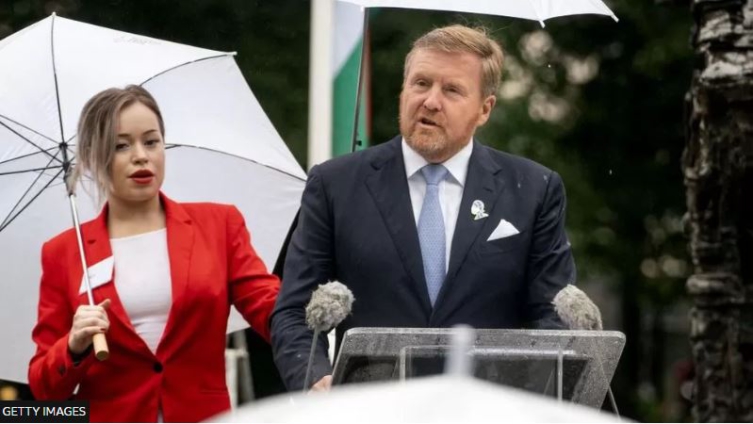
The King of the Netherlands has formally apologised for his country's role in the slave trade, saying he felt "personally and intensely" affected.
The country became a major colonial power after the 17th Century, holding territories across the globe, and Dutch slave traders trafficked more than 600,000 people.
King Willem-Alexander on Saturday called the practice a "horror".
The royal family did nothing to stop it, he said.
He was speaking at an event marking the 160th anniversary of the abolition of slavery in the country - it was unclear ahead of the event whether the King would apologise for the Royal Family's role in the practice.
In June, a new study revealed that Dutch rulers received the equivalent of €545m ($595m) in today's money between 1675 and 1770 from colonies where slavery was enforced.
During his speech in Amsterdam, King Willem-Alexander conceded that the "monarchs and rulers of the House of Orange took no steps against [slavery]".
"Today I'm standing here in front of you as your King and as part of the government. Today I am apologising myself," he said.
"Today, I am asking for forgiveness for the crystal-clear lack of action."
Accompanied by his wife Queen Maxima, the King acknowledged that he could not speak for the entire nation, but he told the crowd that "the vast majority" of Dutch citizens "do support the fight for equality for all people, regardless of colour or cultural background".
"After acknowledgment and apology, we can work together on healing, reconciliation and restoration," the King added.
His speech received cheers from the crowd at the Keti Koti Festival - the country's annual commemoration of the abolition of slavery.
During the 17th Century the Netherlands conquered large swathes of territory in regions that now make up Indonesia, South Africa, Curaçao and West Papua, and became a key player in the transatlantic slave trade.
Thousands of people were trafficked from Africa to Dutch colonies in the Caribbean and South America - amounting to around 5% of the entire transatlantic slave trade - before the practice was banned in 1863.
But in the nation of Suriname it continued during a mandatory 10-year transition period, causing untold grief and pain.
The Netherlands generated huge wealth from the slave trade, and in the western province of Holland alone a Dutch Research Council study found that 40% of economic growth between 1738 and 1780 could be attributed to the trade.
Last year, Prime Minister Mark Rutte also apologised for the country's historical role in the slave trade, saying in a speech at the Hague that it must be recognised in "the clearest terms" as "a crime against humanity".
And several Dutch cities, including Amsterdam and Rotterdam, have issued apologies for their role in the trade.
But the country has taken time to address its colonial past, and it was not until 2006 that the history of Dutch slavery was added to the school curriculum.
Latest Stories
-
Anti-LGBTQ Bill: Forget the rumour mongers, I’m a man of action, and will pass the bill – Speaker
2 minutes -
Women and children among those killed in Sudanese army shelling of wedding celebration
6 minutes -
President Mahama is not sincere with Ghanaians on LGBTQ bill matter – Hassan Tampuli
23 minutes -
Gov’t to establish Prison Industrial Hub to equip inmates with income-generating skills – Prison Service boss
42 minutes -
Alhassan Tampuli donates cement, roofing sheets to support storm victims in Gushegu
43 minutes -
Alhassan Tampuli appeals for urgent support for storm victims in Gushegu
46 minutes -
The hypocrisy must stop; pass Anti-LGBTQ+ Bill now – Alhassan Tampuli to Mahama
49 minutes -
Imprisonment should be rehabilitative, not punitive – Ghana Prisons boss at UNGA
1 hour -
Ga Adangbe traditional priests petition Mahama over McDan aviation licence revocation
1 hour -
Anti-LGBTQ Bill: NDC’s arrogance is worrying – Hassan Tampuli
2 hours -
Let’s give OSP time to mature, not to scrap it – Hassan Tampuli
2 hours -
Nigeria convicts 386 Islamist militants in mass trials
2 hours -
Djibouti president wins election with 97.8% of vote, state media says
2 hours -
We don’t have mandate to deduct tax from rent allowance of security services personnel – Interior Ministry clarifies
2 hours -
Ablakwa receives Presidential Special Envoy on Reparations to advance global agenda
2 hours