

Audio By Carbonatix
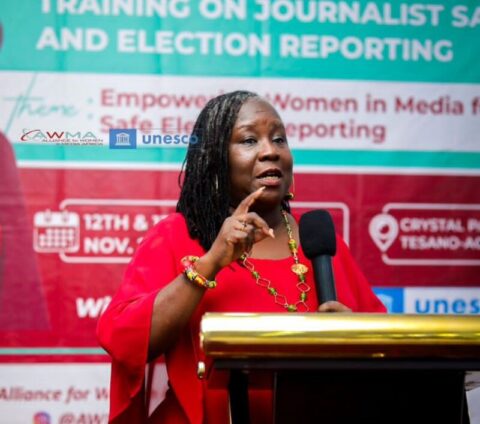
At a pivotal UNESCO-sponsored training session in Accra, the Dean of the School of Communication Studies at the University of Ghana, Professor Audrey Gadzekpo, and a distinguished patron of the Alliance for Women in Media, Africa (AWMA) called for urgent and strengthened support for women journalists covering Ghana’s upcoming elections.
With the nation preparing for its ninth democratic election, Prof Gadzekpo emphasised that Ghana’s journey toward democratic maturity must not foster complacency. Instead, she advocated for strategic measures to protect the journalists—especially women—who face unique risks in the field.
Addressing an audience of women journalists, she underscored the pressing need for safer reporting conditions, noting that their work is essential for transparency and civic engagement.
Prof Gadzekpo acknowledged Ghana’s democratic achievements, noting that while the upcoming election is a milestone, it is crucial not to become complacent.

"We cannot take democracy for granted," she emphasised, highlighting the risk of democratic backsliding seen in other African countries that transitioned to democracy around the same time as Ghana.
Her message was clear: Ghana has a vested responsibility to preserve its democratic progress and set an example for the region.
Prof Gadzekpo raised a stark reminder of the risks journalists face in covering elections, especially women journalists who, due to gender-related vulnerabilities, often confront heightened threats.
She said while Ghana is celebrated for peaceful elections, incidents of violence still surface, putting journalists in precarious situations.

"Violence is always a possibility," she said, "and we women are particularly vulnerable when it occurs."
She praised UNESCO’s partnership with the AWMA for its steadfast commitment to equipping female journalists with the skills and resources necessary to navigate these challenges safely.
Prof Gadzekpo also underscored the need for balanced election reporting, emphasising that while Ghana’s political landscape is dominated by two major parties, coverage must extend beyond them to include less prominent candidates.
This, she argued, is critical in ensuring a truly democratic process where all voices have a platform.
She noted the significance of having a woman vice-presidential candidate in the race, celebrating it as an achievement for gender representation in politics, but reminded journalists of their duty to shine a light on marginalised candidates and perspectives as well.

Reflecting on her longstanding collaboration with UNESCO, Prof Gadzekpo commended the organisation’s unwavering support, singling out team members who have been key allies in these efforts.
"For me, this is a very intimate space," she remarked, reinforcing her personal and professional commitment to creating a safer, more inclusive media environment for women.
Through this training, women journalists received practical tools and strategies to address the risks associated with election coverage, preparing them to foster accountability and transparency in a volatile environment.
The session was not only a forum for skills-building but also a space for solidarity, as attendees shared experiences and built networks to support one another in the demanding task of election reporting.
With Ghana on the cusp of yet another election, the training programme reinforced a powerful message: safeguarding democracy requires not just robust institutions but also the courage and protection of those who report its story, particularly women journalists who continue to push boundaries in the face of risk.
The programme, which was moderated by media personality Selikem Acolatse Apaloo, focused on the importance of safe, informed coverage as Ghana approaches its ninth democratic election.
Latest Stories
-
Friends of Bridget Bonnie Marks her 35th birthday with donation to Kasseh Model Health Centre
6 minutes -
Landfilling waste management creates no value, it’s an economic waste
33 minutes -
Photos: Speaker Bagbin Commissions MPs constituency office under parliamentary decentralisation programme
49 minutes -
Black Stars technical advisor Winfried Schäfer sacked as GFA shakes up backroom staff
53 minutes -
Wenchi water project almost complete, critical to gov’t agenda – GWL MD
1 hour -
Anti-LGBTQ+ bill not part of government’s legislative agenda – Inusah Fuseini
1 hour -
Anti-LGBTQ Bill: Forget the rumour mongers, I’m a man of action, and will pass the bill – Speaker
2 hours -
Women and children among those killed in Sudanese army shelling of wedding celebration
2 hours -
President Mahama is not sincere with Ghanaians on LGBTQ bill matter – Hassan Tampuli
2 hours -
Gov’t to establish Prison Industrial Hub to equip inmates with income-generating skills – Prison Service boss
3 hours -
Alhassan Tampuli donates cement, roofing sheets to support storm victims in Gushegu
3 hours -
Alhassan Tampuli appeals for urgent support for storm victims in Gushegu
3 hours -
The hypocrisy must stop; pass Anti-LGBTQ+ Bill now – Alhassan Tampuli to Mahama
3 hours -
Imprisonment should be rehabilitative, not punitive – Ghana Prisons boss at UNGA
3 hours -
Ga Adangbe traditional priests petition Mahama over McDan aviation licence revocation
3 hours