

Audio By Carbonatix
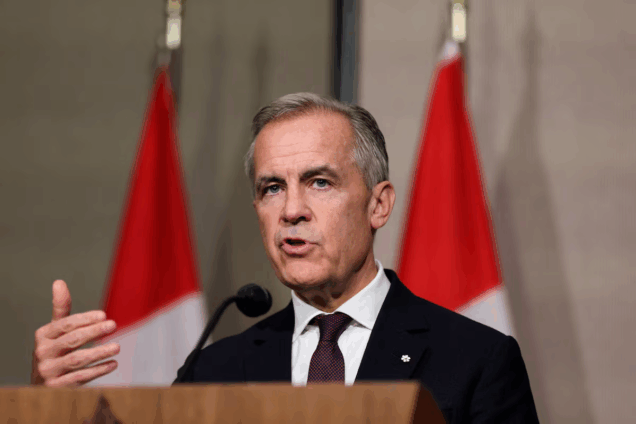
Canadian Prime Minister Mark Carney says "everything is on the table depending on the outcome of the negotiations" as the country's trade dispute with the US heats up.
Carney's comments come after he met his provincial and territorial counterparts on Thursday to discuss a response to the Trump administration's announcement of new 50% tariffs on some C$20bn of Canadian imports.
He said the trade talks with Washington are intensifying ahead of 19 August, when the new US tariffs will come into effect.
Some provincial leaders have pushed for firmer action - and faster results - on trade negotiations by Ottawa.
Carney said options included continuing to diversify trade away from the US and helping sectors most exposed to tariffs.
In terms of a direct response, he said "there's a full range of things we can do in that regard" but did not elaborate on potential punitive measures.
"We are going to support Canadian workers, families, businesses, full stop," he said.
The US announced the new levies on Monday, citing what it called "unequal treatment" of US cars, dairy and alcohol by Canada.
Everyday consumer items like wine and hockey sticks, as well as industrial goods such as cement, are on the target list. Several key exports, though, will be spared, including energy, potash, critical minerals and fish.
The two sides have about a month to negotiate before the levies take effect.
Carney said the deadline is "both" a pressure tactic from the Trump administration and an opportunity to move talks forward.
Talks between the US and Canada to renew the North American free trade agreement with Mexico - known as the USMCA - have been progressing slowly recently.
Earlier this year, the US chose not to renew the USMCA in its current form as it aimed to make changes to the agreement, which was reached during Trump's first term in office.
US Trade Representative Jamieson Greer told US lawmakers on Wednesday that he hopes to have interim deals with Canada and Mexico ready to be considered before the end of the year.
Tougher issues, like US objectives for stronger automotive rules of origin and labour and environmental standards could drag into next year, he conceded.
He also argued the tariffs on the northern neighbour were part of a broader strategy to protect American workers and address the US trade deficit, which he called a "national emergency".
Latest Stories
-
WAFU Zone B: Black Starlets seal semifinal place with 3-1 win over Benin
4 minutes -
Kaizen as a strategic pathway for micro business scale-up in Ghana
17 minutes -
Minister orders suspension of Obuasi SHS headmaster over alleged sexual misconduct following JoyNews investigation
21 minutes -
Over 38,000 commercial, 150,000 residential customers unbilled – Ghana Water MD
50 minutes -
Several injured as Sprinter bus collides with ‘trotro’ at Odorkor
51 minutes -
Ghana records progress on reparatory justice agenda – Ablakwa
1 hour -
Mahama commissions Christian Tetteh Yohuno Ward Complex at Police Hospital
1 hour -
Vice President calls for wider access to Ghana’s political party histories
1 hour -
Republic Bank JoyNews Habitat Fair to connect prospective homeowners with exhibitors in Ho from October 16 to 18
2 hours -
Obaasima Summit: ‘AI is not a spiritual attack’ — Rev. Dr. Ofori-Boateng urges young women to embrace technology
2 hours -
GHS to distribute 80,000 pairs of locally-made protective footwear to health workers
2 hours -
GoldBod boosts local jobs as 90% of gold undergoes refining in Ghana – Sammy Gyamfi
2 hours -
The search for the politically unblemished: Are we asking the impossible of public appointees?
2 hours -
Ghana seeks climate finance access for debt-restructuring countries
2 hours -
Afenyo-Markin urges stronger media scrutiny of public institutions
2 hours