

Audio By Carbonatix
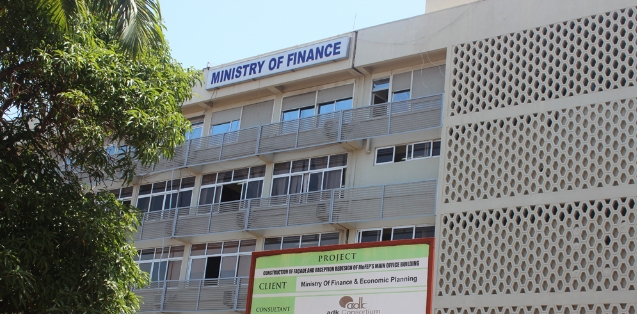
The Ministry of Finance has attributed the latest economic growth to the macroeconomic stability and growth interventions pursued under the IMF-supported Post-COVID-19 Programme for Economic Growth (PC-PEG).
“The latest GDP statistics released by Ghana Statistical Service (GSS) on Wednesday 18th September 2024, show that the Ghanaian economy is fast recovering amid global challenges and debt restructuring,” it said in a statement.
The ministry assured Ghanaians that the government would continue to prioritise the restoration and sustenance of macroeconomic stability which is necessary for the promotion of our inclusive growth agenda.
“It is expected that the implementation of the government’s growth strategy including the Planting for Food and Jobs Phase 2 Programme, the SME Growth and Opportunity Programme, the 1 District 1 Factory Programme, the Economic Enclave Programme under the Ghana CARES Programme will further consolidate the gains we are making in the economic recovery to improve the living conditions of the Ghanaian people,” the statement highlighted.
Ghana’s economy grew 6.9 per cent in the second quarter of 2024 as compared to 2.5 per cent recorded in the same period last year, the GSS said Wednesday.
The second quarter provisional growth was 1.6 per cent higher compared to real GDP in the first quarter of 2024.
“This was 0.4 percentage points higher than what was recorded in Q1 2024 thus January to March.
The provisional quarterly real GDP growth rate without oil and gas (non-oil GDP) for 2024 Q2 is 7.0 per cent, which compares to a growth rate of 3.1 per cent in the same quarter last year,” the GSS said in a statement.
Mining and Quarrying, Crops, Information and Communication, Construction, and Manufacturing, were the main drivers of GDP growth in the second quarter.
“Forestry and Logging, Other Personal Service Activities, and Water Supply, Sewerage, Waste Management and Remediation Activities were the main subsectors that contracted in the second quarter,” the GSS said.
It also noted that the Services sector continued to be the largest sector of the Ghanaian economy with a share of 44.2 per cent of GDP while the GDP shares of Industry and Agriculture were 32.2 per cent and 23.6 per cent, respectively.
The Ministry said that Ghana completed its domestic debt restructuring programme in 2023 and is currently in the process of completing its external debt restructuring programme, the growth performance for the first half-year of 2024 is much higher than the growth recorded by countries which have undergone similar debt restructuring programmes in the past.
“A case in point is Jamaica which recorded average real GDP growth of 1%-2% for about a decade post its debt restructuring,” the statement said.
Latest Stories
-
Banks NPL ratio of 16.1% is still too high – S&P
19 minutes -
Guidelines, regulations of cryptocurrency in Ghana fall short of comprehensive oversight – IMF
53 minutes -
COCOBOD’S GH¢16.3bn SPV: Real progress toward a sustainable cocoa sector
1 hour -
Ghana lose Morocco friendly as Atlas Lions turn to Mali
3 hours -
2026/2027 GPL: Kelvin Nkrumah strike sends Medeama top of league table
3 hours -
Punish Manchester City this season, say other club chiefs
3 hours -
Emmanuel City crowned champions of maiden Global Game Scouting Tournament
3 hours -
MPship should not shield anyone from arrest – Felix Ofosu-Kwakye
4 hours -
Thomas Partey loses father Jacob Teye Partey
4 hours -
Gov’t rejects Baffour Awuah ‘kidnap’ claims, says EOCO officer was lawfully executing arrest
4 hours -
Martin Kpebu explains when EOCO can arrest Manhyia South MP after securing court warrant
4 hours -
EOCO’s reasons for seeking Manhyia South MP arrest warrant not justified – Kpebu
4 hours -
MTN Ghana warns SMEs against sharing PINs amid digital fraud risks
4 hours -
Yendi nursing students warn restricted access to skills lab could affect their training
4 hours -
Minority awaits formal notice of arrest warrant for Manhyia South MP – Annoh-Dompreh
4 hours