

Audio By Carbonatix
Fitch Ratings is predicting in its latest report a growth rate of 5.0% for Ghana in 2026.
This is lower than the 5.9% Gross Domestic Product (GDP) growth rate achieved in 2025.
Its rating is based on the Middle East war, which has reached another dimension.
The UK-based firm disclosed that Sub-Saharan African (SSA) sovereigns face the external shock precipitated by the US-Iran war from a stronger starting point than when Russia invaded Ukraine in 2022.
It said improvements to monetary, fiscal and macroeconomic policy settings and metrics have enhanced the region’s resilience, but the war’s impact will test its depth and durability.
Key transmission channels are higher costs for energy imports, possible supply shortages (notably of refined oil products and fertilizer, domestic inflationary pressures, and the cost of fiscal support measures.
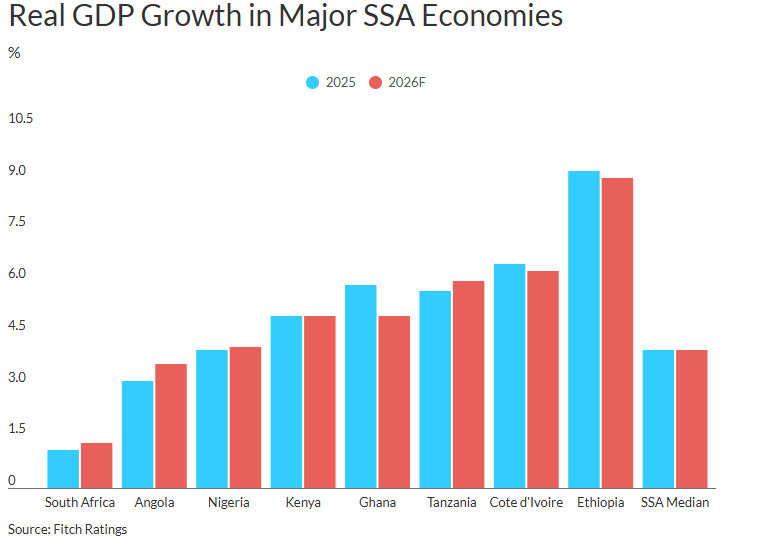
“Our baseline forecasts are for real GDP [Gross Domestic Product] to grow in all Fitch-rated SSA sovereigns this year, with the median of 4% unchanged from 2025. But some oil importers are exposed to a supply shock, which may be exacerbated by efforts to prevent the full pass-through of international fuel price moves incentivising speculative hoarding and artificially boosting demand”, it said.
Headline inflation is rising, but Fitch said often from a fairly low base, reflecting greater currency stability. “Central banks are well positioned to respond as most are running positive real policy rates, despite cuts pre-war facilitated by the previously subdued inflation backdrop”.
External Positions Stronger than in 2022
It continued that external positions are generally stronger than in 2022, with narrower current account deficits in several sovereigns and reserves of at least three months of current external payments.
It added that greater exchange-rate flexibility has also boosted resilience to shocks in some sovereigns. High prices for some export commodities can offset higher energy prices, depending on the composition of trade.
“Revenue mobilisation efforts and subsidy reforms have strengthened public finances since 2022, but political and social pressures were, to varying degrees, already a constraint on fiscal adjustment. Fiscal measures to ease the pass-through of energy prices have been widespread, but generally time-limited and small”, it concluded.
Latest Stories
-
Teacher unions to meet government Monday over nationwide strike
15 minutes -
Photo story: Republic Bank-JoyNews Habitat Fair clinic wraps up after three days of housing solutions, expert engagement
18 minutes -
National Peace Council urges investment in youth to sustain Ghana’s peace
40 minutes -
Afenyo-Markin urges youth to speak up against injustice
51 minutes -
CAF annuls Edo Queens victory, orders WAFU B final to resume from extra time
1 hour -
Interior Minister urges traditional authorities to enforce anti-bushfire bye-laws
1 hour -
3rd Republic Bank-JoyNews Habitat Fair Clinic ends on a high note after three days of strong patronage
1 hour -
Ten climbers missing after avalanche hits Himalayan base camp
2 hours -
NPP had more permanent fuel relief measures than current GH¢2 diesel cut – Amin Adam
2 hours -
Photos from the 3rd Republic Bank-JoyNews Habitat Fair Clinic
2 hours -
Ethiopia’s army promises restraint amid fears of new civil war
2 hours -
Amin Adam calls for review of fuel taxes as diesel prices remain above GH¢18
3 hours -
World Vision Ghana, Ahafo districts sign MoU for universal WASH coverage
4 hours -
When the gold engine stutters: What Ghana’s Cedi and reserves are telling us about the new economic architecture
4 hours -
Two reportedly die after being trapped in mining pit at Juaboso
4 hours