

Audio By Carbonatix
Stakeholders and gender advocates have called for a fundamental redesign of Nigeria’s justice landscape to ensure it effectively serves women and girls.
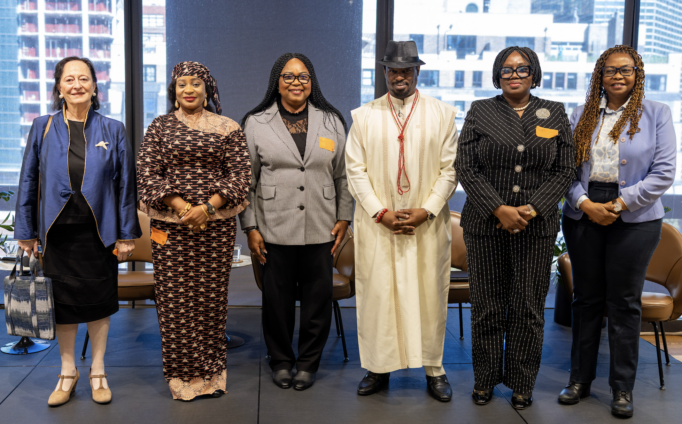
This was during a Ford Foundation dialogue centred on the effectiveness of the nation's plural justice system.
The conversation, which took place on the sidelines of CSW70 in New York, moved beyond legal frameworks to address the lived realities of survivors.
It emphasised that justice only works when legal literacy is strengthened, and the economic and cultural barriers that currently force women into silence are removed.
Across the country, justice is shaped by multiple systems: statutory, customary, and religious. In theory, these systems should work together.
In reality, they often leave gaps where survivors of gender-based violence fall through, unheard and unsupported, and Legal processes can be costly and slow. Customary systems, though closer to communities, can reflect norms that do not always protect women and girls.
The conversation extended beyond systems and frameworks, becoming a frank exploration of lived experiences, complex trade-offs, and the potential for change, where the most impactful moments were shaped not by theory but by genuine honesty.
Speaking on the barriers many women face in accessing formal justice, His Royal Majesty, Obi Benjamin Ikenchukwu Keagboruzi, the Dein of Agbor, underscored the practical constraints that continue to push justice out of reach.
“Court fees, transportation, legal representation, and time away from work, each one a cost that pushes justice further out of reach,” he said.
For many women, he added, these realities leave them with little choice but to turn to customary systems that are more accessible, but not always more protective.
Sharing her perspective from the Bench, Justice Bukunola Adebiyi, Justice of the Lagos State High Court, reminded the room that even when laws exist, justice is not guaranteed.
Cases can fail long before judgment — in how they are investigated, how evidence is gathered, and how they are presented. Strengthening these processes, she said, is essential if the system is to truly serve survivors.
The most sobering reflections came from lived experiences.
Ngozi Valentina Enih, Commissioner for Children, Gender Affairs, and Social Development in Enugu State, spoke not only as a policymaker but also as a survivor.
She shared what it means to pursue justice in a context where silence is often reinforced by the need for economic survival.
She explained that “Families sometimes withdraw cases not because harm did not occur, but because the perpetrator is also a provider. In those moments, justice competes with survival — and too often, survival wins”.
Rather than treating culture only as a barrier, Elsa Stamatopoulou, Adjunct Professor of Anthropology and former Director of the Indigenous Peoples’ Rights Program at Columbia University’s Institute for the Study of Human Rights, offered a different lens, one that recognised culture as a resource.
Across communities, women are already mobilising cultural systems, building networks of support, and challenging violence from within.
The question, then she said, is not whether culture is part of the problem, but how it can become part of the solution.
Moderating the conversation, Professor Joy Ezeilo, SAN, Executive Director of the Women’s Aid Collective (WACOL), brought these threads together with clarity. Nigeria’s plural legal system, she argued, “should not be seen as a weakness to be resolved, but as a possibility to be shaped.
The task is not to choose between systems, but to ensure that all of them evolve toward a single standard: dignity, safety, and equality for women and girls”.
Participants pointed to a number of solutions, including strengthening legal literacy so that women understand their rights, expanding grassroots legal support so that communities are not left to navigate systems alone, and ensuring that women themselves play a central role in shaping both customary and statutory reforms.
As Dr ChiChi Aniagolu-Okoye, the Regional Director, West Africa, Ford Foundation, reflected, the real challenge — and the real opportunity — lies in building a system where justice is not only available in principle, but reachable in practice for every woman and girl.
“The future of justice for women and girls in Nigeria will not be built on one system alone. It will be shaped at the intersections — where courts, communities, and cultures meet.
"It will be built when barriers are reduced, when systems listen, and when solutions are designed with the realities of women at the centre,” she said.
Latest Stories
-
Over 38,000 commercial, 150,000 residential customers unbilled – Ghana Water MD
21 minutes -
Several injured as Sprinter bus collides with ‘trotro’ at Odorkor
22 minutes -
Ghana records progress on reparatory justice agenda – Ablakwa
39 minutes -
Mahama commissions Christian Tetteh Yohuno Ward Complex at Police Hospital
54 minutes -
Vice President calls for wider access to Ghana’s political party histories
54 minutes -
Republic Bank JoyNews Habitat Fair to connect prospective homeowners with exhibitors in Ho from October 16 to 18
1 hour -
Obaasima Summit: ‘AI is not a spiritual attack’ — Rev. Dr. Ofori-Boateng urges young women to embrace technology
1 hour -
GHS to distribute 80,000 pairs of locally-made protective footwear to health workers
1 hour -
GoldBod boosts local jobs as 90% of gold undergoes refining in Ghana – Sammy Gyamfi
1 hour -
The search for the politically unblemished: Are we asking the impossible of public appointees?
1 hour -
Ghana seeks climate finance access for debt-restructuring countries
2 hours -
Afenyo-Markin urges stronger media scrutiny of public institutions
2 hours -
GoldBod recovers GH¢38.7m in legacy PMMC debts, targets remaining arrears
2 hours -
62 out of every 100 commercial meters inspected missing from Ghana Water database – MD
2 hours -
GoldBod gets BoG authorisation to sell forex, Sammy Gyamfi tells PAC
2 hours