

Audio By Carbonatix
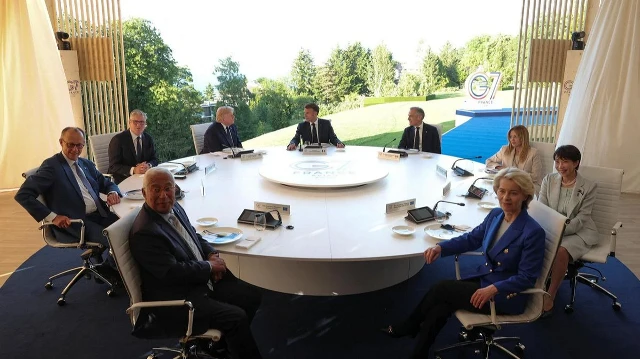
World leaders gathered in the French spa town of Évian-les-Bains for the three-day Group of Seven summit. A tentative deal to end the Iran war emerged as the dominant topic. U.S. President Donald Trump arrived in France on Monday evening. He was buoyed by a preliminary accord between Washington and Tehran to end the wider conflict. A formal signing is targeted for Friday in Geneva. The high-stakes gathering explicitly positions this newly struck pact alongside a critical European push to resolve the war in Ukraine. Both issues now sit at the top of the international agenda.
The preliminary framework is expected to open a 60-day window for complex negotiations. These talks will cover Iran’s highly enriched uranium and the lifting of economic sanctions. A U.S. official confirmed that Trump and Vice President JD Vance both virtually signed the agreement. It aims to reopen the Strait of Hormuz, end the U.S. blockade on Iranian ports, and start the nuclear talks. Before the summit, the leaders of France, Germany, Italy, and the UK issued a joint statement congratulating the U.S., Iran, and the mediators on what they called a “diplomatic breakthrough”. Canada also signed the statement.
The text of the tentative deal remains tightly guarded. However, the American president expressed immense confidence upon his arrival. “The Iran deal will bring a lot of success,” Trump said shortly after reaching Evian-les-Bains. He later reiterated his optimism during the opening leg of the summit, noting that “great things are going to happen.”
Friction Over Maritime Security
Despite the optimistic rhetoric from Washington, the accord has sparked intense, behind-the-scenes debates among G7 members. Discussions at dinner Monday night were “frank” and in-depth, according to people familiar with the conversation. The meal lasted nearly two hours around a table perched above Lake Geneva’s south shoreline. It also veered toward topics like Ukraine.
Emerging from the dinner, European officials noted they still harboured critical questions regarding the mechanics of the accord. They are mainly concerned with how quickly the Strait of Hormuz can be reopened to commercial traffic. French President Emmanuel Macron is hosting the summit near the Swiss border. He said the priority was to ensure a “solid, serious agreement that is finalised”. Macron noted that Tuesday’s working lunch would focus on reopening the waterway. This includes a possible Franco-British-led maritime mission and identifying alternative energy routes that bypass the strait. Allied leaders stated it was vital for detailed negotiations to take place and for the deal to be quickly implemented.
Trump has stated that the Strait of Hormuz would be “completely open” on Friday. However, a rift has developed over who will secure the path. U.S. officials indicated they expected European nations to assist with removing mines. Macron confirmed that France and other Western partners are “ready to take action very quickly” to restore security peacefully. He told Trump that his country was “ready to take our fair share of the burden” to support the deal. Conversely, Trump downplayed the necessity of a coordinated allied naval presence. “I don’t think we’re going to need much help, but I don’t think it’s a bad idea to have a ship or two up here from a few countries,” Trump said.
Geopolitical Fallout and Regional Scepticism
The diplomatic breakthrough has sent shockwaves across the Middle East. It generated contrasting reactions from regional powers and displaced populations. Some residents of southern Lebanon who were displaced by months of war between Israel and Iran-backed Hezbollah began returning to their homes Monday. They expressed joy and cautious optimism pending Friday's formal signing. “It’s the best feeling … We’re returning to our town, to our land,” a man travelling to the city of Tyre told Reuters. Another resident from Tyre reflected the raw reality. He told Reuters that returning home was “an indescribable feeling … even if returning to rubble, it doesn’t matter.”
However, these returns face severe resistance from Israel. Prime Minister Benjamin Netanyahu largely avoided addressing the deal directly in his remarks Monday. He noted that he and Trump “do not always see eye to eye.” Israeli Defence Minister Israel Katz reinforced this position. He stated that Israeli troops will not be withdrawing from security zones in southern Lebanon, Gaza, and Syria.
The broader regional implications will face intense scrutiny on Tuesday. Leaders from the United Arab Emirates, Qatar, and Egypt will join the summit at Macron's invitation. Trump plans to meet with them individually to address regional anxieties. However, diplomats told the Reuters news agency that these Arab state leaders are not expected to engage in detailed discussions on Iran’s nuclear programme.
Meanwhile, geopolitical tension found expression at the 2026 World Cup match between Iran and New Zealand on Monday night. Some attendees carried banned pre-revolutionary flags featuring the lion and sun symbol. They defied warnings from Tehran and a FIFA ban upheld by a last-minute hearing in Los Angeles. The display highlighted deep domestic fractures. “This team is not the team of the people of Iran,” spectator Farhad Jafargad told Reuters. Others sought to separate sports from politics. Fan Mehdi Jafari told Reuters, “We’re here to support Iran. I think we should all let go of the politics and just go in and cheer on the Team Melli.”
Confronting the War in Ukraine
While the Middle East dominated the initial hours, European leaders pushed to refocus the agenda on the Russian invasion of Ukraine, now in its fifth year. European nations want to convince Trump that past U.S. peace proposals have been overly favourable to Moscow. They want to signal a willingness to engage in talks with Russian President Vladimir Putin while tightening sanctions and boosting military aid. This is meant to emphasise that Moscow, not Kyiv, is blocking progress. The opening session on Tuesday explicitly centres on “building peace in Ukraine,” providing a direct backdrop for these efforts.
Ukrainian President Volodymyr Zelenskyy arrived at the summit following a heavy Russian attack on Kyiv’s historic Kyiv Pechersk Lavra monastery. Condemning the fire at the iconic site, Zelenskyy stated he would push hard for advanced air defence systems during his meetings. He offered to meet with Putin at the G7 summit. This repeated an open-letter offer from earlier this month. Putin rejected that advance, claiming he saw “no point” in a meeting unless a deal was ready.
European Commission President Ursula von der Leyen delivered a strong assessment of the battlefield dynamics in Évian on Tuesday. She asserted that Ukraine was “holding the front line and even partially regaining territory.” Von der Leyen added that “Ukraine has developed the capability to strike strategic targets deep inside Russia. And Ukraine has become a world-leading producer of cutting-edge military equipment.” In contrast, she noted the degrading state of the Russian economy under international pressure, stating, “On the other hand, Russia is feeling the strain and pressure of sanctions … Putin’s war economy has never been as weak.”
Diplomatic Manoeuvring and Personal Tensions
The success of the summit depends heavily on the personal diplomacy of President Trump. His relationships with G7 counterparts remain severely strained after months of public insults. Trump’s historical aversion to the G7 is well-documented. He previously cut short summits in Canada and consistently questioned why Russia remains excluded from the group.
Macron is actively working to broker an impromptu meeting between the American president and Zelenskyy. Trump’s official schedule does not include bilateral talks with Zelenskyy, but Macron was overheard asking the Ukrainian leader, “So first, do you have a bilateral thing organised … with President Trump?” before offering to “arrange this.” An unscheduled meeting on the sidelines of Pope Francis' funeral last year served as a turning point in their complex relationship, and officials hope to replicate that contact.
Trump maintained that he retains a unique ability to mediate. He noted he had good conversations on Sunday with both Zelenskyy and Putin and thought both of them were “open to doing something about the war.” However, he must navigate a room of European leaders whom he has consistently alienated. Trump recently dismissed British Prime Minister Keir Starmer as “no Winston Churchill,” and mocked Canadian Prime Minister Mark Carney as “Governor Carney” following trade disputes. He also targeted German Chancellor Friedrich Merz and Italian Prime Minister Giorgia Meloni after they questioned the U.S. strategy or declined to participate in the conflict with Iran. Whether these personal grievances will impede the finalisation of the Iran deal or a unified strategy on Ukraine remains the central question as the summit continues.
An Uncertain Path for Global Coalitions
The convergence of the U.S.-Iran agreement and the war in Ukraine underscores a fundamental shift in global diplomacy. Unilateral breakthroughs are clashing directly with established allied frameworks. As President Trump attempts to leverage his diplomatic wins, the scepticism radiating from European partners, regional neighbours, and frontline states highlights the fragile nature of these parallel negotiations. The remaining days of the summit will test whether personal grievances and deep ideological rifts can be overcome to forge a unified consensus, or if these cracks will further isolate the United States from its traditional Western alliance.
Latest Stories
-
National Peace Council urges investment in youth to sustain Ghana’s peace
3 minutes -
Afenyo-Markin urges youth to speak up against injustice
14 minutes -
CAF annuls Edo Queens victory, orders WAFU B final to resume from extra time
36 minutes -
Interior Minister urges traditional authorities to enforce anti-bushfire bye-laws
38 minutes -
3rd Republic Bank-JoyNews Habitat Fair Clinic ends on a high note after three days of strong patronage
40 minutes -
Ten climbers missing after avalanche hits Himalayan base camp
1 hour -
NPP had more permanent fuel relief measures than current GH¢2 diesel cut – Amin Adam
2 hours -
Photos from the 3rd Republic Bank-JoyNews Habitat Fair Clinic
2 hours -
Ethiopia’s army promises restraint amid fears of new civil war
2 hours -
Amin Adam calls for review of fuel taxes as diesel prices remain above GH¢18
2 hours -
World Vision Ghana, Ahafo districts sign MoU for universal WASH coverage
3 hours -
When the gold engine stutters: What Ghana’s Cedi and reserves are telling us about the new economic architecture
3 hours -
Two reportedly die after being trapped in mining pit at Juaboso
3 hours -
Petrosol cleans up Wa Municipal Hospital, to donate medical equipment
3 hours -
‘If NPP was ‘insensitive’ over fuel prices, NDC must accept same description now’ — Amin Adam
4 hours