

Audio By Carbonatix
The debate over what caused delays to the Greater Accra Resilient and Integrated Development (GARID) Project has taken a new turn.
In May 2026, the World Bank downgraded implementation of the $350 million project to "Moderately Unsatisfactory", arguing that fiscal controls introduced by the Ministry of Finance significantly slowed implementation by delaying contractor payments and restricting access to project funds.
Privately, however, officials at the Ministry of Finance have defended the controls, arguing that tighter oversight was necessary because of concerns over how some project funds had been spent under the previous administration.
Documents submitted by the Ministry of Finance as part of the GARID expenditure records offer a glimpse into some of the expenditures that may have prompted greater scrutiny.
Among the items captured in the expenditure schedule is ¢504,450 spent on a management training programme at Aqua Safari in September 2020.
The records also show ¢476,784 spent on an end of year retreat in December 2022.
Another entry dated May 11, 2023 records ¢11,040 for meetings and fuel relating to the Project Director's late father's funeral.
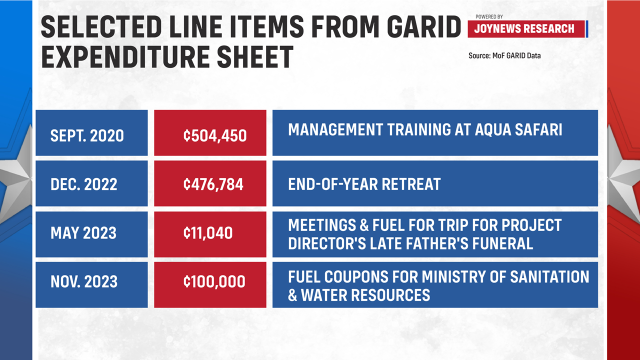
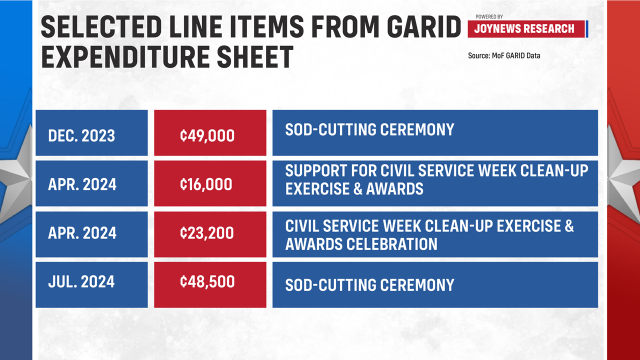
Other expenditures include ¢100,000 for fuel coupons for the Ministry of Sanitation and Water Resources in November 2023, ¢49,000 for a sod cutting ceremony in December 2023, and a further ¢48,500 for another sod cutting ceremony in July 2024.
The expenditure schedule also records ¢16,000 and ¢23,200 for activities relating to Civil Service Week clean up exercises and awards in April 2024.
Viewed individually, some of the expenditures may have legitimate administrative or project related justifications. However, taken together, they raise questions about whether all spending under the project was directly aligned with GARID's primary development objectives of strengthening flood risk management, improving solid waste management and enhancing urban resilience in Greater Accra.
The World Bank's implementation report does not specifically identify these expenditure items as irregular, nor does it cite them as the reason for introducing the fiscal controls.
Instead, it attributes the project's implementation delays to the Ministry of Finance's subsequent funding restrictions.
The Ministry of Finance has not publicly detailed the specific expenditures that informed its decision to tighten controls. However, the expenditure records suggest that project spending itself may have become an area of concern within government.
Whether these expenditures complied with the project's financing agreement, procurement guidelines and eligible expenditure rules remains unclear.
Latest Stories
-
Ghana’s tuna industry in crisis as 20 hook-and-line vessels collapse
6 minutes -
South Tongu MP launches apprenticeship programme for 159 young people
20 minutes -
The Pusiga connection behind Gertrude Atongi’s work in New York
46 minutes -
Teachers took promotion exams in December to beat government clearance deadline – GNAT
48 minutes -
NPA launches 2026 staff welfare week with focus on teamwork and employee wellbeing
51 minutes -
Ghana, Saint Kitts and Nevis sign labour deal to strengthen protections for Ghanaian nurses
57 minutes -
Delayed promotions put teachers’ retirement benefits at risk – GNAT
1 hour -
No ‘Bawumia candidates’ in NPP executive elections – Anthony Karbo
1 hour -
Over 3,000 displaced as flooding overwhelms Hohoe communities
1 hour -
Sunyani East NPP executives begin reconciliation drive ahead of 2028 polls
1 hour -
Agric Minister engages Ga Mantse on agriculture transformation agenda
1 hour -
Aayalolo expansion targets private car users, not trotro operators – Mahama Ayariga
1 hour -
KNUST, GMTF explore AI partnership to transform healthcare delivery
1 hour -
MTTD records 9,000 preventable crashes, over 900 deaths in eight months
2 hours -
UN Secretary-General expresses optimism about future, pledges support for Mahama, AU
2 hours