

Audio By Carbonatix
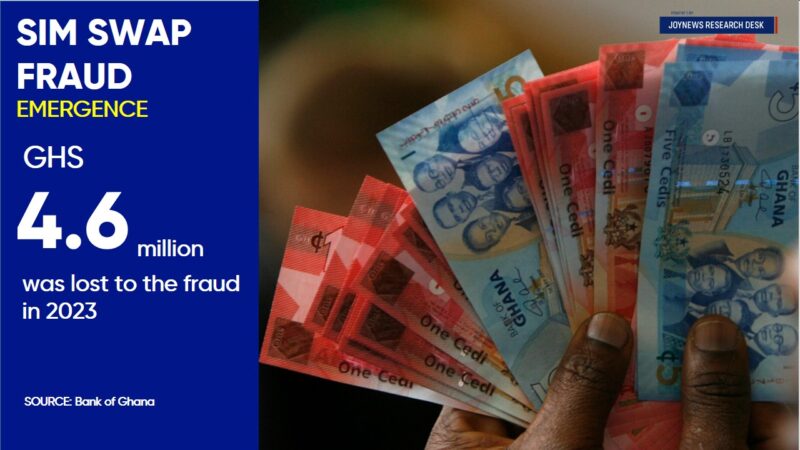
The Bank of Ghana has revealed a rapid emergence of SIM swap fraud targeting individuals with access to mobile banking channels. According to the apex bank, about GHȼ4.6 million was lost to this fraud in 2023, attributed to 15 recorded cases.

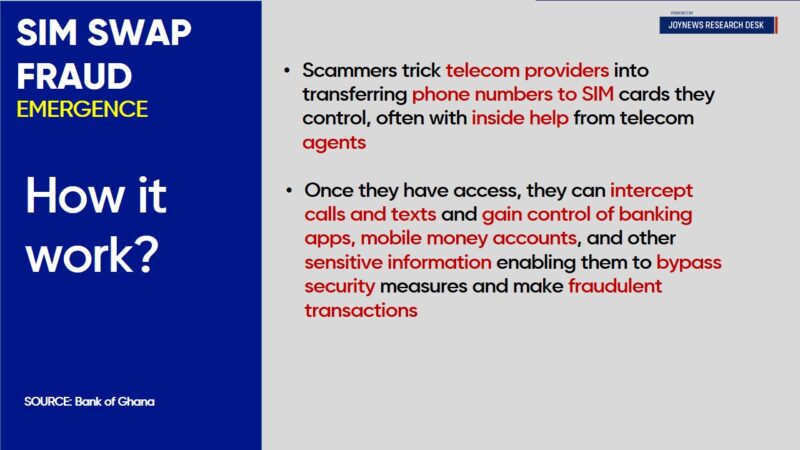
This type of fraud targets individuals with mobile banking access, including banking apps, WhatsApp banking, or any account linked to their mobile number. Scammers trick telecom providers into transferring victims' phone numbers to SIM cards they control, often with inside help from telecom agents.
Once they have access, they can intercept calls and texts and even gain control of banking apps, mobile money accounts, and other sensitive information, enabling them to bypass security measures and make fraudulent transactions.
Even in the event of cheque clearing, fraudsters can intercept mobile phone confirmations.
The threat extends beyond individuals to corporate institutions, where large sums of money can be stolen.
Ransford Nana Addo Junior, a Certified Fraud Examiner and Financial Crime & Fraud Lecturer at the National Banking College, says "It is not only individual accounts. When a SIM swap happens on corporate accounts, it's more dangerous. For instance, if the CFO of a hotel has his number swapped and a fraudulent transaction is initiated, the fraudsters will be the ones receiving the confirmation."
He also noted that SIM swap fraud extends beyond banking:
"It goes beyond just the mobile channels and even beyond banking. For instance, if somebody wants to intercept your medication information sent through SMS or your SSNIT records, it can be intercepted through SIM swap as well."
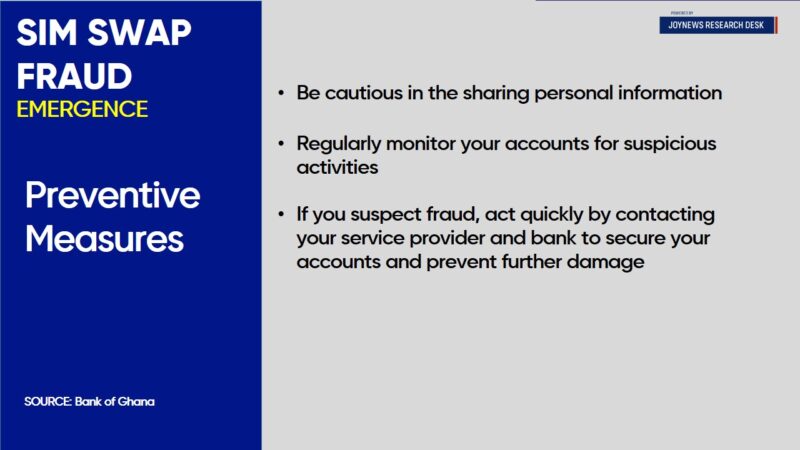
To protect yourself, be cautious in sharing personal information and regularly monitor your accounts for suspicious activities. If you suspect fraud, act quickly by contacting your service provider and bank to secure your accounts and prevent further damage.
For payment service providers, the Bank of Ghana has directed compliance with section 34(3)(a) and (b) of the Payment Systems and Services Act 2019 (Act 987). This requires the deactivation of a customer's electronic money account for two days when they swap or replace their SIM card. The account can be reactivated once the customer presents valid identification, mitigating SIM swap-related fraud.
Details of the report showed a 5% rise in the number of overall fraud cases reported leading to a loss of GHS 88 million in 2023.
Latest Stories
-
Nearly 400 sentenced in Nigeria for links to militant Islamists
12 seconds -
Ghana’s recovery supported by gold strength despite global oil price pressures – Standard Bank Research
7 minutes -
Kwaku Azar writes: A-G vs OSP
40 minutes -
Mfantsipim–Adisadel rivalry built excellence, not division – Sam Jonah
1 hour -
Vice President launches Mfantsipim’s 150 years of shaping Ghana’s greatest mind
1 hour -
I assure Otumfuo, Mahama will join him to commission KNUST Teaching Hospital by end of this year – Haruna Iddrisu
2 hours -
Barcelona dominate derby to extend La Liga lead
2 hours -
Gov’t to roll out free special education for persons with disabilities from July 1 – Education Minister
2 hours -
Importers and Exporters Association declares full support for Publican AI port system
3 hours -
“We used it to test our officiating officials’ readiness” – Bawah Fuseini after CAA Athletics event
3 hours -
Volleyball emerges as Ghana’s fastest rising sport
3 hours -
National Sports Fund needs strong leadership from the top – Administrator David Wuaku
3 hours -
JoySports Exclusive: Steve McLaren in talks with GFA after expressing interest in Black Stars job
3 hours -
Fire guts auto parts warehouse at Bubuashie, one fire officer injured
3 hours -
I owe my victory to coach Ofori Asare – Allotey after winning WBA Africa Gold Super Flyweight belt
4 hours