

Audio By Carbonatix
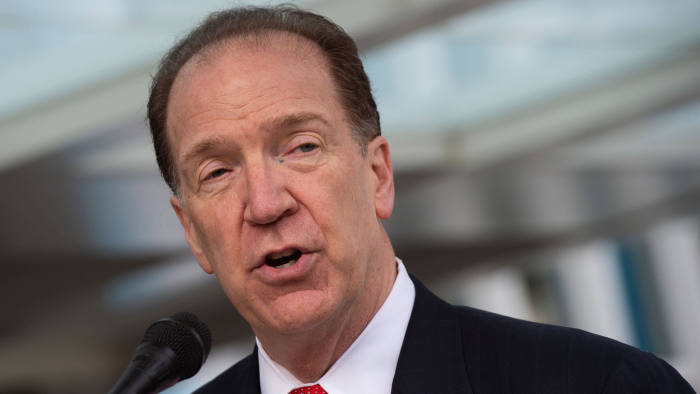
The World Bank Group President, David Malpass, has expressed disappointment over Ghana and Nigeria’s decision not to sign up for the Debt Service Suspension Initiative (DSSI).
Established in May 2020, the DSSI expired at the end of December 2021.
The DSSI, put together by the International Monetary Fund (IMF) and World Bank offered countries an opportunity to freeze debt servicing, whiles they concentrate on using their minimum funds to deal with other commitments.
Mr. Malpass was responding to questions at a programme in Washington DC, on suggestions that the Bretton Wood institutions are not doing enough to help cancel the debts of some African countries in distress.
But reacting to the question, he pointed out that Ghana and Nigeria failed to apply for the DSSI, which would have provided some financial space for the repayment of loans.
“Kristalina (IMF Boss) and I were talking yesterday with the Group about the Common Framework. If countries could have a situation where the common framework clause allow the country to have a standstill on debt, that would help the country choose their path forward on debts restructuring. That would mean they would get a break on debt repayment while they work on debt restructuring,” he explained.
Mr. Malpass stated that such initiatives are designed to help reduce the impact of economic hardship on developing countries.
He, however pointed out that some developing countries refused to take advantage of the initiative to minimise the impact of the current global hardship on their citizens.
“Nigeria and Ghana both, did not ask for the common framework treatment”, he said, adding that the situation has made it difficult for such countries to overcome the negative impact of current global economic hardship on trade and currencies of developing countries.
Debt to GDP to hit 90.7% - IMF
The International Monetary Fund (IMF) had already projected that Ghana will end 2022 with a debt-to-Gross Domestic Product of 90.7%.
This was captured in its Fiscal Outlook Report released on the sidelines of the on-going IMF/World Bank Annual meetings in Washington DC, USA.
The report, also forecasts that the debt–to-GDP could reduce to 87.8% in 2023.
According to the IMF, revenue expressed as a ratio of GDP could also hit 14.1% at the end of 2022.
It will subsequently increase to 14.7% in 2023 and 15.4% in 2024”, the report said, classifying Ghana as a Low Income Developing Country.
Latest Stories
-
John Boadu pledges unity, reconciliation as he takes over as NPP National Chairman
1 minute -
‘Whatever the personal cost, I will not abandon my duty’ – Baffour Awuah assures Salomey Bafoh
3 minutes -
Government to increase funding for Houses of Chiefs to speed up dispute resolution
5 minutes -
Govt’ to introduce digital property rate system to boost MMDAs’ revenue – Mahama Ayariga
7 minutes -
Traditional Medicine Practice Council closes three unlicensed spa and massage centres in Ashanti Region
9 minutes -
Let’s accept the reality and move along – Mike Oquaye on NPP’s decision to make flagbearer party leader
11 minutes -
Early presidential primary helped cool tensions in NPP – Prof. Mike Oquaye
29 minutes -
NDC congratulates new NPP executives, urges national interest above party interests
31 minutes -
NPP implementing 2024 election review recommendations in stages – Prof Mike Oquaye
33 minutes -
Ghana Rugby Union announces managerial changes
33 minutes -
US removes all bombers from RAF Fairford base
34 minutes -
France closes up to 500 schools Monday over student protests
34 minutes -
Girl, 12, fatally shot in US during ‘dispute over parking space’
35 minutes -
NPP is a party for all classes – Prof. Mike Oquaye
36 minutes -
Chief Justice urges Judiciary to strengthen foundations of justice
36 minutes