

Audio By Carbonatix
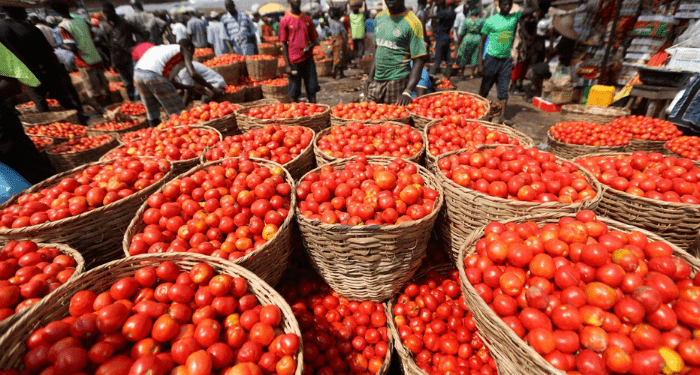
Ghana plans to produce between 200,000 and 300,000 metric tonnes of tomatoes within the next two to three years, particularly during the dry season, as part of efforts to reduce imports, the Deputy Minister for Food and Agriculture, John Dumelo, has said.
Speaking on Joy FM’s Super Morning Show on Wednesday, 18 February, Mr Dumelo said the country is scaling up tomato production through irrigation, research and direct support to farmers.
“Our yearly demand is almost 800,000 metric tonnes. And hopefully, by the end of two to three years, we should be doing about 200,000 or 300,000 metric tonnes, especially in the dry season,” he said.
He noted that Ghana has, over the years, made several attempts to become self-sufficient in tomato production.
“It would be interesting to know that over the years, we’ve tried so many ways to be able to be self-sufficient when it comes to tomato production,” he said.
“As we speak, there are certain irrigation facilities around the country where trials are ongoing with different varieties of tomatoes to see how best we can commercialise them.”
The Deputy Minister said he would be touring some of these facilities to assess progress.
“From tomorrow to Friday, I’ll be around some of these irrigation schemes to see how far they’ve gone,” he said, adding that harvesting has already started in some areas.
He cited specific locations where trials are underway.
“When you go to Ashanti Region, at the Komadan irrigation scheme, they are doing some trials there. When you go to the Tono Dam in the north, they are doing some trials there with the FSRP. When you go to Garu, there’s an irrigation facility there where they are also undertaking tomato production,” he said.
Mr Dumelo pointed out that the current administration came into office last year and is now in its second dry season.
“By the end of this year, when we are beginning the third dry season, I’m sure we’ll be able to scale up production,” he said.
He added that the immediate goal is to cut tomato imports by 20 to 30 per cent within two years.
Beyond irrigation, the government is also providing direct support to farmers. Mr Dumelo said some farmers have been selected to receive solar-powered boreholes, while water pumps have been distributed to several farmer organisations.
He disclosed that he recently met vegetable farmers in the Eastern Region and assured them of government support to boost dry season production.
When asked whether increasing output by 200,000 metric tonnes within two to three years would make Ghana self-sufficient, Mr Dumelo admitted that it would not.
However, he stressed that agricultural transformation takes time.
“If you look at how agriculture works, there are periods of research and development, and there are periods of trials. It’s going to take some time,” he explained.
He compared the tomato strategy to the government’s poultry policy aimed at reducing imports.
“It’s going to take a couple of years for us to reach that point, and the same applies to tomatoes,” he said.
Mr Dumelo expressed confidence that with sustained trials and research, Ghana could eventually halt tomato imports from neighbouring countries.
“I can assure you that if we continue as we are doing now in terms of the trials and the research and everything we are undertaking, I should think that in about five or six years we should stop the total importation of tomatoes from Burkina Faso and neighbouring countries,” he stated.
Latest Stories
-
South Tongu MP launches apprenticeship programme for 159 young people
11 minutes -
The Pusiga connection behind Gertrude Atongi’s work in New York
38 minutes -
Teachers took promotion exams in December to beat government clearance deadline – GNAT
40 minutes -
NPA launches 2026 staff welfare week with focus on teamwork and employee wellbeing
43 minutes -
Ghana, Saint Kitts and Nevis sign labour deal to strengthen protections for Ghanaian nurses
49 minutes -
Delayed promotions put teachers’ retirement benefits at risk – GNAT
52 minutes -
No ‘Bawumia candidates’ in NPP executive elections – Anthony Karbo
53 minutes -
Over 3,000 displaced as flooding overwhelms Hohoe communities
58 minutes -
Sunyani East NPP executives begin reconciliation drive ahead of 2028 polls
1 hour -
Agric Minister engages Ga Mantse on agriculture transformation agenda
1 hour -
Aayalolo expansion targets private car users, not trotro operators – Mahama Ayariga
1 hour -
KNUST, GMTF explore AI partnership to transform healthcare delivery
1 hour -
MTTD records 9,000 preventable crashes, over 900 deaths in eight months
1 hour -
UN Secretary-General expresses optimism about future, pledges support for Mahama, AU
1 hour -
Ghana’s desalination lesson: A water project must work on paper and at the tap
2 hours