

Audio By Carbonatix
Community leaders from Ghana’s key cocoa-producing regions are pioneering collaborative approaches to sustainable farming through peer-to-peer learning exchanges designed to reduce deforestation while maintaining agricultural productivity.
This has been made possible through the Hotspot Intervention Areas (HIAs) under the Ghana Cocoa Forest REDD+ Programme, aimed at reducing deforestation, enhancing sustainable cocoa production, and improving community livelihoods.
The recent peer-learning programme was through the instrumentality of the United Nations Development Programme (UNDP) with support from the Forestry Commission of Ghana.
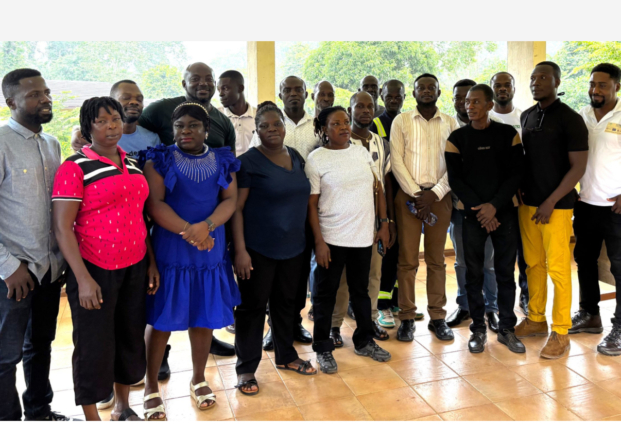
It saw HIA executives from Atewa in the Eastern Region and Sefwi-Wiawso, Western North Region, visit their counterparts in Asunafo-Asutifi in the Ahafo Region and Juaboso-Bia, Western Region, to observe their sustainable cocoa-forest management strategies.
At the Ayum Forest Reserve in the Asunafo South District, participants witnessed the Modified Taugya System (MTS) in action, an integrated agroforestry approach that allows farmers to combine traditional farming practices with native tree planting.
A highlight of the visit was the Bia Soap Processing Factory, a community-based enterprise established by the Bia West Cooperative Union, an economic model of diversification and providing additional income streams for cocoa farmers and forest conservation.
The initiative receives funding from the Swiss State Secretariat for Economic Affairs (SECO) through the Green Commodities Programme, reflecting international recognition of Ghana’s community-driven approach to sustainable cocoa production.
“This peer exchange is helping us to see what is possible when communities are organised and supported. The soap factory, for instance, is more than a business; it’s a model of how livelihood empowerment and environmental stewardship can go hand in hand,” said Ms Henrittah Kyerewaa, the Atewa East Akim Secretary.
“We are committed to building a greener cocoa future, and these learning visits give us the tools and networks we need to make that happen,” Mr Sylvester Mensah, the Chairman of Sefwi-Wiawso HIA, said.
Mr Forbah Fabian Ebuley, the Director of Bia West Cocoa Health and Extension Division (CHED), explained that the collaborative approach emphasised the importance of respecting indigenous farming knowledge while introducing climate-smart technologies.
“To us, we do not condemn straight ahead the indigenous practices the farmers are used to, we work with them together to also take on board new technologies, and that has proven to work. We also innovate a lot,” Mr Ebuley said.
The recent exchanges involved support from UNDP and Ghana’s Forestry Commission, highlighting the multi-stakeholder approach necessary for sustainable landscape transformation.
Latest Stories
-
Ghana explores centre of excellence for hearing, communication and cochlear implant care
60 minutes -
Schizophrenia-related disorders lead mental health cases recorded in Ghana
1 hour -
Dutch authorities enlist Ghana in hunt for fugitive drug lord Bolle Jos
2 hours -
Ghana housing finance conference adopts communiqué to improve affordable housing access
6 hours -
Special Initiatives Minister urges Wa Technical Institute to enrol more girls as EU-backed solar training lab opens
7 hours -
In the matter of my first year at the Bar
7 hours -
ActionAid Ghana calls for an end to child marriage, greater investment in girls’ rights
7 hours -
Newsfile to tackle World Cup visa scandal, beach demolitions, education strikes, BRICS bid
7 hours -
UK-Ghana Trade & Investment Summit: Trade Resource Centre to help businesses maximise UK-Ghana trade opportunities
8 hours -
Embassy of Denmark celebrates World Maritime Day
8 hours -
Linking LEAP to productive inclusion could cut extreme poverty by 2030 – UNICEF
9 hours -
Trade Ministry backs use of creative arts to rehabilitate prison inmates
9 hours -
Negotiations with government to continue despite strike suspension – GNAT
9 hours -
‘Ghana cannot afford to waste public resources; every cedi has a job’ – Ato Forson
9 hours -
Ghana expects economic boost as World Assemblies of God Congress brings 10,000 delegates to Accra
9 hours