

Audio By Carbonatix
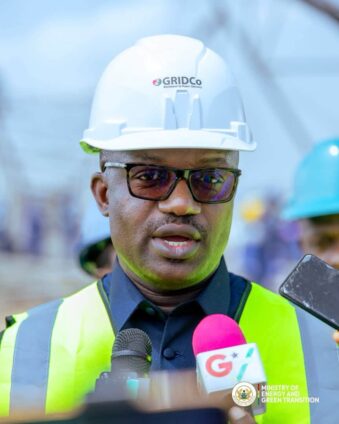
Energy and Green Transition Minister Dr John Abdulai Jinapor has acknowledged significant weaknesses in Ghana's electricity transmission network, saying urgent and targeted investment is needed to strengthen the grid and improve the reliability of power supply.
Speaking on Newsfile on JoyNews, Dr Jinapor said the energy sector requires substantial investment but stressed that government must prioritise projects that address the system's most critical infrastructure gaps.
“It is true, the energy sector needs investment, no doubt about that,” he said. “And the investment must also go into the critical areas, not just investment.”
Dr Jinapor conceded that Ghana's transmission network continues to face challenges and requires significant upgrades.
“The grid is not the strongest,” he said on Saturday, August 22, adding that there are still vulnerabilities that must be addressed through investment.
He specifically identified the transmission lines between Kumasi and Accra as an area requiring attention.
Dr Jinapor attributed part of the difficulty in financing critical energy infrastructure to restrictions associated with Ghana's International Monetary Fund (IMF) programme.
He explained that several state-owned enterprises in the energy sector, including the Ghana Grid Company Limited (GRIDCo) and the Volta River Authority (VRA), were placed under financing constraints during the programme.
“One problem we had was when we went into the IMF programme, almost all the energy sector SOEs, including GRIDCo and VRA, were put under the cap,” he said.
He explained that the restrictions made it difficult for the two institutions to take on the financing required for major infrastructure investments.
“VRA couldn’t risk financing, GRIDCo couldn’t risk financing,” he added.
The Minister expressed optimism that the easing of those constraints would create greater room for investment in the sector.
He said government was hopeful of securing the necessary support to begin investing more heavily in the national grid.
Among the infrastructure projects requiring attention are the transmission lines linking Kumasi and Accra.
The corridor is strategically important to Ghana's electricity network because it facilitates the movement of power across two major economic centres and between different parts of the national grid.
Investment in the corridor could strengthen transmission capacity and provide additional resilience when faults or maintenance requirements affect other sections of the system.
Dr Jinapor's comments suggest that the government is considering transmission upgrades as a critical component of its strategy to improve electricity reliability.
The focus comes against a backdrop of concerns that Ghana's transmission system needs additional capacity and alternative routes to prevent individual faults from escalating into wider system disruptions.
The Minister also announced that the Akosombo control station is expected to return to service next month.
He said the restoration would enable electricity generated at the Akosombo facility to be evacuated directly into the transmission network.
“Next month, we should have the Akosombo control station back in service, so that we can now evacuate power direct from Akosombo,” he said.
Latest Stories
-
Baffour Awuah’s arrest is a political witch-hunt – Kofi Bentil
6 minutes -
MT Asharami Ghana arrives in Tema as government pushes stronger LPG infrastructure
9 minutes -
Weweso JHS wins 5th edition of Otumfuo Reading Competition 2026
12 minutes -
‘Criminal law can’t turn every poor commercial judgment involving state entity into an offence’ – Victoria Bright
12 minutes -
Baffour Awuah has shown willingness to cooperate, qualifies for self-recognisance bail – Kofi Bentil
22 minutes -
NPP national officers’ elections 2026: Who is contesting the nine national positions?
28 minutes -
EOCO is only carrying out its mandate, not violating Baffour Awuah’s rights – Dzimegah
36 minutes -
Heavy security at Baba Yara Stadium as NPP elects national officers today
42 minutes -
Horticulturists call for dedicated authority, irrigation and tomato factory revival
1 hour -
Nakpayili E-Block opens, admits first batch of 650 students after nearly a decade of neglect
1 hour -
Ethel Cofie writes: You need board experience to get board experience
1 hour -
Baffour Awuah expected in court as EOCO moves to meet bail deadline
1 hour -
Happy 76th Birthday to the Daily Graphic!
1 hour -
Weija Children’s Hospital now operational with 120-bed capacity – Health Minister
2 hours -
Health Minister orders deployment of 40 additional health workers to Weija Children’s Specialist Hospital
2 hours