

Audio By Carbonatix
The Ghana Health Service (GHS) has developed a new policy aimed at attracting and retaining health professionals in deprived areas of the Country.
Consequently, Regional Health Directors have been tasked to ensure that the policy worked effectively in their respective Regions to achieve its intended objective.
The immediate Past Chairman of the GHS Council, Dr Yao Yeboah, who made this known underscored the need to ensure equitable distribution of health professionals as Ghana sought to achieve universal health coverage.
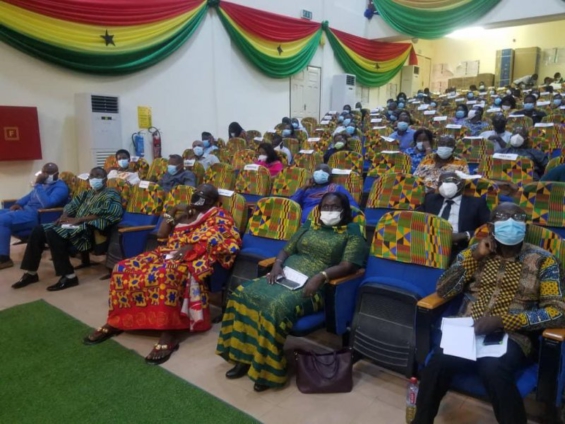
He was speaking at the opening of a two-day Central Regional health sector 2020 annual performance review in Cape Coast.
The performance review was on the theme: “Achieving universal health coverage, containing the Covid-19 pandemic, improving good governance and services; the role of stakeholders”.
“The issues of having very few professionals in deprived areas has been on the drawing table of the GHS for some time now. Accra alone has got 30 percent of all doctors in Ghana but does not have 30 percent of the population of Ghana”.
“One hospital in Greater Accra has more doctors than in the Upper West Region. That is unfair”, he added.
Under it, health professionals who opted to serve in deprived areas of the country would among other things have quicker promotion and opportunities for further training compared to their colleagues in the cities.
They would also be automatically transferred to the city after three years of service in a deprived community.
“If a staff is sent to a deprived area, the staff will not be condemned to life term imprisonment there, maximum three years, the staff should not request for transfer but automatically be brought to the city and be replaced.
“ ...this has worked in some institutions and could work in the GHS too”, Dr Yeboah assured.
Deputy Director-General, Dr Anthony Adofo Ofosu, of the GHS said the Service was finalizing plans to set up and strengthen systems to help address staff needs like compensation, benefits and training packages.
This, he emphasised would ensure that staff were more skillful, efficient, motivated, equitably distributed and well protected during the delivery of services, especially in this Covid-19 pandemic era.
Going forward, he said the Service would focus on promoting opportunities for health research which was paramount in the provision of evidence-based health policies and practices.
“One other area that the pandemic has brought to the fore is the importance of health research. There is strong evidence that a research-informed health system with a research-aware workforce ultimately results in better outcomes for patients”, he said.
Latest Stories
-
T-bills auction: Government exceeds target marginally; yield on 91-day bill remains unchanged
11 minutes -
GPL 2026/27: 10-man Aduana hand Kotoko defeat in Kumasi
22 minutes -
GPL 2026/27: Medeama ease past Basake Holy Stars
56 minutes -
Appiah Adomako writes: Why DVLA must stop treating every expired licence holder as delinquent
59 minutes -
Localization must transfer decision-making power, not just project responsibilities
1 hour -
Modernising Ghana’s traditional markets through the 24-Hour Economy markets initiative
1 hour -
New economy will boost local production and create jobs – Finance Minister
1 hour -
Real-Time VAT on cross-border digital services – not a new tax and does not violate double taxation principle
2 hours -
Digitalisation, AI key to Ghana’s tourism transformation – GHATOF
2 hours -
Stronger GTA-private sector partnership needed to grow tourism – GHATOF
2 hours -
Amazon eyes Ghana for broadband expansion after talks with Mahama
3 hours -
National Investment Quiz 2026: Six schools qualify for quarter-finals
4 hours -
‘Do not let Russia pay for its madness with lives of your people’ – Zelensky to Ghana, 46 other countries
4 hours -
6,079 promotion cases fully processed and paid – CAGD says amid nationwide teachers’ strike
4 hours -
Teacher unions to meet government Monday over nationwide strike
4 hours