

Audio By Carbonatix
The Deputy Minister for Communications, Digital Technology and Innovation (MCDTI), Mr Mohammed Adams Sukparu , has urged girls to acquire skills in Information and Communication Technology (ICT) to enable them to compete favourably in an increasingly technology-driven world.
He noted that ICT had become indispensable in every profession over the world, and that the government, through the MCDTI had introduced policy initiatives such as the One Million Coders programme to enable young people to advance in ICT.
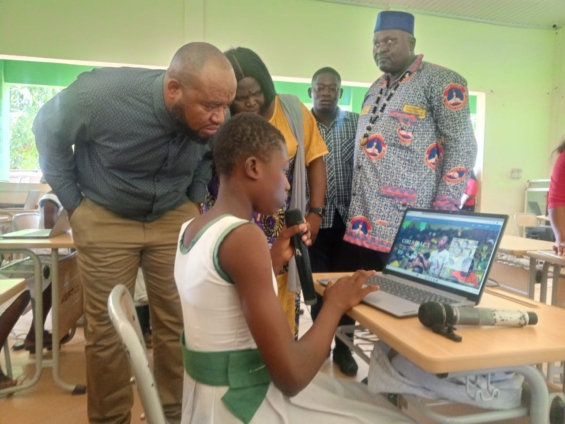
Mr Sukparu said this in Nadowli in the Nadwoli-Kaleo District at the weekend during a visit to the McCoy College of Education centre for the “Girls-In-ICT" programme to assess progress of the programme in the region.
About 80 basic schoolgirls in the Nadowli-kaleo District were undergoing ICT training under the “Girls-In-ICT” programme at the center as part of efforts to encourage girls and young women to pursue ICT education and jobs.
The Deputy Minister and his team also visited the training centre at the Wa Senior High School where a similar training session was ongoing for basic schoolgirls.
The programme was being implemented by the MCDTI in collaboration with the Ghana Investment Fund for Electronic Communications (GIFEC), which provided the infrastructure for its implementation.
Mr Sukparu said the initiative formed part of the government’s digital inclusion agenda and encouraged girls participating in the programme to take advantage of it to acquire ICT skills for the job market.
“This is not just one of the usual training programmes we have seen over the years, it is a government-backed initiative that seeks to identify and nurture young female talents in ICT,” he explained.
Mr Sukparu, also the Member of Parliament for Sissala West Constituency, recommended the integration of ICT as a core subject in Ghana’s educational curriculum due to its importance in the rapidly evolving technologically driven job market.
Dr Tanko Rashid Computer, the Chief Executive Officer (CEO) of GIFEC, said the selection of the region for the programme was part of the government’s efforts to bridge the digital divide and extend technological education and skills to underserved communities.
He explained that introducing young girls to ICT at the basic level was crucial in equipping them with the needed skills in a modern digital era, where technology influenced almost every aspect of life and development.
Dr Computer said the One Million Coders programme, for instance was designed to build a critical mass of young digital innovators across the country, adding that the Upper West Region would have a significant share in the initiative.
The CEO said GIFEC remained committed to supporting the Ministry’s digital transformation agenda through the provision of ICT infrastructure, including laptops, and other learning resources to schools and training centres.
Latest Stories
-
Don’t let speed of information become your judgement – CJ tells new lawyers
34 minutes -
World Cup visa scandal: People have leveraged public office to facilitate fraud – Senyo Hosi
40 minutes -
Glut! Farmers count losses as prices crash, customers happy
1 hour -
GSA postpones auction of unserviceable vehicles
1 hour -
Man charged with attempted murder after stabbing
1 hour -
World Cup visa scandal: Senyo Hosi says issue goes beyond calls for Sports Minister’s resignation
1 hour -
Yaw Ampofo Ankrah hasn’t taken or received any money to facilitate visas – Lawyer insists
2 hours -
World Cup visa scandal: Senyo Hosi urges focus on constitutional accountability
2 hours -
La Beach demolition: Senyo Hosi condemns lack of consultation
2 hours -
Russian glide bomb attack on Zaporizhzhia kills at least 15 people
2 hours -
Jinapor warns underperforming energy sector CEOs of consequences, says no protection for failure
2 hours -
Fire destroys head of tipper truck on Lower Volta Bridge
2 hours -
Palmer signs new Chelsea contract until 2034
2 hours -
World Cup visa scandal: Mahama will act on corruption allegations – Abass Nurudeen
2 hours -
Abass Nurudeen accuses Minority of ‘scandal scavenging’ over World Cup visa controversy
2 hours