

Audio By Carbonatix
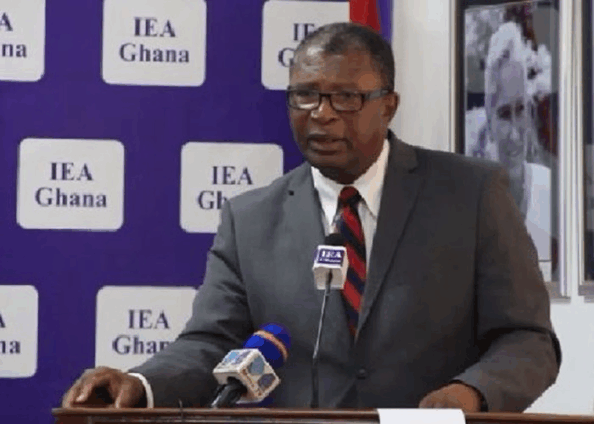
Dr Charles Mensa, the Chairman of the Institute of Economic Affairs (IEA), has urged the government to reorient Ghana’s mining policy by granting leases to local companies instead of foreign firms.
He noted that such a shift was critical to maximising the country’s gains from its natural resources.
Dr Mensah said Ghana’s mining sector had for decades been dominated by foreign multinationals, whose operations were largely extractive in nature.
Those companies, he said, exported minerals in their raw form, repatriated profits abroad, and left Ghana with minimal returns in the form of royalties and taxes.
“It is time to put Ghanaians at the centre of our mining sector. By granting leases to indigenous firms and supporting them to add value, we can create jobs, strengthen industries, and ensure that our resources drive national prosperity,” Mr Mensa said at a media engagement on Thursday in Accra.
He explained that local companies, when empowered with the right financing, technology, and regulatory support, could set up processing plants to refine gold, bauxite, manganese, and lithium in Ghana.
That would not only boost domestic industries but also significantly increase revenue generation for the state.
“These concession agreements cede exclusive rights to foreign firms who keep disproportionately high shares of the output and pay paltry sums in royalties and taxes. They perpetuate dependency instead of empowering Ghanaians,” Dr Mensah said.
Dr Mensa praised the recent decision to grant mining leases to E&P, describing it as a step in the right direction.
He said the move demonstrated that local investors had both the capacity and commitment to manage large-scale operations responsibly.
“When you look at the performance of some local firms recently awarded leases, it proves that Ghanaians can operate in this space.”
“What they need is the opportunity, fair terms, and the right policies. The benefits to our economy will be far greater if more such leases are given locally,” he added.
Dr Mensa expressed the belief that a deliberate focus on local ownership and beneficiation would change this trajectory.
“Our natural resources are our greatest endowment. If we want true economic independence, then the leases must empower our people, not foreign interests,” he emphasised.
He urged government to review existing mining laws, renegotiate unfavourable contracts, and design incentives for indigenous firms to scale up.
Ghana, Africa’s leading gold producer, also sits on significant deposits of bauxite, manganese, and newly-discovered lithium.
Yet, industry analysts argue that the country has not leveraged these resources effectively for industrialisation, as most continue to be exported in raw form.
Latest Stories
-
(Photos) Mfantsipim School launches historic 150th anniversary
15 minutes -
Knights and Ladies of Marshall group backs Catholic Bishops’ stance on anti-LGBTQ+
1 hour -
Bright Simons writes: All the Filla in the Ibrahim Mahama/E&P – Gold Fields Saga
2 hours -
Monetise Idiocy In Ghana
2 hours -
The Ghanaian prophet and the mysterious death of his scottish wife Charmain Speirs
2 hours -
Nearly 400 sentenced in Nigeria for links to militant Islamists
3 hours -
Ghana’s recovery supported by gold strength despite global oil price pressures – Standard Bank Research
3 hours -
Methodist Church hails Mfantsipim@150; calls for “fresh consecration” to excellence
3 hours -
‘Excellence is our inheritance’ – Nana Sam Brew-Butler hails Mfantsipim’s 150-year reign in leadership
3 hours -
Kwaku Azar writes: A-G vs OSP
3 hours -
Mfantsipim–Adisadel rivalry built excellence, not division – Sam Jonah
4 hours -
Vice President launches Mfantsipim’s 150 years of shaping Ghana’s greatest mind
4 hours -
I assure Otumfuo, Mahama will join him to commission KNUST Teaching Hospital by end of this year – Haruna Iddrisu
5 hours -
Barcelona dominate derby to extend La Liga lead
5 hours -
Gov’t to roll out free special education for persons with disabilities from July 1 – Education Minister
5 hours