

Audio By Carbonatix
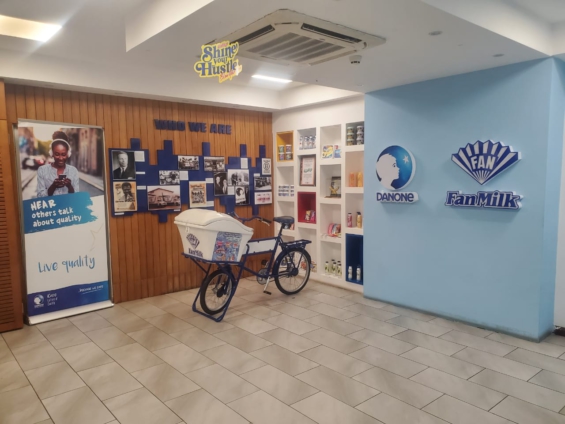
Imagine your typical hot day in the city. As you’re walking along the road, you hear a familiar sound, one you’ve known since you were a child. It’s the sound of the FanMilk vendor’s horn on a bicycle or a pushcart. That one sound sends a flood of messages through you: fond memories of your childhood friends and the neighbourhood playground, or anticipated relief from the punishing African sun, or a sweet treat to keep you positive.
What goes into making a sachet of FanYogo or Fan Ice or a tub of more recent brands like Go Slo and NutriDay? When FanMilk became a Danone company in 2019, a lot of good things happened. Not only did the company introduce new product offerings, but Danone brough it’s over 100 years of experience to play. Perhaps the most important benefit of Danone is that all the company’s new technologies were built on sustainability.
In an age where there is a perception that environmentally friendliness is just a buzzword, FanMilk has taken specific steps to make it real. From power production to waste treatment end to end – FanMilk is showing real commitment to sustainability as a core part of its business model. Here is how FanMilk’s new factory is advancing the planet’s sustainability agenda and how it will impact communities and the economy.
Giving life to Odaw River
Danone factories all over the world must meet strict efficiency standards and environmental metrics. It does not matter what continent the factory is on or what the national standards are in that country. This means that FanMilk’s new Wastewater Treatment Plant in Accra treats industrial discharge from production in accordance with the strict Danone Clean Water standard. As a result, the Odaw River in the heart of the capital is benefitting from the factory because clean water is coming into the river and helping to regenerate life in the ecosystem for plant and animals. This has been a big boost to the environment.
Harnessing the sun
Today, the administrative block in FanMilk’s office in Accra, and the regional distribution center in Tema and Kumasi are no longer dependent on the national grid and are more energy efficient than they were in the past. This can be attributed to the solar power project, which provides 575Killowat hour per day of clean energy.
The office equipment and other non-production functions are powered by energy from the sun. The 72T/Y CO2 emission reduction is also a drop of 40% in power consumption.
While this is a plus for FanMilk where energy costs are concerned in the long term, it also means that more power is available to other producers, which is an overall benefit to the economy of Ghana. The nation has year-round sunshine. What better way to utilise it than to produce more much-needed energy resources?
Plants powered by plants?
Boiler plants are needed in the production process to generate steam. However, with rising costs of diesel and the pollution it produces when used, FanMilk made the decision to use a multi-fuel boiler plant – using palm kernel shells or wooden chips – in order to produce 1,800kg of steam, which is more than it’s requirements in the factory.
These shells, already a waste product, are used as effective fuel, reducing annual carbon footprint by an emission factor of 2,513 TCO2 eq. At the same time, this is creating jobs for palm producers who get extra revenue from a resource that would otherwise have to be thrown away. This is a very positive initiative.
One Planet, One Health
At the heart of FanMilk’s initiatives is this drive to protect the environment, to be a responsible corporate citizen, and give customers not only nutritious and delicious products, but also to leave the planet in a better place for future generations. So, the next time you hear that familiar horn, remember that FanMilk is on the side of the environment, and there’s so much more to come.
Latest Stories
-
GAEC must retain nuclear scientists for Ghana’s nuclear ambitions – Minister
19 minutes -
Man reportedly mistaken for game and shot by hunter dead in forest
22 minutes -
19-year-old mason jailed 15 years for defiling seven-year-old pupil
26 minutes -
Ghana’s banking sector assets rise 20.47% to GH¢500.2bn – BoG Governor
30 minutes -
22 injured as Sprinter bus overturns at Sege after tyre burst
32 minutes -
UN housing expert urges Ghana to strengthen Rent Control Department amid housing affordability concerns
40 minutes -
Delta-BCI partnership reaches 166,000 people with breast cancer education
50 minutes -
Power restoration fault suspected in Kumasi Central Market fire
6 hours -
The 7-foot giant of Ngleshie Amanfro: Seven-foot Ghanaian Ephraim Saawa dreams of joining the national basketball team
7 hours -
Government promises support for Kumasi Central Market fire victims
7 hours -
Vibes The Movie: Big Ghun’s Ghanaian film earns five nominations at 2026 REFFA
7 hours -
‘I’m a fulfilled man’—Justice Korbieh on missing out on Supreme Court despite two nominations
7 hours -
MamaCare CEO warns unresolved conflicts among health workers could undermine maternal and neonatal care
8 hours -
Health professionals urged to translate medical knowledge into practice to save mothers
8 hours -
Retired judge Justice Francis Korbieh charges 1,568 new lawyers to uphold integrity
9 hours