

Audio By Carbonatix
The Ministry of Gender, Children and Social Protection has announced an electronic payment platform for beneficiaries on the Livelihood Empowerment Against Poverty (LEAP).
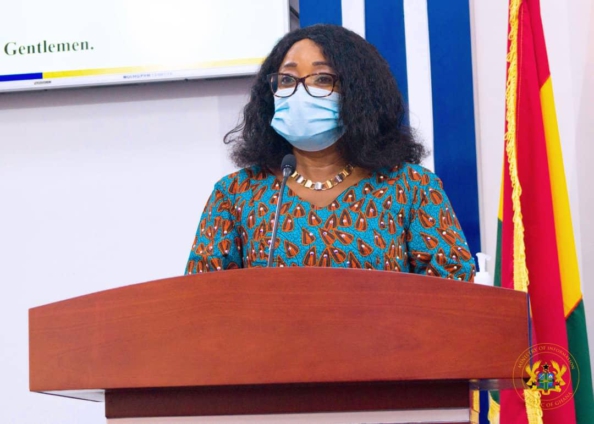
Addressing journalists at the Information Ministry during the “MEET THE PRESS” series on Wednesday, September 2, 2020, the sector Minister, Hon. Cynthia Mamle Morrison stated that all LEAP households have been connected to financial services through the e-payment (Ezwich) platform.
“Five (5) cycles of LEAP cash grants have been paid to 334,084 households to help smoothen their daily consumption. A total of 1,451,656 extremely poor beneficiaries are currently on the LEAP register.
Other achievements chalked under the LEAP include; development of an emergency payment strategy for LEAP in the wake of COVID 19 pandemic, regular engagements with district Social Welfare officers, participating financial Institutions and GHIPSS to discuss and provide solutions to electronic payment challenges.”
According to the minister, 73% of LEAP beneficiaries have been signed unto the National Health Insurance Scheme with 5,522 individuals linked to other complementary and productive activities.
She gave the breakdown is as follows; Labor Intensive Public Works- 3,054, Japanese Social Development Fund -1,235, Village Savings and Loans Association -348 and Complimentary Income Generating Scheme -537.
Touching on data collection, Hon. Morrison also mentioned that the Ghana National Household Registry has been instituted to collect data on the vulnerable in Ghana and become the centre of targeting for social interventions programmes including the Livelihood Empowerment Against Poverty (LEAP), LIPW, NHIS among others.
This data, according to her is useful for planning by the various Metropolitan, Municipal and District Assemblies (MMDAs), Academia, Non-Governmental Organizations (NGOs), Civil Society Groups and other agencies in social development.
The objective of the GNHR database is to improve targeting efficiency and effectiveness and make it easier for the government to identify and target the poor and vulnerable for all social protection interventions in Ghana.
“Currently, Upper West and Upper East regions have data on socio-economic status of 137,565 and 184,125 households respectfully. Northern, North East and Savannah have data on the socio-economic status of 140,000 households so far.
The GNHR is currently continuing with data collection in the North East, Northern and Savannah Regions to obtain an updated and more comprehensive database on poor and vulnerable persons in the country”, she emphasized.
Latest Stories
-
The Ghanaian prophet and the mysterious death of his scottish wife Charmain Speirs
36 minutes -
Nearly 400 sentenced in Nigeria for links to militant Islamists
57 minutes -
Ghana’s recovery supported by gold strength despite global oil price pressures – Standard Bank Research
1 hour -
Kwaku Azar writes: A-G vs OSP
2 hours -
Mfantsipim–Adisadel rivalry built excellence, not division – Sam Jonah
2 hours -
Vice President launches Mfantsipim’s 150 years of shaping Ghana’s greatest mind
2 hours -
I assure Otumfuo, Mahama will join him to commission KNUST Teaching Hospital by end of this year – Haruna Iddrisu
3 hours -
Barcelona dominate derby to extend La Liga lead
3 hours -
Gov’t to roll out free special education for persons with disabilities from July 1 – Education Minister
3 hours -
Importers and Exporters Association declares full support for Publican AI port system
4 hours -
“We used it to test our officiating officials’ readiness” – Bawah Fuseini after CAA Athletics event
4 hours -
Volleyball emerges as Ghana’s fastest rising sport
4 hours -
National Sports Fund needs strong leadership from the top – Administrator David Wuaku
4 hours -
JoySports Exclusive: Steve McLaren in talks with GFA after expressing interest in Black Stars job
4 hours -
Fire guts auto parts warehouse at Bubuashie, one fire officer injured
4 hours