

Audio By Carbonatix
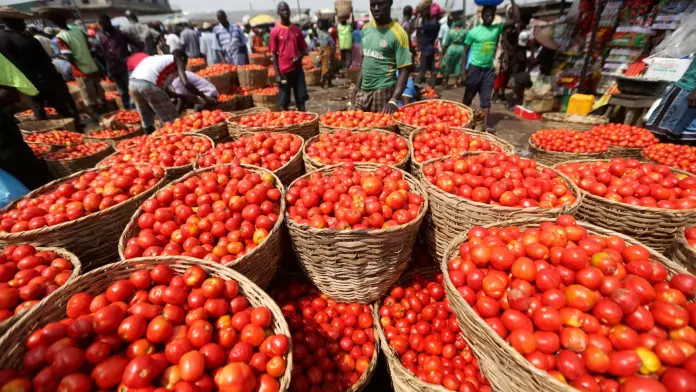
Government, through the Agriculture Ministry, has intensified efforts to increase local tomato production and reduce the country’s dependence on imports through targeted support programmes for farmers, George Batse, the Tema Metropolitan Director of Agriculture, has said.
Mr Batse said the interventions included the distribution of subsidised high-yield hybrid tomato seeds, technical training for farmers, and the promotion of dry-season farming through improved irrigation systems.
In an interview with the Ghana News Agency (GNA), he said the measures formed part of broader efforts to address recurring tomato shortages, stabilise market prices, and strengthen national food security.
According to him, the Ministry was encouraging farmers to adopt improved agronomic practices, including proper seed selection, nursery management, pest control, fertiliser applications, and post-harvest handling.
Mr. Batse anticipated that the introduction of improved seed varieties would enhance yields and improve the quality of locally produced tomatoes.
He said the government was also supporting year-round tomato cultivation, particularly in northern Ghana, through irrigation projects aimed at reducing seasonal supply shortages that often contribute to price increases.
“The objective is to improve local production and reduce the country’s reliance on imported tomatoes,” he said.
Meanwhile, Mr Abdullah Alhassan, a tomato farmer from Nanton in the Northern Region, has welcomed the interventions and said access to improved seeds and technical support could significantly increase production.
He said programmes such as the Feed Ghana Programme and the Vegetable Development Project, known as Yeredua, had the potential to improve productivity and strengthen the local tomato value chain.
However, Madam Saada Adams, a vegetable farmer from Kumbungu, said inadequate irrigation infrastructure remained a major challenge to tomato production.
She noted that the absence of functional dams and irrigation systems limited farmers’ ability to produce during the dry season when demand for tomatoes was often high.
Madam Adams called also for increased access to climate-resilient seed varieties and continuous technical training to improve yields and competitiveness.
She observed that Ghanaian farmers generally recorded lower yields than some neighbouring countries, including Burkina Faso, due to limited access to quality inputs and modern farming techniques.
Agriculture experts believe that sustained investment in farmer training, irrigation infrastructure, and improved planting materials will be critical to increasing local tomato production and ensuring a stable supply throughout the year.
Latest Stories
-
South Tongu MP launches apprenticeship programme for 159 young people
11 minutes -
The Pusiga connection behind Gertrude Atongi’s work in New York
38 minutes -
Teachers took promotion exams in December to beat government clearance deadline – GNAT
40 minutes -
NPA launches 2026 staff welfare week with focus on teamwork and employee wellbeing
43 minutes -
Ghana, Saint Kitts and Nevis sign labour deal to strengthen protections for Ghanaian nurses
49 minutes -
Delayed promotions put teachers’ retirement benefits at risk – GNAT
52 minutes -
No ‘Bawumia candidates’ in NPP executive elections – Anthony Karbo
53 minutes -
Over 3,000 displaced as flooding overwhelms Hohoe communities
58 minutes -
Sunyani East NPP executives begin reconciliation drive ahead of 2028 polls
1 hour -
Agric Minister engages Ga Mantse on agriculture transformation agenda
1 hour -
Aayalolo expansion targets private car users, not trotro operators – Mahama Ayariga
1 hour -
KNUST, GMTF explore AI partnership to transform healthcare delivery
1 hour -
MTTD records 9,000 preventable crashes, over 900 deaths in eight months
1 hour -
UN Secretary-General expresses optimism about future, pledges support for Mahama, AU
1 hour -
Ghana’s desalination lesson: A water project must work on paper and at the tap
2 hours