

Audio By Carbonatix
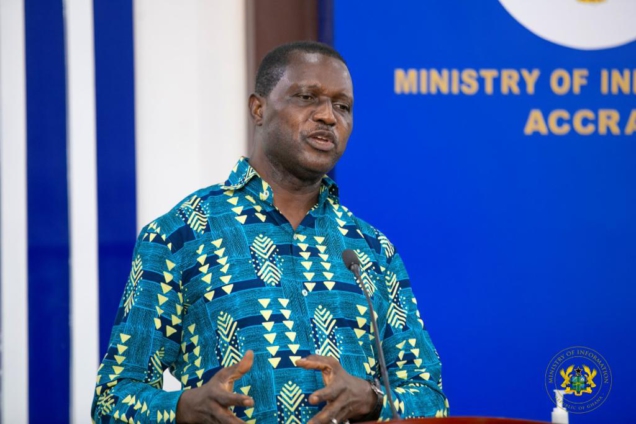
The Education Minister, Dr Yaw Osei Adutwum says the government is working to strengthen the lower secondary level of education as part of efforts to improve the country’s educational system.
“So when you see that as one of the areas that we are going to focus on in the next three-plus years, to make sure we strengthen the lower secondary end of things so if high school has libraries, lower secondary must also have them.”
Addressing the media on the President’s education agenda on Sunday, he said Akufo-Addo has tasked the sector to ensure not only strengthening the lower level but the higher end is six years.
“President Nana Akufo-Addo is saying that he will really want to ensure a high is actually six years and that we should do everything possible to do ensure that high school is actually six years.”
According to him, the move will make way for a framework of quality education along the entire value chain.
“When we talk about science, technology, engineering and mathematics, we are not talking about doing this at the university but we are talking about creating a pipeline. A pipeline that begins from the primary school that takes us through junior high school all the way to the university.”
The Minister added the move will also allow the country to utilise and implement “what we call the 4 Cs, which is effective communication, critical thinking, creativity, and collaboration that would be seen.”
He noted for that to be visualised, there is a need to pay critical attention to bridging stem, science, technology, engineering and mathematics, not as isolated subject.
The Bosomtwe MP further indicated that the country’s secondary education is not different from that of many other countries, as it moved from a seven-year system to six years.
He explained that the 1987 education reform decided that “we are only going to keep three at the higher end of the secondary education system."
“But because we did not implement all the six, we cut off the four years from upper secondary and ended up with a situation where the lower secondary which is three were shift to the elementary that used to be middle school.”
“Unfortunately though, the reform of 1987 did not do justice to the lower end. The lower end became part of Primary school, they wear the same school uniform as primary students, taught by the same teachers invariably, and we forgot about the fact that the lower three was truly secondary or high school,” he future noted.
This, he noted, may have contributed to the wrong perception by some Ghanaian, painting a different picture of the educational system.
“So if you meet anybody on the street and you ask them how many years of high school do we have in Ghana, you will be told that three, and we wish it was four, but is actually six years,” he said.
Latest Stories
-
High Court sets November 4 for ruling on Wontumi’s bail application
12 minutes -
Tetteh Kwetey files nomination for NDC Greater Accra Regional Chairmanship
21 minutes -
Korle Bu appeals for more doctors, nurses as A&E Centre struggles under pressure
34 minutes -
AFCON 2027Q: ‘I’m optimistic Black Stars can turn things around’ – Agyemang-Badu
35 minutes -
Digital innovation could widen Africa’s inequalities if people are left out – Sam Jonah
37 minutes -
Galamsey is an economic, health and moral problem – Sam Jonah
40 minutes -
Africa must create AI technology instead of paying to use it – Sam Jonah
42 minutes -
2026 U-17 WWC: Black Maidens to face Norway, Brazil and Canada in Group C
47 minutes -
Agbodza, Sam George move to curb fibre optic cable cuts during road works
54 minutes -
2026 U-17 WWC: Black Maidens unveil 21-player squad for competition in Morocco
55 minutes -
South Africa evacuation and the minority’s half-truth
1 hour -
‘You never know tomorrow’ – Anthony Baffoe on contesting for GFA Presidency
1 hour -
Obuasi SHTS head accused of sexually abusing students is NDC Juaben secretary seeking chairmanship
1 hour -
Cedi depreciates by 7.11% against dollar in August 2026 – BoG report
2 hours -
Put women and youth at the centre of mineral resource governance — ActionAid
2 hours