

Audio By Carbonatix
Government is preparing to link rice import permits directly to investment in the country’s own rice farms and mills - a policy shift that the Agric Ministry hopes will accelerate progress toward self-sufficiency and trim a growing import bill.
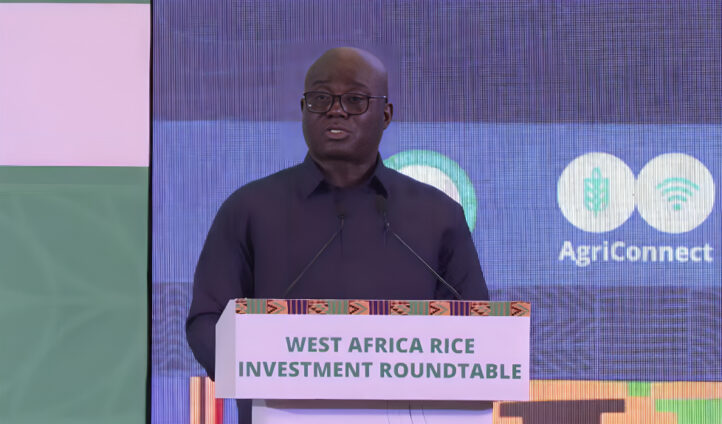
The new regime was announced by the Minister of Agriculture, Eric Opoku, at the West Africa Rice Investment Roundtable in Accra, organised in partnership with the World Bank, ECOWAS Commission, and the African Development Bank.
The announcement was greeted with loud applause from the participants, who included Ghana’s Vice President, Prof. Jane Naana Opoku-Agyemang; President of the ECOWAS Commission, Dr Omar Alieu Touray; Vice President for Planet at the World Bank, Guangzhe Chen; and Deputy Finance Minister, Thomas Nyarko Ampem.
The policy, when implemented, will mean importers can no longer secure permits without first showing verifiable partnerships with Ghanaian rice producers.
“Government will implement an import quota policy that directly links the privilege of importing rice to the growth of domestic production,” Mr Opoku said.
Under the plan, importers must provide evidence of procurement deals or investment arrangements with local rice growers before receiving approval to bring rice into the country.
The minister sought to reassure consumers and traders that the goal is not to drive up prices or empty shop shelves.
“We are not raising tariffs that punish consumers. We are not imposing bans that create shortages,” he stated. Instead, he argued, the policy aims to redirect value from the rice trade toward building Ghana’s own productive capacity.
Ghana’s reliance on imported rice remains a heavy burden on the economy, even as domestic output has risen. Last year, the country consumed about 1.71 million tonnes of rice, while local milled production reached roughly 960,000 tonnes. That gap—nearly 751,000 tonnes—forced Ghana to spend around $320 million on imports to meet demand.
Self-sufficiency currently stands at about 56 per cent, up from around 45 per cent at the start of the decade. But according to the government, the pace needs to accelerate significantly to achieve full self-reliance.
The minister told investors and industry players at the two-day gathering that the share of imports in the market would be reduced progressively over the next decade, with each reduction tied to verified increases in local production. “We will not create a gap we cannot fill,” he assured them.
Government modelling suggests that achieving 100 per cent self-sufficiency within ten years could save Ghana roughly $2.1 billion in cumulative foreign exchange costs, attract more than $400 million in private-sector investment, and create over 200,000 jobs across farming, processing, logistics, and related services. Mr Opoku described the rice sector as the country’s “single largest untapped agribusiness opportunity.”
Beyond the import reforms, the government is also deploying satellite-based geospatial mapping technology—developed with support from the World Bank and experts from the NASA Harvest programme—to identify and classify land suitable for rice production nationwide.
The exercise is expected to provide investors with location-specific data on production opportunities and irrigation potential.
The minister said combining data-driven investment planning with guaranteed market access through the quota regime should help de-risk the sector and unlock capital for large-scale expansion.
The new policy is part of the broader Feed Ghana Programme, which includes investments in irrigation, mechanisation, improved seed systems, post-harvest infrastructure, and value addition, alongside intensified efforts to curb rice smuggling and expand the market for locally produced rice through the “Buy Ghana First” initiative.
Latest Stories
-
Gbande’s arrest directive confirms NPP’s claims of selective justice – Miracles Aboagye
41 seconds -
US to announce $150 million for Alaska power lines as Vance campaigns in Senate battleground
1 minute -
Two CHPS compounds, educational facilities under construction in Keta – MP
3 minutes -
Not every difficult season means you’re in toxic love – Counsellor Adofoli explains
6 minutes -
Badminton: Ghana wins bronze, two silver medals at All Africa U-19 Champs
11 minutes -
Black Star Experience announces national choral music contest to discover new Ghanaian talent
21 minutes -
Melcom serves 1,000 meals to children in selected orphanage homes
23 minutes -
Miracles Aboagye questions Mustapha Gbande’s authority to direct EOCO arrest of Manhyia South MP
24 minutes -
My music is a true reflection of who I am – Nigerian singer Ladé
24 minutes -
Activa International Insurance Ghana reinforces culture of compliance and customer protection
30 minutes -
Mining must prove its impact, not just publicise it — Chamber of Mines
40 minutes -
NDC disqualifies Dzifa Gunu from La Dadekotopon contest
47 minutes -
Togbe Afede XIV opposes proposed 5-year presidential term
50 minutes -
World Vision targets 90 percent universal WASH access in Asunafo North, Asutifi North
1 hour -
I told EOCO to arrest Manhyia South MP – Mustapha Gbande
1 hour