

Audio By Carbonatix
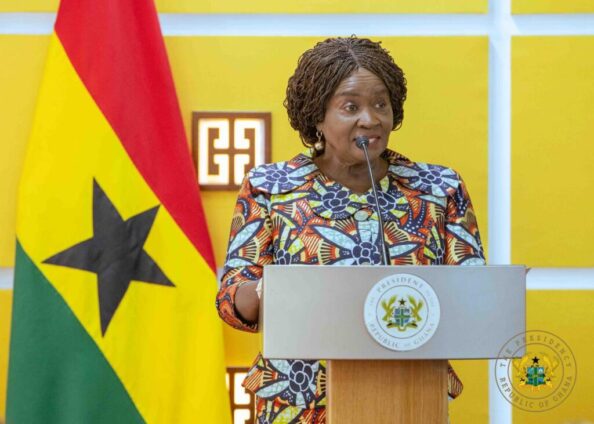
Vice President, Professor Jane Nana Opoku-Agyemang, has reaffirmed the government’s unwavering commitment to safeguarding the integrity and value of pension fund assets to ensure a secure future for Ghanaian workers.
She made the assurance while delivering an address at the 2026 National Labour Conference held in Ho, where government officials, labour unions, employers, and other stakeholders gathered to deliberate on issues affecting the country’s labour sector.
The Vice President emphasised that pension funds represent the lifelong savings and sacrifices of workers and must therefore be managed with the highest levels of transparency, accountability, and prudence.
“Government remains committed to safeguarding the integrity and value of especially pension fund assets for the benefit of the Ghanaian worker. We therefore remain committed to our obligations with other tier pension schemes.
“We must also continue to explore ways to accelerate economic growth through measures such as a 24-hour economy policy, with a seven-point plan of action to maximise the use of our resources and capacities while also moving Ghana towards a fast-growing export-based economy,” she said.
Professor Opoku-Agyemang noted that protecting workers’ retirement savings remains a key priority of the government, adding that efforts are being intensified to strengthen regulatory oversight and promote sound investment practices that will preserve the value of pension assets despite economic challenges.
She further stressed that maintaining confidence in the country’s pension system is essential to ensuring social protection and financial security for workers after retirement.
Highlighting the theme for this year’s National Labour Conference, the Vice President said, “The theme for this year reinforces the importance of workplace harmony in driving Ghana’s industrial development.
“To understand why it is important, we must look to our own history. Ghana has faced implicit turbulence in recent years. In light of this, the government has worked to ensure that our economy remains resilient in the face of geopolitical crises.”
“The collective but difficult decisions we have made over the past year are yielding some results. And we must maintain that momentum. The key is how to maintain it, how not to work for neutral poverty, and how to fulfil them.
“All of these are key to our national security. The determination over the years, public sector disparity, labour agitation, and fragmentation in the governance of the movement have placed significant strain on our economy,” the Vice President said.
“The single plan structure was introduced about a decade and a half ago and was premised on equal pay for equal work. While some modest successes have been recorded, the system is now under severe strain.”
“The current pay system, personal pay, is market demand. Therefore, the establishment of an independent emolument is a deliberate intervention to address the issue. It allows the government to stabilize the compensation system and build strong institutional foundations while ensuring continuity and industrial harmony,” the vice president stated.
Vice President also stated that, in the interest of stability and responsible fiscal management, the government has also proposed that 2026 will not be a year for major renegotiation with the public sector.
Hence, targets and modest duty to collective agreements as an interim measure while the modular reforms to our economy are completed.
The Vice President also called for stronger collaboration among government, organised labour, employers, and regulatory institutions to promote industrial harmony, decent work, and sustainable national development.
“The government, for its part, is expanding access to reliable, affordable energy, providing efficient public transport systems, security and lighting, and incentives to encourage this transition.
“We therefore encourage stakeholders to consider adopting new approaches to work schedules, to build cooperation with various communities, employers, and organized labour, and to implement flexible working arrangements. The feature of work also means assessing our labour laws to ensure adequate labour and social protection,” she added.
Latest Stories
-
Conflicts among care providers linked to maternal, neonatal deaths – Expert
1 hour -
GIS marks 10th TIME conference, champions improved teaching practices
2 hours -
BRICS Or Balance? What Ghana’s bid really means
2 hours -
GPRTU wants full TRAFFITECH-GH implementation to start in 2027
2 hours -
Mahama announces plans to import electric wheelchairs for PWDs
2 hours -
KGL U17 Colts 2026: Western beat Prempeh Elite Academy to set up final final with Greater Accra Region
3 hours -
Late Solanke strike salvages 10-man Spurs draw at Man United
3 hours -
Gender Ministry to monitor welfare of Nana Akua Addo’s children amid domestic violence case
3 hours -
Benedict Okyere Yeboah: Ghana’s football problem goes beyond sacking a coach
3 hours -
GPL 2026/27: Darkwah Wiafe’s winner sees All Blacks beat Kotoko
3 hours -
ITF World Tour : Patel Wins Boys’ Singles Final at J100 Accra
3 hours -
Ghana must pursue BRICS partnership if it brings economic benefits – Kpebu
4 hours -
Success and Wright Claims J100 Accra Girls’ Doubles Championship
4 hours -
ITF J100: America’s Wright wins J100 Accra Girls’ Singles Title
4 hours -
Expedition hopes to find aviator Amelia Earhart’s plane on remote island
4 hours