

Audio By Carbonatix
Ghana Water Limited (GWL) has taken a significant step forward in reducing water losses by launching a specialized Leak Detection Field (LDF) to train staff in modern leakage detection techniques.
In partnership with Denmark’s Aarhus Vand, the project aims to equip GWL’s engineers and technicians with the necessary tools and skills to address Ghana’s water loss challenges more effectively.
Currently, GWL loses approximately 48 per cent of some 324 million cubic metres of water production, across the combined 90 urban water systems, annually due to leakages and system inefficiencies.
This loss translates into a substantial financial impact, costing GWL around GH₵1.89 billion Ghana cedis annually.
The collaboration with Aarhus Vand, facilitated through the Danish Embassy, includes training and resource support to bolster GWL’s capacity in leak detection and water loss management.
It marks the beginning of a rigorous practical training framework for its technical staff and a renewed approach in using Danish Technology to detect leakages on GWL networks for fixing.
The Danish partners have shared expertise and best practices, focusing on modern asset management techniques and Geographic Information System (GIS) tools.
The pilot project, implemented in Tema under Denmark’s Strategic Sector Cooperation (SSC), serves as a proof of concept, demonstrating the efficacy of Danish water loss reduction strategies in Ghana’s context.
The newly established Leak Detection Field will serve as a practical training ground, allowing GWL staff to locate and repair both visible and hidden leaks in water pipelines.
This venture builds upon GWL’s existing modernization efforts as the company has recently introduced smart meters that enable remote readings, simplifying billing processes and enhancing accuracy.
Additionally, GWL has digitized its commercial business operations, including payment systems, making it easier for customers to pay bills and report issues via their mobile devices.
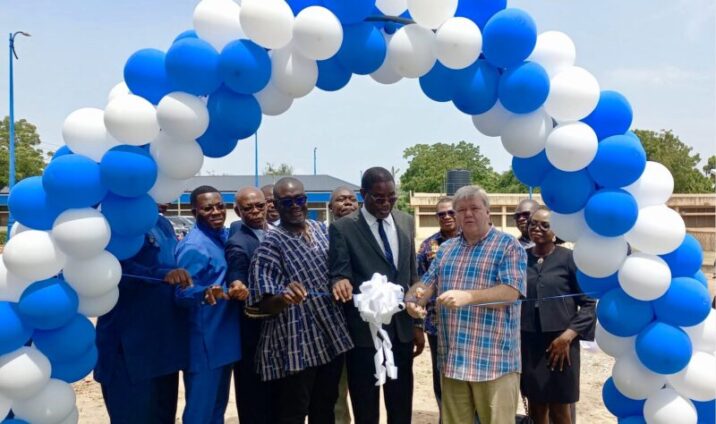
Dr. Clifford Braimah, Managing Director, GWL, speaking at the launch of the new Leak Detection Field at the Ghana Water Institute, highlighted the critical need for proactive measures in combating water loss using appropriate industry technology for both operational efficiency and the long-term sustainability of the company’s services.
He explained that unreported leaks, which were often undetected and persisted for years, significantly reduced pressure within the network and hindered the utility company’s ability to maintain consistent water supply to households.
“This initiative is not only about fixing visible issues but also targeting those unseen losses that impact our technical and financial performance,” he stated.
The MD emphasized that embracing innovative technology was essential to positioning GWL as a world-class utility, capable of meeting the increasing demands of Ghana’s urban population.
“Our commitment to technology and effective water management is crucial in making potable water accessible and affordable,” Dr Braimah remarked, urging further investments in water infrastructure.
He said as GWL intensified its efforts to reduce water losses, the Leak Detection Field offered a pivotal shift toward a sustainable water management model, benefitting both the utility and its customers across Ghana.
The MD explained: “The impact on our technical and financial performance is quite great, reducing pressures in the network, robbing our customers of accessing the vital resource which we have distributed, and more so preventing us from getting the much-needed funds to maintain and expand our water networks. This is why we need to actively search for these leaks and solve them.”
He expressed gratitude for the support received from the Danish government and other international partners, including the World Bank under the Greater Accra Metropolitan Area (GAMA) – a Sanitation and Water Project instrumental in advancing Non-Revenue Water (NRW) management.
The MD commended the Water Worx Project for its contributions, specifically in providing essential tools to improve the efficiency of GWL’s technicians.
Mr Tom Norring, Danish Ambassador to Ghana, flanked by the GWL MD and other Chief Managers, to commission the Leak Detection Field, stated that “the cheapest water is the water we do NOT use. If we can reduce the loss of water, we can improve the water service to the ones that do not have regular water in the pipes.”
He noted that low water loss also meant reduced energy consumption for Ghana Water as most of the water travelled more than 50 kilometres before it reached the consumer, and that “a lot can go wrong on this journey.”
To ensure a “safe journey” for water, the Ambassador observed that skilled expertise and technical knowledge were essential, adding that the Leakage Detection Field would bring the country close to achieving Sustainable Development Goal (SDG 6).
Mr Maxwell Akosah-Kusi, Manager, Non-Revenue Water, GWL, who demonstrated the use of the device, said it would collect leaking sound signals through its sensor, processed and displayed by the host machine with an output on its earphones.
Water leakage point, he added, could be found out easily through listening to the different and abnormal sounds – categorized by the engineers of GWL – for repair.
Latest Stories
-
Zonda Tec launches HOWO T3M truck to support agric and logistics
6 minutes -
Obuasi SHTS scandal: Eduwatch calls for sex offenders’ register and mandatory background checks for teachers
19 minutes -
GloMeF CEO urges intensified public education on new road traffic regulations
30 minutes -
‘Any tax on ChatGPT is an attack on education and innovation’- Akim Swedru, MP
33 minutes -
Obuasi SHTS sexual abuse scandal exposes systemic failure in child protection – Moving Masculinity
34 minutes -
Hubtel CEO calls for national data-sharing framework to boost AI development
37 minutes -
Twelve Golden Rules of real estate development in Ghana, Africa
41 minutes -
Five new telephony cell sites in Ashanti Region to be activated in October 2026 – Sam George
42 minutes -
Mahama cuts sod for Afienya Industrial Park, targets 120 enterprises
46 minutes -
Rush for fuel from accident tankers is stealing, punishable by law – NPA boss, Edudzi Tamakloe
52 minutes -
GhIG pushes for legislation to regulate geoscientists’ activities
58 minutes -
Mfantsipim @150: Ace Anan Ankomah leads project to preserve school’s musical heritage
1 hour -
Gov’t launches rCOMSDEP in Ahanta West, Mpohor Fiase to promote responsible community mining
1 hour -
AI is forcing professionals to rethink how they deliver value – Hubtel CEO
1 hour -
Daily Insight for CEOs: Strengthening the CEO’s Leadership Legacy
1 hour