

Audio By Carbonatix
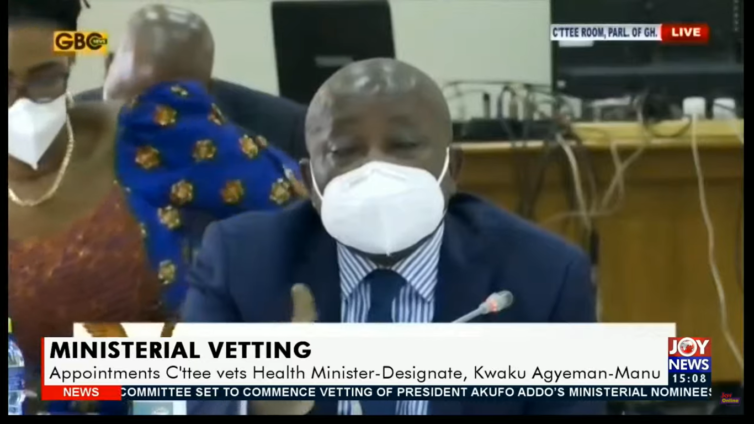
The Minister-designate for Health, Kwaku Agyeman-Manu has revealed that his outfit spent over $100 million in its effort to fight the Covid-19 pandemic in the country last year.
Responding to a question during his vetting on Wednesday, Mr Agyeman-Manu noted that the Health Ministry was allocated some $100 million to undertake programmes to control the spread of the disease.
The money, according to him, has been fully exhausted.
“You remember initially, we got $100 million allocation to be spent on Covid-19. All that has been exhausted,” he told Parliament’s Appointments Committee.
He added that “We got another money that is just about to mature for us to utilise and it is about $120 million from the World Bank.”
With regards to the specifics of the expenditure, Mr Agyemang-Manu indicated that the Finance Ministry, headed by Ken Ofori-Atta at the time, would be in the best position to give a detailed accounts on the amount spent by the Health Ministry.
“But some of these things, I believe the Finance Minister had actually presented before the House some summary of these Covid expenditure. And I was thinking that these ones can be elucidated by the Finance Ministry instead of trying to take this away from the now learning medical officer,” he said.
In total, government has spent several billions of cedis in its quest to implement policies that will serve as a cushion to citizens who have been badly affected by the advent of the pandemic.
Mr Ofori-Atta when presenting the 2021 Budget in October 2020 revealed that government has spent approximately GH₵1.3 million on Covid-19 Emergency Preparedness and Response Plan to protect lives and operationalized the GH₵1.2 billion Coronavirus Alleviation Programme (CAP) to support businesses.
In addition, a GH₵2 billion Guarantee Scheme was launched to enable SMEs borrow at a more affordable rate.
Other interventions under the Covid-19 relief programme included supporting the GH₵3 billion credit and stimulus package by commercial banks in Ghana to revitalize industries, especially pharmaceutical, hospitality, services and manufacturing sectors.
Latest Stories
-
GRA assures Tullow of collaboration to settle $393m tax liability without disrupting its petroleum operations
16 minutes -
South Korea demands apology from Pyongyang for landmine blasts that injured three
19 minutes -
Carlos Queiroz not the sort of coach Black Stars need – Nii Lante Vanderpuye
50 minutes -
AFCON 2027Q: ‘Our Black Stars team is gone’ – Former Sports Minister
1 hour -
Prof. Prempeh calls for public review of draft constitutional reform bills
1 hour -
AFCON 2027Q: ‘I have never seen a poor performance from Black Stars like against Gambia’ – Nii Lante Vanderpuye
1 hour -
Nigeria set to launch National Digital Address System 9 years after Ghana showed the way
2 hours -
Policy rate decision takes time to reflect in lower lending rates – BoG
2 hours -
Western Regional Minister applauds Karpowership’s role in Ghana’s power sector
2 hours -
Playback: Road safety crises: Where are we getting it wrong?
2 hours -
Enterprise Life celebrates 25 years of protecting families and building trust
3 hours -
ICC London rules in favor of Ghana against Tullow over $400m tax charge
3 hours -
We are disappointed in ICC’s ruling over our corporate income tax assessment in Ghana – Tullow Oil
3 hours -
Cost of building inflation for August 2026 increases to 4.6% – GSS
3 hours -
Today’s front pages: Wednesday, September 30, 2026
3 hours