

Audio By Carbonatix
The UNESCO Accra Office commemorated a historic first World Science Day for Peace and Development (WSDPD) in Ghana with a call for greater emphasis on Science, Technology, and Innovation (STI) in helping communities prepare for environmental-related events.
The WSDPD, also known as World Science Day, was established in 2001 by the United Nations Educational, Scientific, and Cultural Organization (UNESCO) and is observed every November 10th.
For the first time, UNESCO celebrated the day in Ghana, with the goal of promoting and emphasizing scientific and policy initiatives that contribute to the achievement of the Sustainable Development Goal (SDG) 13: Climate action.
This year's theme, "Building climate-ready communities" reflects the need for communities, particularly the poor and vulnerable, to be supported in managing and adapting to the changing climate conditions through science-led solutions.
The celebration comes at a time of heightened interest in climate change with COP26, underlining the importance of science-based policies and decisions in mitigating the environmental crisis that has had a devastating impact on humanity.
In a welcome address read on his behalf, the UNESCO Representative to Ghana, Mr. Abdourahamane Diallo expressed his delight at having all stakeholders including governmental and academic institutions present for the function and explained that the goal of the event was to show how Ghana’s STI policy and system can advance a green agenda and make the country more peaceful and sustainable.

Ms. Audrey Azoulay, Director-General of UNESCO, emphasized in her message, which was read on her behalf, the critical role of STI in assisting communities to prepare for and adapt to environmental upheavals.
She noted that researchers in West Africa have developed climate-ready crops that are resistant to extreme heat and drought, among other things.
However, she said that more academic research on new technologies to protect communities from climate-related disasters is needed, as this research accounted for only 0.005% of total global scientific output between 2012 and 2019.
In her address to the participants, the keynote speaker, Mrs. Cynthia Asare-Bediako, Chief Director of the MESTI spoke about the various ways climate change is affecting Ghana's economy and highlighted the work the Ministry and its agencies are doing with the support of UNESCO to address climate change using STI.
Meanwhile, Ms Ifeoma Esther Charles-Monwuba, the United Nations Office for Project Services (UNOPS) representative to Ghana addressed how the UN supports Ghana’s Agenda on Sciences.
Her message noted that the theme for the celebration was appropriate given the recent discourse on the displacement of over 3,000 persons due to rising tidal waves in the Ketu South Constituency of the Volta Region.
Further, she stressed the need for stakeholders to work collectively to enhance accessibility to clean technologies, particularly for developing countries.
Ms Ifeoma also observed that the COVID-19 pandemic has brought to the fore the fact that the world needs STI to guide developmental aspirations.
There were presentations on Ghana’s STI for SDGs Roadmap, West Africa in the 2021 UNESCO Science Report, and the Excellence and Recognition of Ghanaian Scientists.
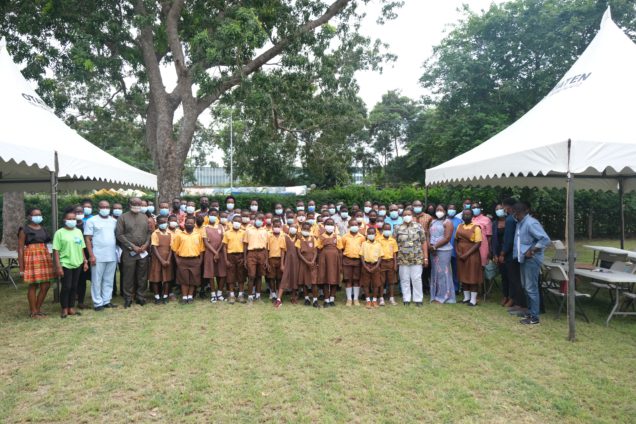
A key activity marking the day was a hands-on workshop on Artificial Intelligence (AI) and Robotics using UNESCO’s Cogbots Robotics kits for 30 basic school pupils from the Nima Cluster of Schools and Kotobabi 1 and 2 Basic School.
The session coordinated by the Ghana Institution of Engineering (GhIE) demonstrated to participants how such emerging technologies can be used to help mitigate the effects of climate change and also build a brighter future for the world.
In fulfillment of its aim to engage the general public and mobilize key actors to highlight the value of science in society and our everyday lives, the event brought together a host of participants from UNESCO, UNOPS, Ministry of Environment Science, Technology and Innovation (MESTI), Council for Scientific and Industrial Research (CSIR), Kwame Nkrumah University of Science and Technology (KNUST), GhIE, CSIR-Science and Technology Policy and Research Institute (STEPRI), African Institute of Mathematical Sciences (AIMS-Ghana), CSIR-Soil Research Institute, teachers, students, and the media.
Latest Stories
-
EOCO grants Suame MP John Darko enquiry bail in GH¢27m SIC investigation
3 seconds -
NPP cannot question EC appointment after appointing own people to Commission – Kwakye Ofosu
6 minutes -
BoG deepens public trust with regional stakeholder forum in Techiman
15 minutes -
‘We have turned the tide’ – Ato Forson says Ghana is ready to take off
20 minutes -
Police arrest man captured in viral video assaulting wife in Agona Nkwanta
22 minutes -
KATH Mother and Baby Unit construction stalled for 14 months over unpaid contractor arrears
36 minutes -
Government wanted to ‘tilt the balance’ with new EC appointments – Kwakye Ofosu
42 minutes -
Angry Tema Community 25 residents threaten to sleep at GWL over water shortage
55 minutes -
BoG takes financial literacy drive to Techiman, vows to protect depositors
55 minutes -
‘Stop the distractions’ – Akosua Manu demands answers over GH¢49.7m South Africa evacuation cost
56 minutes -
Formula 1 to return to Africa with Rwanda Grand Prix in early 2030s
1 hour -
Mahama says Ghana is safer today as he commissions 85-bed ward at Police Hospital
1 hour -
LA 2028: Black Queens face Zambia in final Olympic qualifier
1 hour -
WAFU Zone B: Black Starlets seal semifinal place with 3-1 win over Benin
1 hour -
Black Queens thrash Mauritius 7-0 to advance 10-0 on aggregate in Olympic Qualifiers
2 hours