

Audio By Carbonatix
The Finance Minister has outlined strategic measures to address the fiscal gap that will arise from its decision to abolish several taxes, including the E-Levy, Betting Tax, and COVID-19 Levy.
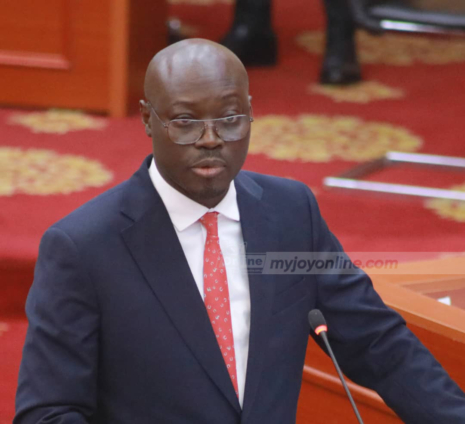
Speaking during the presentation of the 2025 Budget Statement and Economic Policy on March 11, Dr. Cassiel Ato Forson assured that the shortfall will be covered through enhanced revenue mobilisation and expenditure controls.
Dr. Forson stated that the abolition of selected taxes will be offset by reducing the tax refund ceiling.
"The Tax Refund Account has been abused in recent years. A study on the use of the tax refunds in the last eight (8) years revealed that GHS29.11 billion had accrued to the tax refund account with only 12.5 billion, representing 43% of the total accrued amount is used for tax refund purposes," he explained.
The Minister explained that the tax Refund Account has been mismanaged in recent years, with large sums being misapplied.
For him, the government will cut the tax refund ceiling from 6% to 4% of total revenue, saving GH₵3.8 billion.
"Mr. Speaker, by reducing the ceiling on the tax refund from 6% to 4%, we will save GH¢3.8 billion. This
amount is enough to close the revenue shortfall from the removal of the E-Levy amounting GH¢1.9 billion
and the Betty Tax of GH¢180 million. Mr. Speaker, already we have saved GH¢3.8 billion for 2025 alone from only one source and this is enough to close the gap from the taxes that we have removed," the Minister explained.
He also highlighted plans to improve tax compliance and administration.
The Revenue Administration Act will be amended to increase tax efficiency and ensure greater compliance, with the government expecting a 2% improvement in net tax revenue collection.
"Accompanied with this budget, we will amend the Revenue Administration Act, 2016 (Act 915). This
measure will improve the tax revenue, net of tax refunds by 2%, representing 0.3% Of GDP.
"Mr. Speaker, in line with Government policy, the 2025 minimum wage recently negotiated with the
National Tripartite Committee will be zero-rated. This is consistent with our resolve to protect the poor and the vulnerable."
Additionally, a new Non-Tax Revenue Legislation will be introduced to improve the collection and management of revenue from state services and assets.
Property rate collection will also be streamlined and enhanced to boost local government finances.
The government plans to simplify Ghana’s VAT system and eliminate distortions that have led to inefficiencies in tax collection.
The reforms aim to broaden the tax base while reducing the effective VAT rate for businesses and consumers.
To complement revenue measures, the government will implement aggressive spending cuts. The government has cut the number of ministries from 30 to 23 and reduced ministerial appointments from 88 to 60.
This downsizing will result in significant savings on salaries, operational costs, and government logistics.
The government will audit and validate all arrears/payables before making payments, while non-essential programs such as YouStart, One District One Factory, and GhanaCARES will be eliminated.
In the energy sector, he intimated that ECG and NEDCo will implement new strategies to improve revenue collection, while the government will renegotiate Independent Power Producer (IPP) contracts to reduce capacity charges and operational costs.
He further explained that "without increasing the levy, we will also review the Energy Sector Levies Act (ESLA) to consolidate the Energy Debt Recovery Levy, Energy Sector Recovery Levy (Delta Fund), and Sanitation & Pollution Levy into one levy and use the proceeds to cater for the energy sector shortfalls and service the inherited debt service obligation."
Dr. Ato Forson emphasised that these measures will ensure fiscal discipline while supporting economic growth.
“To those asking how we will cover the revenue gap from tax removals, the answer is simple: we have stopped the bleeding,” he stated.
The Minister is confident that by prioritising efficiency, cutting wasteful spending, and improving revenue mobilization, it can maintain fiscal stability while easing the tax burden on Ghanaians.
Latest Stories
-
French Embassy trains Ghana Police CTU in counter-terrorism operations
20 minutes -
UPSA uncovers mass results manipulation involving 178 students, over 500 results compromised
54 minutes -
ECG announces planned power outages in parts of Tema from Sept. 29 to October 1
1 hour -
Sylvester Mensah urges Latenu FM to promote trade, export opportunities in Ga
1 hour -
Ga language under threat of decline as children shy away from speaking it – Sylvester Mensah
2 hours -
‘Let every Ga child you raise know the Ga language and story’ – Sylvester Mensah
2 hours -
‘We are not deterred’ – Ablakwa responds to backlash over South Africa evacuation
2 hours -
NCA announces major voice and data disruption across Northern Ghana due to fibre cuts
2 hours -
Photos: Housing solutions take centre stage at Day 2 of the 3rd Republic Bank-JoyNews Habitat Fair
3 hours -
Ghana Air Force passes out 293 recruits after six months of intensive training
4 hours -
EOCO vrs Baffour Awuah: EOCO should have secured warrant before arrest attempt at court – Inusah Fuseini
4 hours -
Triple fibre cuts disrupt telecom services across Northern, Oti regions – Sam George
4 hours -
Politicisation could undermine parliamentary probe into cocaine seizures – Dr Osae-Kwapong
4 hours -
EOCO chases MP: Can Section 41 cure lacuna in EOCO Act? – Inusah Fuseini asks
4 hours -
GNFS, GWL inspect fire hydrants in Ministries enclave; 23 found faulty
4 hours