

Audio By Carbonatix
More Burkinabes are trooping into Ghana to seek refuge following attacks on their communities by armed insurgent groups
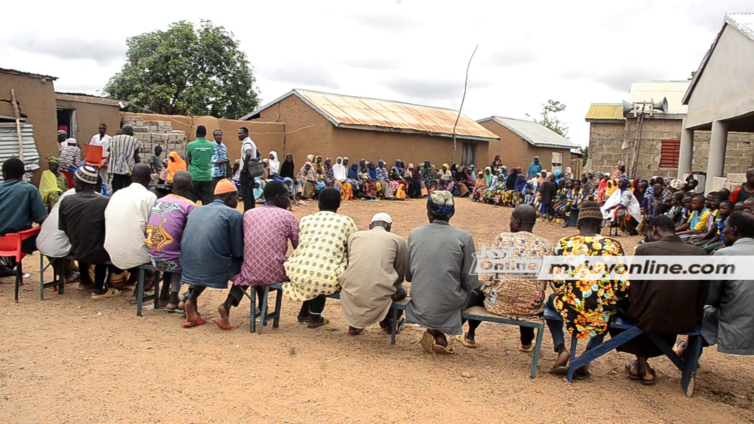
In the last week of June, hundreds of them arrived in the Pusiga district of the Upper East Region, weeks after deserting their own communities which they said were attacked by people believed to be members of an armed militant group.
The arrival of these refugees is raising security, health, and even food security concerns in that part of the Upper East Region, where some of them were reconnecting with their kinsmen in Ghana.
JoyNews' correspondent, Albert Sore who toured the Pusiga district, reported that some of the refugees came from Tarimnoaga, a community in southern Burkina Faso.

They looked sad, dejected, and very exhausted. They were here in Ghana at the Yariga Number 2 community in Pusiga in the Upper East Region, seeking refuge.
They said, a few weeks ago, their community was attacked by armed men of the insurgent militant group
At least five people were killed and the rest of them had to run for their lives.
Although it is not clear which armed militant group attacked the community, Osmani Sebugo, one of the refugees, called them Boko Haram.
“These Boko Haram people came to our community and told us to leave. We thought they were joking. After a number of days, they came back and killed five people in our presence; slaughtered them”, Sebugo said.
“And when they did that, it sent a signal that we had to run away”, he added.

That was how many of the refugees fled from Burkina Faso into Ghana.
Some of them arrived two weeks ago, and others followed later.
An estimated 1, 500 of them are currently in various parts of the Pusiga district.
A lot of them are women and children – even toddlers as young as 2 and 8 months old.
Teresa Segra, a mother and one of the refugees said they left many of their belongings behind while fleeing.
“Our people here [in Ghana] are doing their best for us but it is not easy. We have no food for our children and ourselves. The children are out of school now”, Segra said.
Ghanaian communities are struggling to contain the refugees
At the Yariga Number 2 community where many of the refugees first arrived, the Ghanaians here were finding it hard to give them shelter, let alone food.
The chief of the community said many families were finding it hard to cope with feeding the refugees.
“Imagine having ten members in your family. How can you possibly feed them and still regularly provide food for the strangers [refugees] staying with you? It is very difficult for many of the families in this community”, he said.

Some of the refugees have kinsmen resident at Yariga number 2 and other parts of Pusiga so it is more like tracing their roots back home.
Therefore, the Ghanaians feel they must find a way to accommodate them.
One of the men providing shelter for these refugees is Issah Zakari who says he accommodates 12 of them in a small room.
“They are our people who migrated and came here so I had to move into my new house which is not yet complete and leave this place for them”, Zakari said.
“This room accommodates 12 people, this other room accommodates 11 people and this other one over there accommodates 14 about people”, he revealed.
One of the refugees being sheltered in Zakari’s home is a very old woman whom he described as his aunt.
“She is about 120 years old and when it happened like that and her children were running away, they had to bring here along”, he said.
Fears of Dire Health Implications
The community members of Yariga Number 2 are worried that the influx of these refugees could have serious health implications because a dilapidated building here is what serves as a Community Health Planning and Services [CHPS] centre.

There are no health officials stationed here. According to the community members, two nurses visit every month to provide antenatal and postnatal services to women.
Anytime the nurses arrive, drums are beaten to call women of the community who need those services.
It is only after the antenatal and postnatal services are provided that people with other health needs may be taken care of, and that is only if the nurses still have some time.
At the time of our visit, there was no known record of a health screening exercise for the refugees.
Food Security Concerns
In other places such as Pulmakom, Zong-Natinga and Widana all in the Pusiga district, hundreds of refugees could be seen.
The Ghanaians in these parts are mainly peasant farmers, some of whom have had to give out their lands to those of the refugees who are their relatives.
Salih Abugrago, a farmer at Widana said he barely had any land left for his farming activities this rainy season.

“I had one [refugee] in my house who came with 5 wives and 21 children. Luckily, I had rooms so I gave them 5 rooms. They are still in my house”, Abugrago revealed.
He said many of the refugees upon arrival at the checkpoints, mention his name because he is a former Assembly Member and he has often had to go and help them find places to stay.
“Many of them are in my family houses, others are sleeping at filling [fuel] stations. They don’t have food and it’s bringing a lot of pressure on us”.
“They also need lands to farm. I have offered 3 of my places [lands] so this year, I have no land left to farm”, Abugrago lamented.
The Peasant Farmers Association of Ghana was forced to visit the Pusiga district after its members there reported a possible food shortage crisis in those parts due to the influx of the Burkinabe refugees.
Dr. Charles Nyaaba the executive director of the Peasant Farmers Association of Ghana [PFAG] said the farmers there were on the brink of failing to produce food this year.

“When the rains came, the farmers realised that not only did have to share their food with the [refugees], they also had to share their lands and farm inputs with them so this is beyond us as PFAG”, Dr. Nyaaba said.
“This area is one of the food baskets of the Upper East. They produce many crops including sorghum, soyabean and maize. Here is the case, they may not be able to produce [this year] because of the pressures [from the refugees]”, he revealed.
Dr. Nyaaba appealed for support from government and aid organizations to help control the situation.
Officials of the United Nations High Commissioner for the Refugees [UNHCR] were seen on the ground, registering some of the refugees.
Reports indicate that more refugees could arrive in the Upper East Region in the coming weeks or even days.
Latest Stories
-
President Mahama is not sincere with Ghanaians on LGBTQ bill matter – Hassan Tampuli
29 seconds -
Gov’t to establish Prison Industrial Hub to equip inmates with income-generating skills – Prison Service boss
19 minutes -
Alhassan Tampuli donates cement, roofing sheets to support storm victims in Gushegu
20 minutes -
Alhassan Tampuli appeals for urgent support for storm victims in Gushegu
23 minutes -
The hypocrisy must stop; pass Anti-LGBTQ+ Bill now – Alhassan Tampuli to Mahama
26 minutes -
Imprisonment should be rehabilitative, not punitive – Ghana Prisons boss at UNGA
48 minutes -
Ga Adangbe traditional priests petition Mahama over McDan aviation licence revocation
60 minutes -
Anti-LGBTQ Bill: NDC’s arrogance is worrying – Hassan Tampuli
1 hour -
Let’s give OSP time to mature, not to scrap it – Hassan Tampuli
1 hour -
Nigeria convicts 386 Islamist militants in mass trials
1 hour -
Djibouti president wins election with 97.8% of vote, state media says
1 hour -
We don’t have mandate to deduct tax from rent allowance of security services personnel – Interior Ministry clarifies
2 hours -
Ablakwa receives Presidential Special Envoy on Reparations to advance global agenda
2 hours -
Christina Koch becomes first woman to travel around the moon on Artemis II
2 hours -
Epstein survivors’ calls to meet King Charles and Queen harder to ignore as US visit approaches
2 hours