

Audio By Carbonatix
Associate Professor of Nutrition Education and Training at the University for Development Studies (UDS) has advised Ghanaians to make explicit efforts to decolonize the food they eat on a regular basis in order to achieve independence.
Prof. Victor Mogre reflected on the Igbo proverb that "people who depend on foreign food eventually die of hunger," and stated that the native foods accessible to them provide adequate nutrition.
"If we want to be independent, we must eat our food. The kind of food we eat now is colonized," he explained.
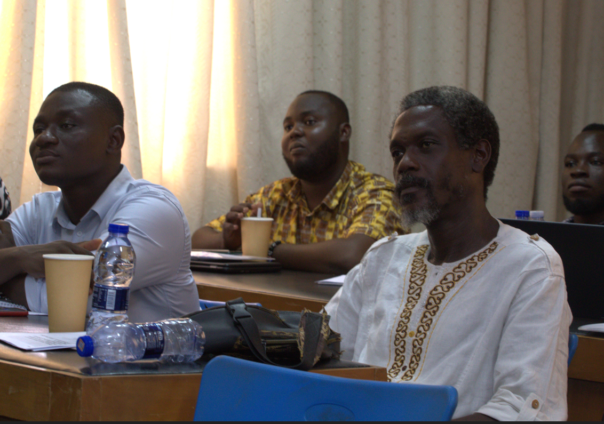
Prof Mogre gave a lecture at the University of Development Studies titled "connecting and building the capacity of rural to urban food sovereignty organizations in Ghana." It was organized by the University of Waterloo and the University of Toronto in partnership with University for Development Studies.

The workshop's findings are expected to aid in the analysis of agri-food policy and planning, as well as contribute to public debate and advocacy on regulating food in ways that increase its quality and accessibility.
Participants at the event advised Ghanaians to begin the transformation at home by ensuring that families decolonize their cuisine.
"It has to start with us because theory alone will not help us," said Dr Dassah Emmanuel of the Religion and Philosophy Department.
Dr. Emmanuel noted that the change must begin with the people leading the discussion in order for it to be expanded to those outside their immediate surroundings.
On his part, Dr. Alidu Bukari Gbensuglo argued that indigenous foods were also colonized and that there should be a concerted effort to decolonize farms.
"When you go to all the rural setups, they don't farm with cutlass any longer, but they use chemicals to clear the farms," Dr. Gbensuglo explained.
He stated that if farmers are encouraged to cultivate without chemicals, indigenous food would be free to be eaten, as indigenous food and health are currently at odds.

Prof. Mogre, whose presentation was titled "Indigenous Food Are Healthy," concurred with Dr. Gbensuglo's fears and stated that efforts should be made to produce chemical-free food for the Ghanaian people.
He stated that the fears are another prominent issue that must be addressed properly in order to completely decolonize indigenous food.
The workshop also touched on the subject of food adulteration in some homes and market places.
A political science lecturer, Katherine Kaunza-Nu-Dem Millar, believed that addressing food adulteration will also change the narrative.
"They should advocate for 100% indigenous food and educate people about the consequences of adulteration," she said.
Madam Katherine gave an example of purchasing an adulterated dawadawa at the Bolgatanga market and discovering it after using it to cook.
"People have forgotten the indigenous taste - and now they want it to taste like processed foods," she said.
“I have been trying to get the seedlings for the local potato but I don't get it,” Hardi Shahadu, Lecturer at the Department of Journalism and Media Studies lamented.
According to Mr. Shahadu whose presentation was on “Assessing Food Security Through Indigenous Knowledge and Perspective,” indigenous foods are quickly becoming extinct.
“The way forward to reverse the trends of the lost of indigenous food systems is self-consciousness about our identity, heritage and cultural values,” he recommended.
Dr. Siera Vercillo, principal investigator at the University of Waterloo said, people's choice to consume foreign, highly processed meals and ingredients are more sophisticated than personal preferences connected with urbanization and upward mobility.

Dr. Vercillo has returned to northern Ghana several times to undertake participatory research with smallholder farming households in rural areas near Tamale.
She stated that NGO, donor, and government support for high-yielding monocrops like maize and rice, which require massive amounts of inorganic fertilizer and agrochemicals, takes up land where many local staples like sorghum and millet were once grown intercropped with other important ingredients.
Participants agreed that indigenous foods should be preserved and eaten by future generations since they provide distinctive and important nutrients while also helping to identify the people.
Latest Stories
-
A source of excellence across generations – Vice President Opoku-Agyemang lauds Mfantsipim
10 minutes -
(Photos) Mfantsipim School launches historic 150th anniversary
34 minutes -
Knights and Ladies of Marshall group backs Catholic Bishops’ stance on anti-LGBTQ+
1 hour -
Bright Simons writes: All the Filla in the Ibrahim Mahama/E&P – Gold Fields Saga
2 hours -
Monetise Idiocy In Ghana
2 hours -
The Ghanaian prophet and the mysterious death of his scottish wife Charmain Speirs
3 hours -
Nearly 400 sentenced in Nigeria for links to militant Islamists
3 hours -
Ghana’s recovery supported by gold strength despite global oil price pressures – Standard Bank Research
3 hours -
Methodist Church hails Mfantsipim@150; calls for “fresh consecration” to excellence
4 hours -
‘Excellence is our inheritance’ – Nana Sam Brew-Butler hails Mfantsipim’s 150-year reign in leadership
4 hours -
Kwaku Azar writes: A-G vs OSP
4 hours -
Mfantsipim–Adisadel rivalry built excellence, not division – Sam Jonah
4 hours -
Vice President launches Mfantsipim’s 150 years of shaping Ghana’s greatest mind
4 hours -
I assure Otumfuo, Mahama will join him to commission KNUST Teaching Hospital by end of this year – Haruna Iddrisu
5 hours -
Barcelona dominate derby to extend La Liga lead
5 hours