

Audio By Carbonatix
The Institute of Financial and Economic Journalists (IFEJ) and the Ministry of Lands and Natural Resources are to establish a formal partnership to strengthen media coverage of mining, forestry and land administration reforms.
The partnership is expected to equip journalists with technical knowledge to report more accurately on policies affecting the extractive sector, forest restoration and land governance, while helping the public and mining communities understand the implications of the reforms.
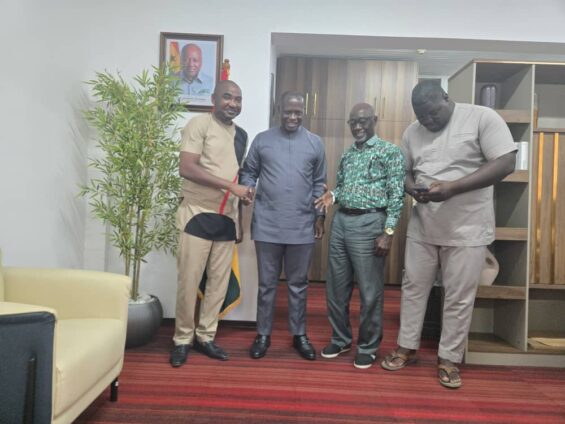
The agreement followed a courtesy call on the Minister for Lands and Natural Resources, Emmanuel Armah-Kofi Buah, by a delegation from IFEJ led by its President, Roger Agambire Agana, in Accra on October 13, 2026.
The delegation included Bernard Yaw Ashiadey and Rayborn Bullay.
Mr Agana called for ministry support for specialised training and technical briefings, saying the institute was prepared to help explain government policies and prepare communities for the drive towards adding value to minerals produced in the country.
He said informed reporting would be important in helping citizens understand the changes taking place in the natural resources sector.
Training and research
Mr Ashiadey proposed a memorandum of understanding (MoU) to guide the collaboration, alongside an annual conference on mining and natural resource governance.
He also called for joint research and publications, supported by technical input from the ministry, as well as stronger engagement between IFEJ members and agencies under the ministry.
The delegation further proposed visits to degraded lands undergoing reclamation to enable journalists to assess restoration work, document the effects of environmental damage and report on progress made.
Welcoming the proposals, Mr Buah agreed to a half-day workshop at which he and heads of agencies under the ministry would brief IFEJ members on sector policies and ongoing reforms.
He observed that general media coverage sometimes failed to capture the substance of government policies, making specialised reporting necessary to improve public understanding.
The workshop will be the first activity under the proposed partnership, with IFEJ members expected to engage directly with the ministry’s agencies afterwards.
Mining policy overhaul
At the meeting, Mr Buah disclosed that Cabinet had approved a new mining policy to replace the 2014 framework. He also outlined provisions in a new mining law before Parliament, including a requirement for mining companies to enter into community mining agreements.
Under the proposed arrangements, companies would be required to commit in writing to development priorities identified by their host communities, including schools, roads and training opportunities, over the life of a mine.
“It’s not a charity. It’s not corporate social responsibility,” he said, stressing the distinction between the proposed agreements and voluntary corporate social responsibility initiatives.
The minister said the reforms would also reduce mining lease terms from 30 years to 20 years. At the end of a lease, the state would determine whether to renew it or bring in Ghanaian partners.
He added that holders of reconnaissance licences who failed to demonstrate expenditure on exploration after five years would risk losing their licences.
A new medium-scale mining category is also being introduced to provide a pathway for Ghanaian small-scale operators to expand their businesses.
The proposed changes form part of broader efforts to strengthen the management of the country's mineral resources and increase local participation in the sector.
Forest restoration and land reforms
On forestry, Mr Buah said 44 forest reserves had been destroyed in recent years, leaving an estimated area of degraded land equivalent to about 13,000 football fields.
He said the state had regained full control of the affected reserves and was pursuing restoration through the ministry’s Tree for Life initiative.
The initiative involves schoolchildren in tree-planting activities and attracts private sector support to help address funding gaps in the restoration effort.
The minister also highlighted the use of technology to reform land administration and improve access to land-related services.
The proposed collaboration with IFEJ is expected to give journalists greater access to technical information and field-level developments, enabling more informed reporting on the implementation and impact of the reforms.
Latest Stories
-
The Inconvenient Truth: We cannot pray for the cure while protecting the disease
11 minutes -
MTN Ghana trains civil society organisations on artificial intelligence
48 minutes -
GoldBod FX framework aims to make dollar supply predictable – Acheampong
1 hour -
How does a Ghanaian team make it to the BAL?
1 hour -
Ghana’s investment climate presents opportunities for industrial growth and job creation.
2 hours -
‘I paid thousands to a company for jobs that never came’
2 hours -
SSNIT intensifies informal sector enrolment drive with Techiman float
2 hours -
Ghana seeks long-term mining investments that benefit local communities – Armah-Kofi Buah
2 hours -
GHATOF demands compensation for 85 businesses affected by La Pleasure Beach demolition
2 hours -
Bono Regional Minister calls for investor education to drive economic growth
2 hours -
Ghana’s Ambassador to China, Kojo Bonsu, presents credentials to Nepalese President
2 hours -
Fairtrade Africa’s Cocoa Hubs Project strengthens rural service centres in cocoa-growing communities
3 hours -
MPs are not development officers – Edem Kpotosu
3 hours -
SEC cautions investors against fraudulent investment schemes
3 hours -
Land Ministry urges rCOMSDEP operators to reserve earnings for land reclamation
3 hours