

Audio By Carbonatix
Legal expert Martin Kpebu has attributed the growing impunity of military personnel in the country to high rates of illiteracy and a culture of mob justice in Ghana.
According to him, despite there not being any rule in Ghana permitting the military to mete out brutality on civilians, the culture of instant justice in the country was fueling military impunity, thus increasing military brutality cases on citizens.
“It’s just the impunity, the impunity that has been going on over these decades that is what is manifesting in what they did.
“There’s that impunity because there is this sub-culture that even Ghanaians, some of our own people, anything that happens, the least thing they say ‘we want you to bring in the soldiers. Bring in the soldiers to discipline them,’” he said on JoyNews’ AM Show.
“Would you believe that people still think that way today? People have no regard for the rule of law. They will tell you that ‘o bring in the military, as for soldier, soldier will come and brutalise them,’” he added.
He stated that a lack of appreciation for due process in the court of law has also contributed to this culture of instant justice, which fuels military brutality.
He stated that the low legal literacy rate in the country has led to most Ghanaians seeing brutality from state security apparatus as a legitimate means of addressing issues in the country.
He said, “You know, because often the court system takes some time, people don’t understand how the court system works and are often very interested in instant justice. But, you know, for instance, justice is also very rife in our culture; we kind of like it, that’s what eats into allowing the military to do what they do. Some people like it.
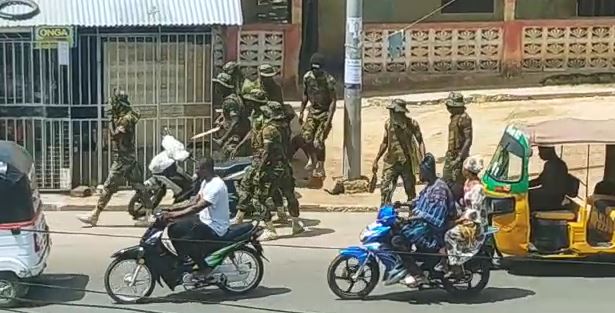
“This video you’ve seen, I’ve heard some people saying, ‘yeah, that’s how it is because when you go to court, it takes forever. However, people fail to appreciate that the rule of law requires that there should be due process so you cannot just go to court and within a week you’ve finished. No. there are processes.”
Thus, he called for education to quell the thirst for instant justice and its consequent military brutality.
“Thus, it comes back to the point that you have to do more education. As long as we have this high rate of illiteracy in Ghana, these soldiers would have room to operate because some people like what they do.
“They say ‘yes that’s justice, as for soldiers when you bring them, they’ll brutalise you, and everything will become quiet.’ So from what I see in this picture, I pray that the authorities will identify the soldiers and have them prosecuted,” he concluded.
Latest Stories
-
30 NDC aspirants file nominations in Upper West as regional election approaches
3 minutes -
UPSA launches laptop assembly plant, requiring new students to assemble their own devices
8 minutes -
UCC sociologist calls for action on gender inequality to end child marriage
10 minutes -
LSN questions Ghana’s proposed five-year presidential term and DCE election reforms
11 minutes -
AFCON 2027Q: Bjorkegren to lead Black Stars for Somalia doubleheader with Tanko and Attram as assistants
12 minutes -
AMA completes road repairs on Kwame Nkrumah Avenue
19 minutes -
Law Students’ Network warns executive dominance could undermine constitutional review
21 minutes -
Mahama to meet relevant stakeholders over concerns about the new Customs Act
29 minutes -
CHASS demands a 20% increase in SHS funding and payment of outstanding debts
31 minutes -
Investigation launched after male body found in County Cork
32 minutes -
We have been scammed by NDC, government is only doing PR – Abanga Fuseini
33 minutes -
Tamale Teaching Hospital records 44 new breast cancer cases in six months
35 minutes -
GES declares October 30 CPD day for private school teachers; learners to observe holiday
35 minutes -
South Korea to support Ghana’s forts and castles restoration with $4.5m over five years
36 minutes -
School headscarf ban sparks rare protests in Azerbaijan and row with Turkey
45 minutes