

Audio By Carbonatix
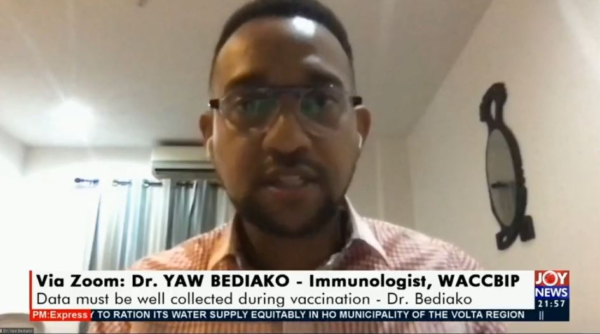
Immunologist and Research Fellow at the West Africa Centre for Cell Biology of Infectious Pathogens (WACCBIP), has called for a data collection on the Covid-19 vaccination and a research programme.
This, according to Dr Yaw Bediako, is critical at this time if “we are going to really understand how these vaccines are working” and what to do to achieve herd immunity.
“It’s important that we begin to collect data on the vaccine response and to be honest we can only do that if we develop a research program alongside this vaccination programme.”
Speaking on PM: Express Monday, Dr Bediako indicated that the collection of data will also help derive some answers that will better inform researchers on how the Covid-19 vaccines work.
“With that information then we can really begin to answer some of the questions you are asking; how long will the immunity last, what does the immunity looks like,” he told host Ayisha Ibrahim.
“We may have different numbers from what is been reported elsewhere, and that is fine, once we have the data, we can plan accordingly,” he stressed.
He noted that the Covid-19 vaccine maybe unlike the “vaccine for measles” where one could have life-long protection.
“The assumption is that we won’t have this luxury with this [Covid-19] vaccine, we probably have a finite amount of time but exactly how long it is, to be honest, we don’t know,” he said.
"But that is why, and I want to hammer on this again in support of Dr Amuasi’s point we really do need to be collecting samples,” he stressed.
Dr Bediako observed that vaccines do not work uniformly well in every population, “the length of protection can vary from geography to geography.”
“Malaria vaccines have worked phenomenally well in volunteer Oxford but failed in our part of the world which is why we need to be collecting our own data,” he cited.
He said: “These vaccines were developed within a year so we haven’t had enough time to know exactly how long the immunity will last.”
While expressing confidence in the safety of AstraZeneca vaccines with proving 70 percent, however, data collection is vital in achieving herd immunity.
“In terms of how well a vaccine works, that has to do a lot with your pre-existing immune function, pre-existing immune stimulation and that vary from geography to geography-based on what we are exposed to.”
He further stressed that “without the data, we are running blind.”
“So I just want to hammer that again, that it’s really imperative as we are rolling out what is in actual fact, could be a large clinical study across our country, we can’t waste this data, we have to collect samples and we have to put out resources,” he added.
Latest Stories
-
Manhyia South MP charged with conspiracy, financial loss and money laundering
2 minutes -
Attorney-General charges Manhyia South MP over alleged GH¢9.85m financial loss
5 minutes -
Food Security: Buffer Stock CEO calls for more investment in Agri-Tech
5 minutes -
Three missing children found dead in parked vehicle in Tamale
15 minutes -
Nana Akomea denies reports linking his absence from NPP executives’ introduction to Kojo Bamba
15 minutes -
2026 U-17 WWC: Black Maidens arrive in Morocco for tournament
18 minutes -
GSA suspends pre-shipment inspection of imported used vehicles
25 minutes -
Elevate Africa confirms presidents, vice presidents and ministers for 2026 Annual Convening in Accra
49 minutes -
Keta MP commissions 60-seater kindergarten facility to replace unsafe structure
54 minutes -
Salomey Awiti-Baffoe’s lawyers welcome GH¢100,000 bail after earlier rejection
55 minutes -
Domestic tourism and its impact on the local economy
1 hour -
Top-Up Pharmacy wins Community Pharmacy Chain of the Year at 2026 PSGH Pharma Excellence Awards
1 hour -
Nigeria military aircraft with 32 on board crashes
1 hour -
Black Stars need a coach who can inspire players to perform – Ignatius Osei Fosu
1 hour -
Revenue collector crushed to death on Kasoa-Winneba highway
1 hour