

Audio By Carbonatix
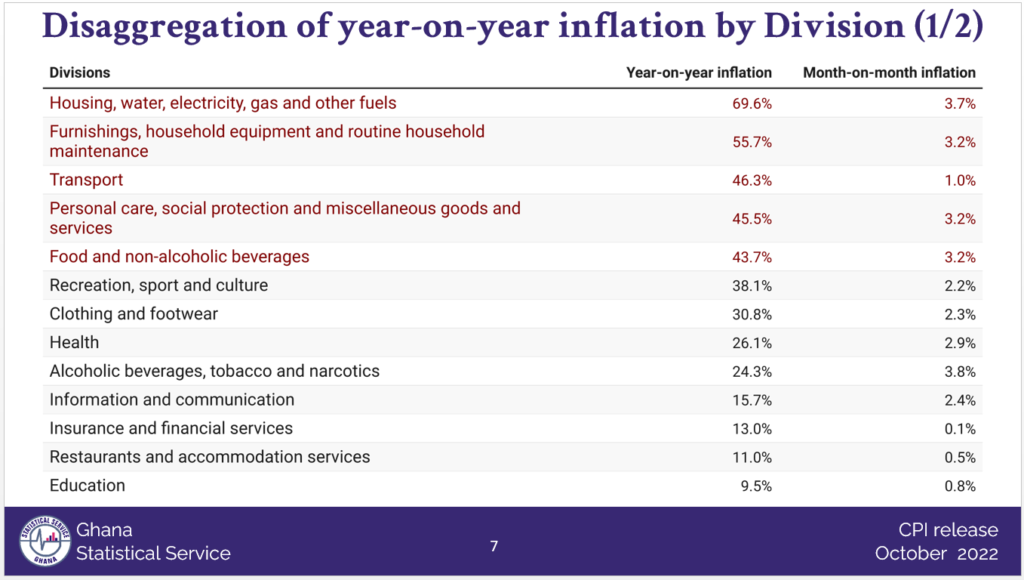
Increases in food prices; housing, electricity and fuel, and three other divisions pushed inflation for the month of October 2022 to 40.4 %.
This means the cost of credit is expected to go up further as the Bank of Ghana is set to take a decision on the policy rate - the rate at which it lends to commercial banks- by November 25, 2022.
The food inflation recorded the highest rate among all the components as against non-food inflation, according to figures from the Ghana Statistical Service. The increase by food inflation indicates a jump of more than 3% from the previous rate of 37.2%.
The other four divisions are Housing, Water, Electricity, Gas and Other Fuels (69.6%); Furnishings, Household Equipment ad Routine Household Maintenance (55.7%); Transport (46.3%) and Personal Care, Social Protection and Miscellaneous Goods and Services (45.5%).
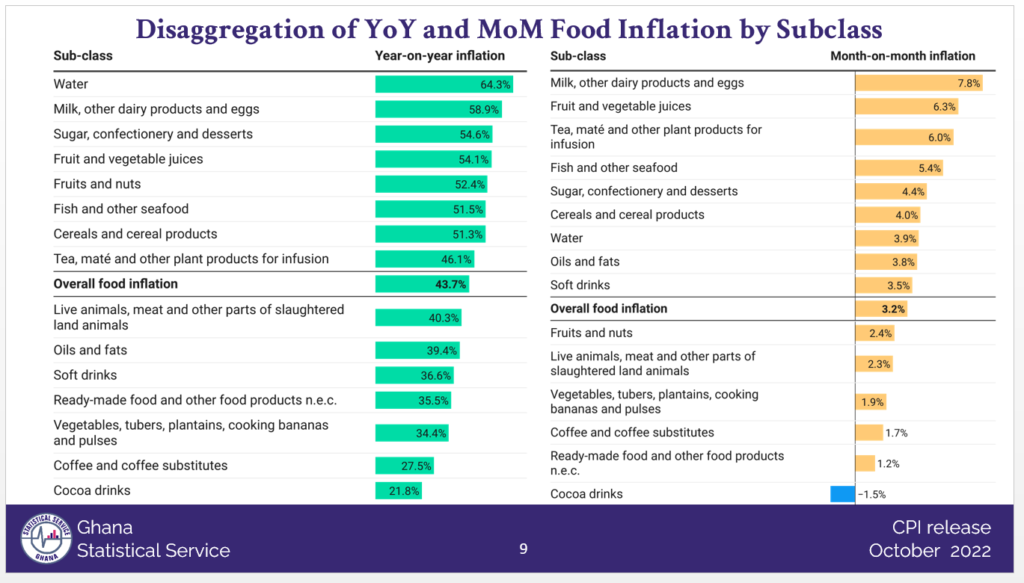
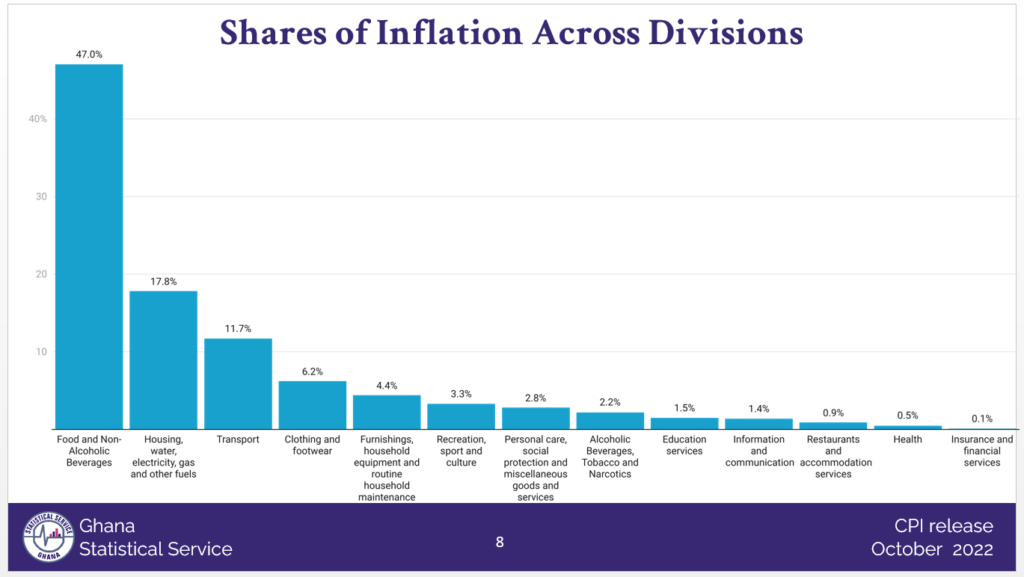
Food inflation was 43.7% in the month of October 2022, compared with 37.8% in September 2022. It has bigger weight than the above divisions.
Eight subclasses in the food inflation group recorded higher rates. This was distantly led by Water (64.3%) followed by Milk, Other Dairy Products and Eggs (58.9%) and Sugar, Confectionery and desserts (54.6%).
Also in the case of month-on-month food inflation nine subclasses record rates higher than the national average. Milk and Other Dairy Products and Eggs recorded the highest, 7.8%.
Non-food Inflation was however 37.8% in October 2022, from 36.8% recorded in September 2022.
Addressing the media, Government Statistician, Professor Samuel Kobina Annim explained that all items in the component for calculating the rate of inflation recorded an increase.
Inflation for locally produced items was 39.1%, whilst inflation for imported items was 43.7%.
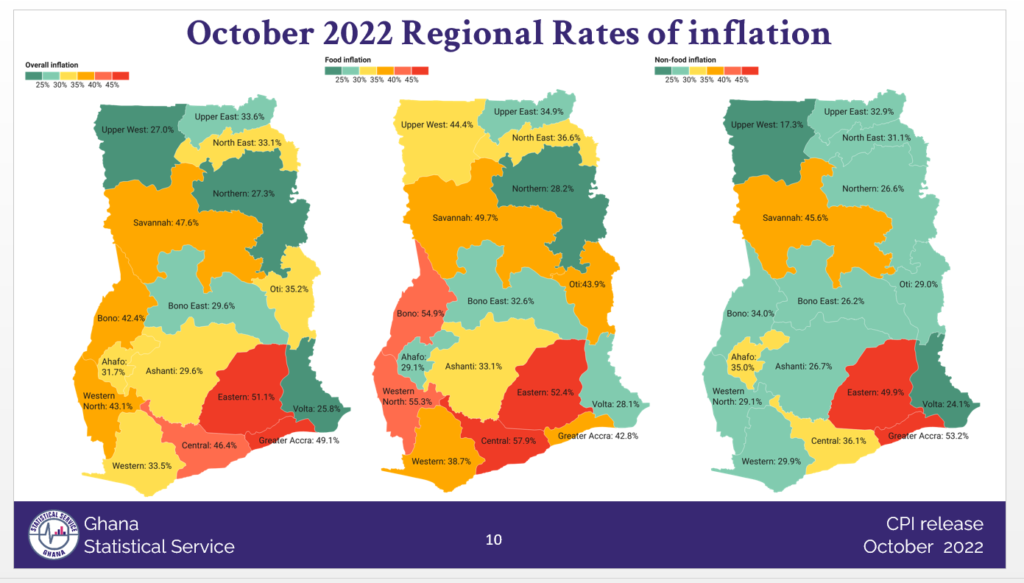
Eastern region records highest inflation rate
Eastern Region recorded the highest inflation of 51.1% in Ghana in October 2022.
It was followed by Greater Accra region (49.1%) and the Savannah region (47.6%).
The region with the least inflation was Volta (25.8%).
The Central Region (57.9%) recorded the highest food inflation while Greater Accra recorded the highest non-food inflation (53.2%).
Latest Stories
-
Mr President, Ghana was mentioned at the UN; why aren’t we talking about it?
2 hours -
Accra to convene Africa’s regulators and markets on tokenisation at AVAS 2026
3 hours -
The Paradox of Plenty — When every smartphone becomes a newsroom
3 hours -
GTA sensitises taxi drivers in ‘Know Ghana’ tourism campaign
4 hours -
Archbishop Agyinasare calls for responsible speech amid growing social media abuse
4 hours -
‘It will be inexcusable for gov’t not to honour payment of teachers’ arrears by 30th October’ – Haruna Iddrisu
4 hours -
Forbes’ World’s Best Employers 2026: No Ghanaian firm ranked among 900 companies
5 hours -
Electronic processing of teachers’ data: ‘The decision is the Controller’s’ – GES boss
5 hours -
Teachers’ Strike: Haruna Iddrisu questions paper-based processing of promoted teachers’ data
5 hours -
Savannah Region: Kunfusi bridge collapses again, leaving nearly 4,000 residents cut off
5 hours -
Teachers’ strike: GES targets Monday deadline to submit promotion data to Controller
5 hours -
Inflation to average 11.3% in 2027 – Fitch Solutions
5 hours -
‘I didn’t campaign for NDC to come and do this nonsense’ – Kpebu on EOCO’s conduct
5 hours -
Fitch Solutions maintains policy rate forecast of 14% by December 2026
6 hours -
Diaspora Nasara Caucus congratulates Mohammed Ali Suraj, new NPP executives
7 hours