

Audio By Carbonatix
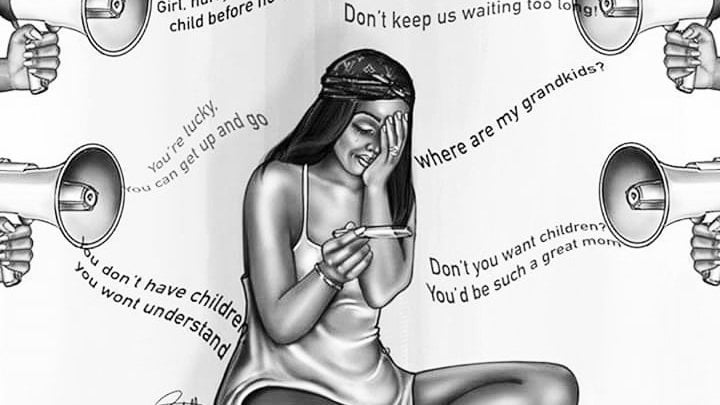
Infertility stigma is one of the cruelest treatments any woman can receive.
Aside from dealing with her own anxieties - such as seeing her menstrual blood again when she had prayed and hoped it will be missed this time; her personal struggles of not having an issue at a time she had hoped for, societal pressure and stigma only aggravate their inferior feeling and plight.
Infertility and infertility stigma
Infertility is defined by multiple sources as the inability to get pregnant after indulging in carefully timed, unprotected sex for one year.
Infertility stigma, on the other hand, is a phenomenon associated with various psychological and social tensions especially for women. The stigma is associated with a feeling of shame and secrecy, as defined by the International Journal of Fertility and Sterility.
Unfortunately, women are mostly the target of infertility stigma. According to some who have experienced this, it is not for the faint-hearted. Some of them have been plunged into various psychological conditions, others have lost their self-esteem, while some have sadly lost their lives. Hadiza Yahan is one of the many women who died in their early 40s.
Hadiza’s medical condition
Hadiza, a waakye seller at Teshie, a town near Accra, did not choose to be infertile. She got married at a very early age as characterised by some practitioners of the Islamic Religion. Sadly, as had been the case of her other female siblings and cousins, Hadiza was not getting pregnant as expected.
Her unending visitations to the hospital revealed that she had Ovarian Varicose Vein.
Stonybrookmedicine.edu explains ovarian varicose vein as a condition that occurs when the ovarian vein dilates so that the valves do not close properly. This results in a backward flow of the blood, also known as “reflux”. When this occurs, there is pooling of blood within the pelvis that leads to pelvic varicose veins and clinical symptoms of heaviness and pain.
Aside from the stigma, Hadiza was suffering painfully from this condition. She always complained of pain in the stomach and lower abdomen, she lost weight, she would throw up, and she would get hospitalised often.
The stigma
Hadiza was called names by the very people who did not know what health condition she had to contend with. They did not know that she was suffering a condition she never brought unto herself. For studies show that ovarian varicose vein could come as a result of hereditary.
There was a time she chastised a child for refusing to go on errands for another adult in the house, the child’s mother cautioned and told her in the Ga language which translates in English as: “After you have learned to have your own child, come and correct mine”. That was just one of the mean reactions Hadiza got anytime she meddled in children’s issues.
Her husband got a new wife who bore him a daughter in a year, compounding Hadiza’s plight that she’s the primary cause of their infertility. This was even not an issue as her husband is allowed to marry up to 4, according to their religion. The problem, however, is how her husband made conscious effort to flaunt his child at any given chance.
The first time this journalist, Emelia, saw her husband, he rode with his child on his bicycle to where Hadiza set up her waakye for sale. Emelia waited for her turn, and, after they had left, Hadiza told her: “Auntie Naa (as the journalist is commonly called in the area), that was my husband”.
The journalist replied that she didn’t know him, and she didn’t also know that he was her husband.
“That’s the daughter the other wife bore him. He always puts her on the bicycle when coming for food. There’s no day he does not bring her. He always reminds me about the fact that she’s not my biological child. When I’m around, she calls the girl by her mother’s name!” Hadiza told the journalist with discouragement written all over her face.
She was excluded from certain activities in the area because she had no child. Even with her own family, Hadiza did not have it easy with dealing with them on the topic. The discrimination and unfair treatment she received made her stay clear off her family.
Hope of conceiving completely lost
All that while, the journalist did not know that Hadiza was suffering from a medical condition that opposed her ability to conceive. And so, her way of consoling Hadiza was: “Amelia, at Allah’s own time, you will have your own child and carry her in your arms.”
Her usual response always was “Allah will do at his own time”.
Not long after that conversation, Amelia was not going to her stall to sell. As a regular customer, the journalist’s calls to her phone went unanswered. After two weeks, she returned the calls only to reveal that she had been on admission at the hospital because her condition had become worse. To save her life, the doctor advised that her womb be taken off completely, which she obliged. Now, it means there is no longer hope of bearing a child - the height of Hadiza’s agony.
More than a mother
After learning of Hadiza’s actual condition and her consequence hysterectomy, the journalist developed a new approach of consoling Hadiza.
This approach is to constantly remind Hadiza that first of all, she is human, a woman, before anything else. The journalist used words of encouragement to boost her self-confidence and to make Hadiza understand that with or without a child, she is a complete woman.
She is more than a mother in many facets. For instance, she cooked and sold waakye to a whole community – thereby, feeding many.
Gradually, Hadiza herself came to accept her condition and fate, and decided to focus her life on making herself happy first before anything else. No more space for gloom.
Hadiza’s sad end
Hazida, with a new mindset, started to mingle. Hitherto, she was almost all alone. The only times she got to spend time with others was when she was selling her waakye, and with other patients in the female ward at the Accra Regional Hospital.
However, after being exposed to the ‘More than a Mother’ strategy, she started attending Awures (traditional Islamic marriage) and Sunna (naming ceremonies) in Kwashiman, a suburb of Accra or Kasoa.
In March 2022, Hadiza went on her occasional admission at the hospital but this time, she never came back. Neighbours say she died without her husband or any family member by her bedside - a sad end of a woman whose story would have been different if society had realised that she was first a human, then a woman, before anything, any expectation else.
Her story would have been different if society had seen infertility as any other medical condition like diabetes, malaria, or even toothache.
Just like Hadiza, there are many other women suffering in silence because of infertility stigma. It is for this and several other reasons that the fight and campaign to eliminate infertility stigma against women must continue unabated!
Latest Stories
-
TTAG raises alarm over proposed recruitment of 7,000 teachers, demands national posting roadmap
32 minutes -
Civilians feared killed after reports of air strike on Nigerian market
42 minutes -
Bishop Simon Kofi Appiah installed as new Jasikan Diocese Bishop
43 minutes -
Trump’s Strait of Hormuz blockade threat raises risks and leaves predicaments unchanged
45 minutes -
US Court backs extradiction of former MASLOC CEO Sedina Tamakloe-Attionu’s to Ghana
1 hour -
Seven arrested as NAIMOS dismantles illegal mining camp, seizes firearms at Boin River
1 hour -
Fire erupts at Madina Ritz Junction, destroys multiple wooden structures and containers
1 hour -
Daniel-Kofi Kyereh returns from long-term injury, registers assist for Freiburg U23
2 hours -
Knifeman calling himself ‘Lucifer’ slashes three at NYC’s Grand Central
2 hours -
Brands are built from within to without
2 hours -
Matriculants urged to pursue excellence as gov’t reaffirms support for Maritime education
2 hours -
See the areas that will be affected by ECG’s planned maintenance on Monday, April 13, 2026
2 hours -
GPL 2025/26: Salim Adams double fires Medeama back to summit after Kotoko rout
2 hours -
Two robbery suspects convicted following violent gold dealer attack in Obuasi
2 hours -
Supreme Court @150: Fanfare meets reflection as nationwide activities roll out
2 hours