

Audio By Carbonatix
Iraq's president said late on Wednesday he would summon the United States ambassador to Baghdad over critical remarks by a U.S. State Department spokesperson regarding the Iraqi government's treatment of a top Iraqi Christian leader.
State Department spokesperson Matthew Miller on Tuesday criticised a decision by Iraqi President Abdul Latif Rashid to revoke a decree that had recognized Cardinal Louis Sako as head of the Chaldean Catholic church in Iraq and allowed him to oversee its assets.
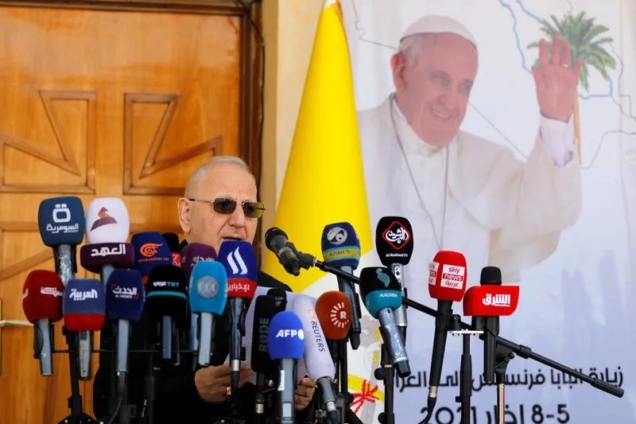
Sako was a key organizer of Pope Francis' landmark 2021 visit to Iraq and has strong support from the U.S. and European governments, who view him as a peace-builder in a country plagued by conflict.
Sako had condemned Rashid's move, which he claimed was made at the behest of an Iraqi Christian militia leader close to Iran, and announced his departure from Baghdad to Iraq's semi-autonomous northern Kurdistan region.
"I will say we are disturbed by the harassment of Cardinal Sako ... and troubled by the news that he has left Baghdad," Miller told a press briefing.
"We look forward to his safe return. The Iraqi Christian community is a vital part of Iraq's identity and a central part of Iraq's history of diversity and tolerance," Miller said.
Rashid was "disappointed by accusations leveled against the Iraqi government" by Miller and so would summon the ambassador, a presidency statement said.
Defending his decision, Rashid has said it was aimed at correcting a constitutional anomaly as presidents had no business recognizing heads of religious establishments. He said the move was not aimed at undermining Sako, whom Rashid said he respects.
On Monday, the Vatican Embassy in Baghdad in a statement said that it "regrets the misunderstandings and inappropriate dealings concerning the role of ... Sako as the custodian of the properties of the Chaldean Church."
Iraq's Christians once numbered around 1.5 million, but the minority community has been reduced to the low hundreds of thousands in the two decades since the 2003 U.S. invasion and the years of sectarian bloodletting that followed.
The community, one of the oldest in the world, was decimated first by al Qaeda’s rise in the early 2000s and later by Islamic State, the extremist group that brutally persecuted Christians and other minority faiths and sects from 2014-2017.
It has struggled to recover since Islamic State's 2017 defeat, plagued by high unemployment and the difficulty of returning to historical Christian areas, some of which remain controlled by militias.
Latest Stories
-
GPL 2025/26: Dreams FC stage stunning comeback to hammer Eleven Wonders
33 minutes -
Livestream: The Probe examines Kumasi’s looming water crisis
37 minutes -
MTN Ghana gears up to lead Africa’s AI revolution
38 minutes -
Philanthropist Alhaji FuZak donates Da’wah bus to Ambariya Sunni community
45 minutes -
GUTA calls for suspension of Publican AI system over trade disruptions
48 minutes -
TTAG raises alarm over proposed recruitment of 7,000 teachers, demands national posting roadmap
1 hour -
Civilians feared killed after reports of air strike on Nigerian market
2 hours -
Bishop Simon Kofi Appiah installed as new Jasikan Diocese Bishop
2 hours -
Trump’s Strait of Hormuz blockade threat raises risks and leaves predicaments unchanged
2 hours -
US Court backs extradition of former MASLOC CEO Sedina Tamakloe-Attionu to Ghana
2 hours -
Seven arrested as NAIMOS dismantles illegal mining camp, seizes firearms at Boin River
2 hours -
Fire erupts at Madina Ritz Junction, destroys multiple wooden structures and containers
2 hours -
Daniel-Kofi Kyereh returns from long-term injury, registers assist for Freiburg U23
2 hours -
Knifeman calling himself ‘Lucifer’ slashes three at NYC’s Grand Central
3 hours -
Brands are built from within to without
3 hours