

Audio By Carbonatix
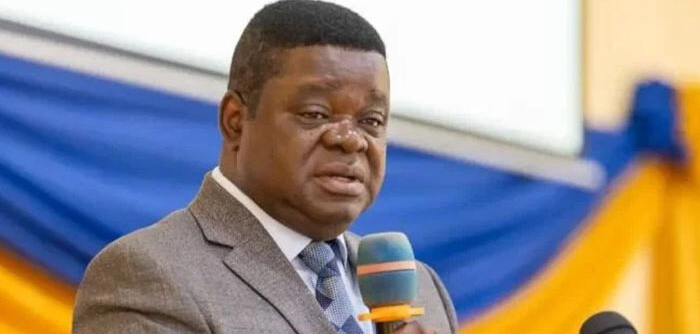
Economist Professor Peter Quartey says businesses can expect some relief from rising borrowing costs in the short term.
However, he cautions that the relief may only be temporary.
Speaking on Joy News’ PM Express Business Edition on Thursday, Prof Quartey said businesses should not expect the cost of credit to rise in the immediate future.
“Oh yes, certainly businesses should be comforted, but temporarily,” he said.
He said the outlook would depend largely on developments in the global economy.
“I mean, we should just touch wood, touch wood if nothing happens, if the prices come down, if what is happening in Iran between Iran and the U.S. doesn’t escalate and things get better, then why not?” he said.
“I believe things will get better, but at the moment, it’s a temporary relief for businesses.”
According to Prof Quartey, businesses are not expected to face higher credit costs over the next few months.
“We’re not expecting to see higher costs of credit, at least in the next month or two,” he said. But he warned that Ghana’s limited economic buffers leave the country exposed to external shocks.
“Yes, you will notice that, I mean, for these countries that are even fighting, Iran, U.S., and the rest, they have a buffer,” he said.
“They have oil reserves that they can fall on.”
“I mean, we basically have very little buffer to fall on, and therefore, anything that happens is we, we, we, I mean, when they sneeze, we catch a cold.”
Prof Quartey said Ghana’s dependence on imported processed fuel adds to the vulnerability.
“And I think we are not processing enough of the oil,” he said.
“We are an oil producer, but we are not processing quite a good chunk of the oil. We still continue to import processed fuel, and that is a big problem for us.”
He also pointed to Ghana’s continued dependence on petroleum products while other countries are moving rapidly towards alternative energy sources.
“Secondly, we’re relying too much on fuel, petrol and, you know, crude, for instance, whereas in other countries, other forms of fuel, green energy, green transition is happening rapidly,” he said.
“That is not happening so much with us, and I think that makes us very vulnerable to external shocks.”
Prof Quartey also highlighted Ghana’s dependence on gold exports.
“And if you even look at our exports, for instance, at the moment, gold accounts for almost 60% or 61% of our export earnings,” he said.
“That puts you in a very vulnerable situation.”
“Should gold prices tumble, or should anything happen to the international market, we are likely to suffer the consequences.”
Latest Stories
-
Ghana’s economy grows by 7.4% in July 2026
4 minutes -
NDC member challenges Dennis Yeboah Twumasi’s eligibility for Bono Regional Secretary elections
14 minutes -
Popular Nigerian gospel singer Toluwanisings dies
24 minutes -
Spio-Garbrah proposes debt swaps to fund reparative justice in Africa and Caribbean
31 minutes -
Alban Bagbin calls for governance reforms and coordinated action to address Africa’s debt crisis
34 minutes -
AAK Academy Ghana trains 22 chocolate and confectionery companies in production techniques
36 minutes -
Adwumawura Programme trains second cohort of young entrepreneurs in Bono East
37 minutes -
Destroying Jimi River for gold could cost us our lives – Asantehene
44 minutes -
Sammy Gyamfi didn’t say BoG has ceded its forex role to us – GoldBod
2 hours -
High Court sets November 4 for ruling on Wontumi’s bail application
2 hours -
Tetteh Kwetey files nomination for NDC Greater Accra Regional Chairmanship
2 hours -
Korle Bu appeals for more doctors, nurses as A&E Centre struggles under pressure
2 hours -
AFCON 2027Q: ‘I’m optimistic Black Stars can turn things around’ – Agyemang-Badu
2 hours -
Digital innovation could widen Africa’s inequalities if people are left out – Sam Jonah
2 hours -
Galamsey is an economic, health and moral problem – Sam Jonah
2 hours