

Audio By Carbonatix
The Ministry of Fisheries and Aquaculture Development has rallied the Ghana Science Association (GSA) and the research community to work with the Ministry to develop practical, science-based solutions to protect Ghana’s ocean and secure livelihoods.
Mrs Emelia Arthur, the Sector Minister, said scientists and researchers were needed to co-create digital solutions and systems to help transform the country’s Blue Economy, which faced serious threats from illegal mining, destructive fishing practices and other harmful environmental activities.
She, therefore, proposed the establishment of a joint technical body between the Ministry and the GSA to facilitate structured engagement on stock assessment, climate adaptation, coastal resilience and other critical areas.
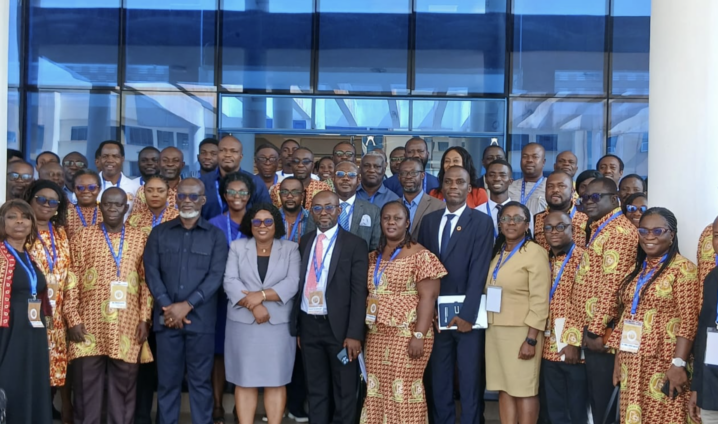
The Minister made the call in a statement delivered on her behalf by Mr Fred Antwi, the Coordinator of the Ministry’s Blue Economy Secretariat, at GSA’s 20th biennial workshop organised in partnership with the Africa Ocean Institute (AOI) of the University of Cape Coast (UCC).
The workshop held on the theme: “Advancing Ghana’s Blue Economy: Securing our shores, feeding our future,” brought together scientists, researchers, policymakers, industry players, students and other stakeholders to discuss the future of Ghana’s Blue Economy.
The stakeholders raised the alarm over the hostile destruction of the environment including rivers, the ocean and the coasts principally through illegal mining and other activities and proposed solutions to same.
Mrs Arthur stressed that transforming the Blue Economy could not be achieved by the Government alone but required strong partnerships with scientists, researchers and the coastal communities.
She said the quest for a robust and viable sector must be guided by integration, innovation, inclusion and integrity, explaining that the challenges cut across sectors and required collaborations, innovative solutions and respect for the law.
The Minister challenged scientists and researchers to go beyond academic publications to translate their findings into clear, actionable policy recommendations that could be readily implemented by government.
She further advocated community-centred science, where fisherfolk and coastal communities were treated as partners whose practical knowledge complemented formal research in addressing real-world challenges.
On blue justice, Mrs Arthur said scientists must ensure that their innovations and recommendations promoted fairness for women fish processors, youth, small-scale fishers and other vulnerable groups across the blue economy value chain.
The Minister indicated that government had already initiated several actions and was making some progress, saying a high-level joint technical committee was preparing a cabinet memo to strengthen governance and protection of aquatic zones.
“To consolidate these gains, a draft Blue Economy Commission Bill prepared by the consultant Dr Godwin Djokoto with UNDP funding has been finalised, technically reviewed by a 19-member intersectoral committee, and is now undergoing stakeholder engagement ahead of validation and submission to Cabinet and Parliament by October 2026,” she announced.
Dr Selina Ama Saah, the National President of GSA, underscored the urgent need to salvage the fisheries sector and save the ocean, indicating that a resilient Blue Economy could strengthen food security, reduce dependence on imported fish, create jobs and stimulate innovation in marine technologies.
She observed that the emergence of Artificial Intelligence, smart systems, advanced breeding technologies and other marine technologies could improve productivity, resource management and environmental protection.
“But technology alone will not solve our problems. We need appropriate policies, investment and infrastructure, skilled human resources, strong institutions, and collaboration among government, academia, industry and coastal communities,” she added.
Dr Saah was hopeful that the workshop would produce a practical framework for cross-sectoral collaboration, a roadmap for science and innovation in aquaculture, and evidence-based recommendations for coastal protection and fisheries management.
Touching on the impacts made through the Association’s biennial workshops and conferences over the years, she noted that they had addressed numerous challenges and offered recommendations which had contributed to key national initiatives and institutions like the CSIR.
Professor Benjamin B Campion, the Executive Director of Fisheries Commission, reiterated the dangers faced by the fisheries sector and noted that reason the Commission could not sustainably manage it alone without adequate support.
”We therefore need continuous investment in fisheries science, stock assessment, fisheries data, ocean observation, digital technologies, climate science, aquaculture research and innovations that can translate directly into management decisions,” he appealed.
Prof Mrs Christine Adu-Yeboah, the Acting Pro Vice Chancellor of UCC, commended the science association for demonstrating leadership and taking practical steps to seek solutions to the country’s challenges.
She expressed the university’s commitment to advancing the development of the Blue Economy through its Africa Centre of Excellence in Coastal Resilience, saying “we are positioning ourselves at the forefront of marine and coastal research.”
”We believe the university must not be an ivory tower, but a solutions hub that directly impacts society and the communities we serve,” she said.
Latest Stories
-
Oil prices retreat as investors weigh supply outlook, Middle East tensions
3 minutes -
Mahama Ayariga highlights Jimi reclamation project as effort to tackle flooding
9 minutes -
Ayine pushes duty-lawyer scheme to protect suspects at police stations
16 minutes -
Fire at GRIDCo’s Mallam Substation cuts power to parts of Accra
21 minutes -
Stephen Amoah criticises 20% digital services tax as excessive
22 minutes -
Ghana secures $3.5bn investment commitments to revive oil and gas sector – Jinapor
27 minutes -
Court to hear Wontumi’s bail application today
27 minutes -
DPC flags six companies for data protection breaches
33 minutes -
Chief Justice appointment from outside Supreme Court possible but unlikely – Bentil
34 minutes -
NEDCo replaces faulty transformer at Saasigli
37 minutes -
Dr Seidu Jasaw urges climate financiers to align funding with farmers’ planting seasons
41 minutes -
Bank of Ghana urges public to uphold dignity of local currency
42 minutes -
Global Chairman of World Assemblies of God Fellowship lauds Mahama’s sterling leadership
47 minutes -
Global economy’s resilience nearing limits – IMF
54 minutes -
Trust-building is crucial for sustaining confidence with communities – Police Commander
59 minutes