

Audio By Carbonatix
Sarah Evanega works in a challenging space.
No, not her pandemic home office or even her car to free up needed internet bandwidth for her three young children’s remote schoolwork. Those are minor compared to a career spent depolarizing and demystifying issues around genetic engineering, especially given the disconnect between scientific consensus on its safety and lingering public skepticism.
As founder and director of the Cornell Alliance for Science, a global communications initiative in the College of Agriculture and Life Sciences (CALS), Evanega faces down misperceptions, myths, and misinformation about GMOs — or to use the scientific term, agricultural biotechnology. Now she’s also taking on the conspiracy theories and disinformation campaigns that swirl around the pandemic, vaccines, climate change, and synthetic biology.
Evanega, a research professor in the Department of Global Development and School of Integrative Plant Science, has found that understanding GMO misinformation trends provides important lessons that can be applied to misinformation around COVID-19. In 2020, she led a comprehensive examination of coronavirus misinformation in traditional and online media, analyzing 38 million documents in order to understand the root of the “infodemic.” The research garnered global coverage from The New York Times, CNN, NBC News, The Hill, and MSN.
“Misinformation became a buzzword with COVID, but in plant science, we’ve been dealing with misinformation for decades,” Evanega says. “We’re not finished yet, but we have made significant progress. Now we’re seeing how we can apply learnings from agricultural biotechnology to other issues of science that suffer from misinformation.”
Evanega didn’t plot a career course into this thicket. She first discovered plant science in 1996 upon taking a plant physiology course as a college elective. It was a revolutionary time for ag-biotech, with the Cornell-developed virus-resistant GM papaya hitting the market. Excited about the role that biotechnology could play in advancing plant science, Evanega earned a doctorate in plant biology from Cornell in 2009.
Then reality hit: “You invest your career and time only to discover that this technology isn’t having the impact that it could,” she says. “And you find it’s not because of the science, but the politics and profit-driven campaigns against it. At that point, I became concerned about the factors that are limiting the plant sciences field’s ability to advance and have impact.”
Evanega wasn’t interested in standing by as misinformation derailed science that provided solutions. In 2013 she pitched her big idea for combatting ag biotech misinformation to the Bill & Melinda Gates Foundation: a $4.5 million grant then launched the Alliance for Science in 2014. She has since brought in a total of $27 million in funding — none of it from industry, despite what some critics claim.
The Alliance’s emphasis is three-pronged: policy, training and communications. “If we want science to have an impact, we have to improve the policy environment. We have to train people who can engage with the public. And we have to tell better stories about the technology,” she says.
As part of that initiative, Evanega mentors science champions across the globe and from all professional backgrounds. Launched in 2015, the Alliance’s Global Leadership Fellows Program delivers an extensive 12-week course at Cornell, to date training 111 Fellows from 35 countries. Additionally, Evanega has facilitated workshops with nearly 800 scientists from 48 countries, and 109 journalists from 15 countries.
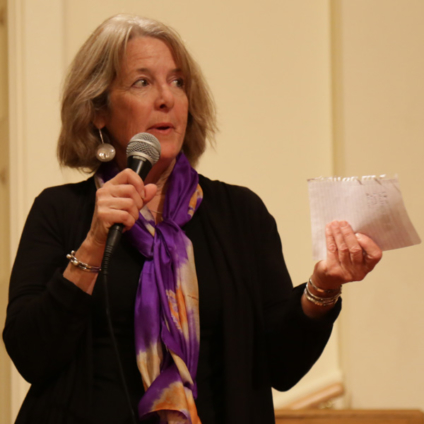
Evanega believes that scientists must join the public debate about the key issues of our time, and she is often invited to give talks on the importance of science communication, especially at the request of young scientists. She also offers guest lectures on plant biotechnology in a range of graduate and undergraduate courses in SIPS and is part of an interdisciplinary team that developed a massive open online course (MOOC) on the science and politics of GMOs on Cornell’s EdX platform in 2016. Throughout her career, she has worked to promote ethnic and gender diversity at Cornell through programs such as Advancing Women in Agriculture through Research and Education.
Evanega sees those efforts and the work of the Alliance as an extension of the land-grant university mission. “Agricultural biotechnology can help us be better stewards of the land and shift people from subsistence to a significant increase in quality of life,” she says.
Looking back on the past seven years, Evanega believes the Alliance has made a difference. “We’re giving people agency. It’s not about us doing development out there in the world. It’s as simple as creating a platform that people can hop on and do what’s culturally appropriate in their own contexts. Not everybody agrees with or appreciates our work, but it’s important, because we’re standing firmly with the science and we’re not imposing it on other cultural contexts.”
Joan Conrow is the managing editor of the Cornell Alliance for Science.
Latest Stories
-
Global InfoAnalytics poll puts John Boadu, Justin Kodua and Titus Glover ahead in NPP executive race
3 minutes -
Ghana to establish skills development university with $50m from German support package
9 minutes -
Baffour Awuah under EOCO investigation over alleged financial loss and money laundering – Deputy AG
15 minutes -
How healthy is Ghana’s health sector?
20 minutes -
HACSA Tech4Girls graduates 80 young women with digital and technology skills
22 minutes -
Arrest of Manhyia South MP should involve Parliament, not police station – Kpebu
54 minutes -
Two Nigerians sentenced to 189 months in US prison over $2.4m cyber fraud
1 hour -
Cristiano Ronaldo leaves Portugal’s training camp after rift with Head Coach
1 hour -
Ghana Energy Awards opens nominations for landmark 10th anniversary edition
1 hour -
Aayalolo contra-flow: Are we treating the symptom instead of the disease?
1 hour -
GTEC orders Colleges of Education to begin 2026/2027 admissions despite fees approval delay
1 hour -
Legal reforms must solve real problems, improve justice – Bagbin
1 hour -
Ofori-Sarpong named Alumni President of the Year, honoured for PRESEC dormitory project
2 hours -
Germany commits $132m to Ghana for skills development and training university – Pelpuo
2 hours -
‘Influence should go beyond visibility’ – Taadi Banyinba GH launches The TB Impact
2 hours