

Audio By Carbonatix
The Education Minister, Dr Yaw Osei Adutwum, says the junior high school (JHS) system lacks the desired quality to produce competitive students and graduates for the country.
He noted that the current JHS system does not favour ‘weak’ or underprivileged students, adding that there are no advanced facilities that build students for their career paths.
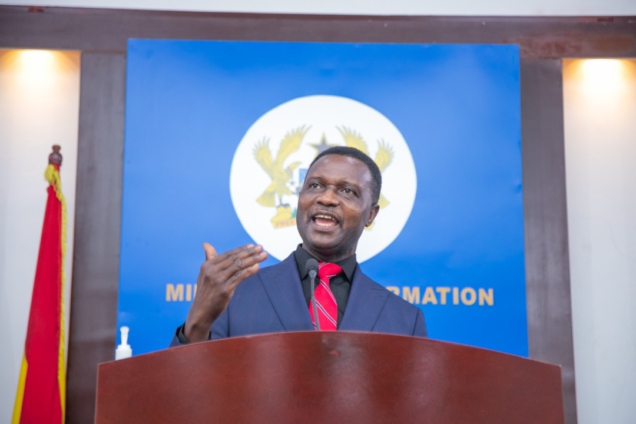
Speaking at a press briefing on Sunday, the Bosomtwe MP recounted that the current JHS education is not robust enough to prepare students for higher education, unlike the former middle system.
According to him, the country created “a monster [when] we removed what used to be middle school, which gave people from disadvantaged backgrounds opportunities to catch up with the rest” in 1987.
“I think the weakest link in the education system is the junior high school because others will go the junior high school and do the quality secondary work; if you meet those students at Wesley Girls, they are ahead of the curve, and they are going to do much better than you.”
“We borrowed a concept from the United States…three plus three but we decided that the first three [JHS] is not something that we’re going to be very concerned about. Something needs to be done about the week middle which happens to be the junior high school,” he said.
Ghana passed a new legislation in 1987 which scrapped the then middle school system and replaced it with the JHS system, making the duration of basic school education nine years instead of the previous 10 years.
Prior to that, the Education Act of 1961 had introduced the Free and Compulsory Basic Education (FCUBE) for all school-age children.
Currently, students who complete the three-year Junior High School take a national test in order to qualify to the senior high school.
Successful Basic Education Certificate Examination (BECE) candidates are then able to continue their education at the secondary level under the flagship Free SHS policy.
The Bosomtwe Member of Parliament hinted at plans being put in place to review and revamp the junior high school.
“We have junior high schools that under construction now and the facilities in there will be just like high schools; everything that is in the high school will be there.”
“It’s a pilot programme, and students who go through it would have had three years of quality junior high school, move on to the high school to do another three years, giving me six years making them competitive and making us compete with the rest of the world,” he assured.
Latest Stories
-
‘Our missing players are more important’ – Gambia coach fires shot at Ghana
42 minutes -
Today’s front pages: Tuesday, September 29, 2026
45 minutes -
Ghana ‘showing up differently’ on global stage – Joyce Bawah Mogtari
1 hour -
Ghana’s tuna industry in crisis as 20 hook-and-line vessels collapse
2 hours -
South Tongu MP launches apprenticeship programme for 159 young people
2 hours -
The Pusiga connection behind Gertrude Atongi’s work in New York
3 hours -
Teachers took promotion exams in December to beat government clearance deadline – GNAT
3 hours -
NPA launches 2026 staff welfare week with focus on teamwork and employee wellbeing
3 hours -
Ghana, Saint Kitts and Nevis sign labour deal to strengthen protections for Ghanaian nurses
3 hours -
Delayed promotions put teachers’ retirement benefits at risk – GNAT
3 hours -
No ‘Bawumia candidates’ in NPP executive elections – Anthony Karbo
3 hours -
Over 3,000 displaced as flooding overwhelms Hohoe communities
3 hours -
Sunyani East NPP executives begin reconciliation drive ahead of 2028 polls
3 hours -
Agric Minister engages Ga Mantse on agriculture transformation agenda
3 hours -
Aayalolo expansion targets private car users, not trotro operators – Mahama Ayariga
3 hours