


Audio By Carbonatix
A ban on plastic carrier bags has come into force in Kenya, which means that anyone found selling, manufacturing or carrying them could face fines of up to $38,000 or prison sentences of up to four years.
The government says the ban will help protect the environment.
But manufacturers of the bags have argued that 80,000 jobs could be lost.
A court on Friday rejected a challenge to the ban. Kenyans are estimated to use 24 million bags a month.
A number of other African countries have outlawed plastic carrier bags, including Rwanda, Mauritania and Eritrea.
Piles of waste plastic bags are a common site across Kenya, as in many African countries.
Animals often graze on the rubbish and the United Nations' Environment Programme says huge amounts of polythene bags are pulled out of livestock in Nairobi's abattoirs - as many as 20 bags per cow - raising fears of plastic contamination in beef.
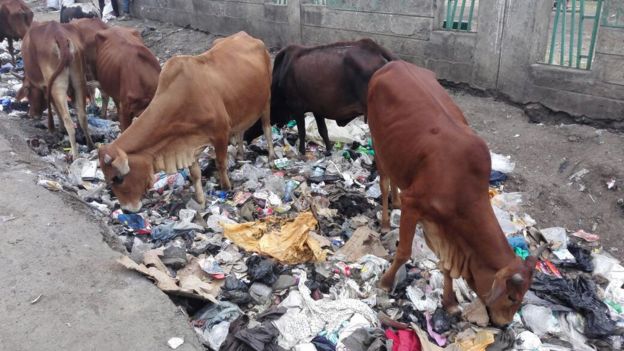
Cows in Kenyan abattoirs are often found with plastic bags in their stomachs
Kenya's Environment Minister Judy Wakhungu says the plastic bags take between 20 and 1,000 years to biodegrade.
"Plastic bags now constitute the biggest challenge to solid waste management in Kenya. This has become our environmental nightmare that we must defeat by all means," she told the BBC.
The BBC's Anne Soy in Nairobi says that supermarkets appear to have adjusted - they are selling fabric bags for 10 Kenyan shillings (10 US cents; 7 British pence).
However, traders in the City meat market are still using plastic bags, she says.
Travellers coming into Kenya with duty-free plastic shop bags will be required to leave them at the airport under the new rules, the National Environmental and Management Authority has said.
This is the third attempt in the past 10 years to ban plastic bags in Kenya.
The government had given a six-month window for adjustment which expired on Sunday night.
Manufacturers who use polythene to wrap products are exempted from the ban.
In its ruling last week, the High Court dismissed a case filed by two plastic bags importers urging it to drop the ban. The court ruled that environmental concerns were more important than commercial interests.
Research in Europe has shown that a paper bag must be used three times to compensate for the larger amount of carbon used in manufacturing and transporting it.
Likewise a plastic "bag for life" must be used four times, and a cotton bag must be used 131 times.
Latest Stories
-
Day Two of 3rd Republic Bank-JoyNews Habitat Fair ends with great homeownership offers and financing solutions
28 seconds -
Guinness Ghana DJ Awards 2026 Pub Fest celebrates Ghana’s DJ culture as Accra turns up the energy
18 minutes -
10th woman found dead in South Africa’s string of killings
19 minutes -
French Embassy trains Ghana Police CTU in counter-terrorism operations
50 minutes -
UPSA uncovers mass results manipulation involving 178 students, over 500 results compromised
1 hour -
ECG announces planned power outages in parts of Tema from Sept. 29 to October 1
2 hours -
Sylvester Mensah urges Latenu FM to promote trade, export opportunities in Ga
2 hours -
Ga language under threat of decline as children shy away from speaking it – Sylvester Mensah
2 hours -
‘Let every Ga child you raise know the Ga language and story’ – Sylvester Mensah
2 hours -
‘We are not deterred’ – Ablakwa responds to backlash over South Africa evacuation
2 hours -
NCA announces major voice and data disruption across Northern Ghana due to fibre cuts
3 hours -
Photos: Housing solutions take centre stage at Day 2 of the 3rd Republic Bank-JoyNews Habitat Fair
3 hours -
Ghana Air Force passes out 293 recruits after six months of intensive training
4 hours -
EOCO vrs Baffour Awuah: EOCO should have secured warrant before arrest attempt at court – Inusah Fuseini
4 hours -
Triple fibre cuts disrupt telecom services across Northern, Oti regions – Sam George
4 hours