

Audio By Carbonatix
“Stonebwoy is NPP. He is Gabby Asare Otchere-Darko’s boy. He is Gyankroma Akufo-Addo’s buddy.” I am sure you heard some of these claims when the New Patriotic Party was in power? I heard them too but I didn’t read deeper meanings into them.
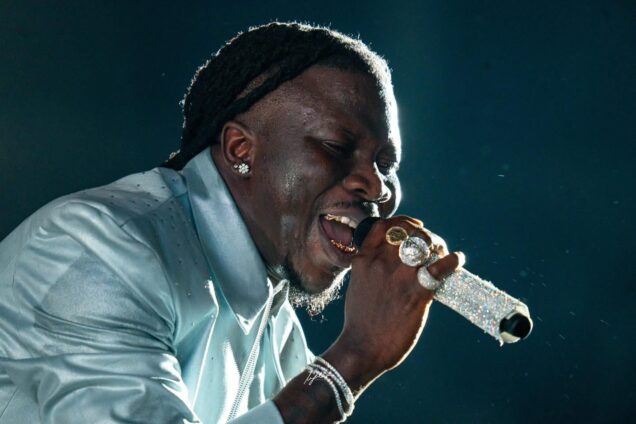
Many who bought into these claims were, therefore, gobsmacked by Stonebwoy’s remarks at the Black Stars World Cup Fundraiser at the Kempinski Hotel on March 21, 2026, where he suggested his song Jejereje contributed to the victory of the National Democratic Congress in the 2024 elections.
“When we talk about contributions, I believe that my contribution has been very significant in actually winning power for the NDC because everybody has heard ‘naano ee nakofa baaye o’. Mainly because I am somebody that believes in reset so per my own judgement, I made sure that that music was dropped within a moment when there was some ease in the system. Because it was so tensed and I dropped it in terms of contributions,” he said.
In the first place, I do not care about which political party Stonebwoy belongs to. My perception of him and how I react to his work would not change even if he openly declares his love for any political party.
However, his statement needs to be put under the microscopic lenses of critical thinking. Did his song Jejereje contribute “significantly” to the NDC’s victory? I do not think so. Did the song ease tension? That is if there was tension. Did it help entertain people? Very well so.
Political science research, including studies on Ghana’s electoral behaviour, consistently points to a hierarchy of factors that determine election outcomes. Candidate credibility, party identification, economic performance and campaign promises, among others rank highest. Campaign communication, including music, plays a role too, but largely as a reinforcing tool rather than a decisive one. While scientifically there are no specific figures to back how exactly individual songs influence voting patterns, political scientists agree that media and messaging tend to shape voter perception. This means the possibility of influence of campaign songs cannot be dismissed.
These songs have the tendency to influence votes, particularly when they carry clear, well-crafted messages that align with a party’s ideology. Such songs can simplify complex political ideas and connect emotionally with voters, when woven into beat and melody. The impact is even well-felt when the songs are deliberately commissioned or adopted as official campaign material, and when the composer is popular. In political marketing, this helps greatly in messaging. Campaign songs appeal to the cognitive theory of music appreciation where people don’t just vibe to the melody or instrumentation but most importantly feed on the words in the song.
Stonebwoy’s Jejereje, however, does not fall in this category. It is not a political campaign song in the sense of the word. Songs of this nature are largely generic and tend to mainly serve entertainment purposes. They do not carry the same persuasive weight as songs with explicit political messaging. For that reason, it would be misleading to suggest that Jejereje “significantly” contributed to bringing the NDC to power. Whatever role it played could not have been significant; it would be infinitesimal.
Note that the word “significant” is a big deal here. On a scale of 0 to 10, a “significant” contribution would suggest a level around 7 or 8, implying strong and measurable impact. That is difficult to sustain in the case of Jejereje.
Songs line Stonebwoy’s ‘Jejereje’ or King Paluta’s ‘Makoma’ could mobilise, energise or even create cultural moments around campaigns, but they possibly would have 0.001% chance to contribute to electoral victory.
Mind you Jejereje was not only played at NDC rallies; it also featured on NPP campaign platforms. So if it contributed to the NDC’s victory because the NDC won power, it is logically sound to assert that it contributed to the NPP’s loss because they lost power? Because the obverse holds true with the power of music.
Another important part of Stonebwoy’s speech was the use of the NDC’s “reset” slogan. For some, it could be interpreted as a subtle signal to President John Dramani Mahama that, contrary to earlier perceptions of his proximity to the NPP, he may be ideologically aligned to his party.
Will this affect Stonebwoy should political power change hands?
Maybe this article is much ado about nothing; maybe Stonebwoy has a grand idea behind what he said. Maybe I am overemphasising the political correctness or otherwise of his words. However, this might come back to bite him hard if he doesn’t handle things well in future.
Already, some supporters of the NPP have expressed disappointment over his comment, which clearly shows some of them thought he was on their side.
That said, I honestly think Stonebwoy’s comment about ‘Jejereje’ significantly contributing to the National Democratic Congress’ win in 2024 elections is hyperbolic; it only entertained patrons like any other non-campaign song that was played during the campaign period.
Latest Stories
-
UPSA uncovers mass results manipulation involving 178 students, over 500 results compromised
17 minutes -
ECG announces planned power outages in parts of Tema from Sept. 29 to October 1
38 minutes -
Sylvester Mensah urges Latenu FM to promote trade, export opportunities in Ga
52 minutes -
Ga language under threat of decline as children shy away from speaking it – Sylvester Mensah
57 minutes -
‘Let every Ga child you raise know the Ga language and story’ – Sylvester Mensah
1 hour -
‘We are not deterred’ – Ablakwa responds to backlash over South Africa evacuation
1 hour -
NCA announces major voice and data disruption across Northern Ghana due to fibre cuts
2 hours -
Photos: Housing solutions take centre stage at Day 2 of the 3rd Republic Bank-JoyNews Habitat Fair
2 hours -
Ghana Air Force passes out 293 recruits after six months of intensive training
3 hours -
EOCO vrs Baffour Awuah: EOCO should have secured warrant before arrest attempt at court – Inusah Fuseini
3 hours -
Triple fibre cuts disrupt telecom services across Northern, Oti regions – Sam George
3 hours -
Politicisation could undermine parliamentary probe into cocaine seizures – Dr Osae-Kwapong
3 hours -
EOCO chases MP: Can Section 41 cure lacuna in EOCO Act? – Inusah Fuseini asks
3 hours -
GNFS, GWL inspect fire hydrants in Ministries enclave; 23 found faulty
3 hours -
Gov’t directs release of 50,000 bags of grain to ECOWAS
3 hours