

Audio By Carbonatix
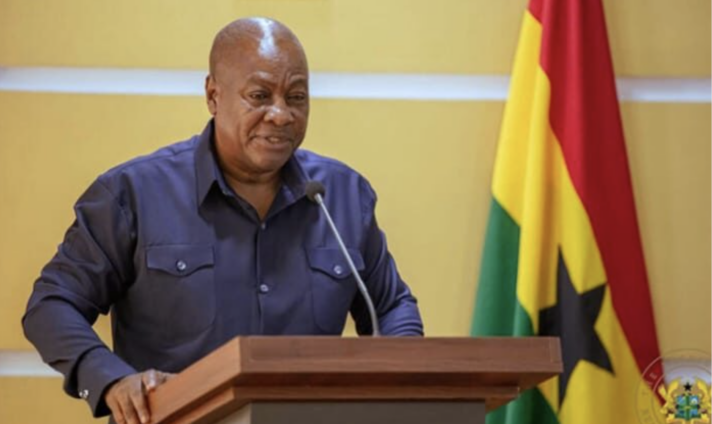
President John Dramani Mahama has called for a fundamental shift in how the transatlantic slave trade is documented and remembered, insisting that the experiences of enslaved women and girls must no longer be treated as “footnotes in history” but placed at the centre of global discussions on reparatory justice.
“The historical experiences of women and girls cannot remain footnotes in the global narrative. They must occupy their rightful place at the centre of truth-telling, remembrance and redress,” he said.
Addressing heads of states, foreign ministers, scholars and members of the African diaspora, the President said the legacy of slavery must be confronted with honesty, stressing that the experience of enslavement was not borne equally by all who endured it.
He noted that while millions of African men, women and children suffered the violence and indignity of the transatlantic slave trade, women and girls faced distinct and often hidden forms of brutality that have long been marginalised in historical accounts.
“As we reflect on this history, it is important to remember that the experience of enslavement was not borne equally by all who endured it,” he said.
The President observed that historical narratives often highlight slave ships, merchants and trading companies, while overlooking the lived realities of enslaved women.
“History remembers the names of the ships, the merchants and the trading companies,” President Mahama said.
“Yet far too often it forgets the woman whose body became a site of exploitation or the mother standing on the shore uncertain whether she would ever see her child again.”
He explained that for many enslaved women, exploitation went beyond forced labour, with their bodies turned into instruments of economic extraction.
“For many enslaved women, exploitation did not end just with providing labour. Their bodies themselves became instruments of economic extraction,” he said.
President Mahama further noted that the reproductive capacity of enslaved women was often exploited to sustain slavery across generations.
“Their capacity to bear children was transformed into a means of reproducing bondage across generations,” he added.
According to the President, much of this suffering was never properly recorded, resulting in what he described as historical erasure that has kept women’s experiences at the margins of global memory.
“Their suffering was often concealed from the official record, leaving them victims not only of their institution but also of historical erasure,” he said.
President Mahama stressed that correcting this imbalance requires recognising the role of women in both resisting oppression and sustaining communities through unimaginable hardship.
He paid tribute to historic female figures who played leading roles in resistance movements, including Nanny of the Maroons, Harriet Tubman, and Sojourner Truth.
“From Nanny of the Maroons in Jamaica, whose story is believed to have begun on the shores of present-day Ghana, to Harriet Tubman and Sojourner Truth, women have been at the forefront of resistance against oppression,” he said.
He also acknowledged countless unnamed women whose courage and sacrifices preserved families, communities and hope under extreme conditions of enslavement.
“Their courage was matched by countless others whose names history has failed to record and yet whose sacrifices helped preserve families, communities and hope in the most difficult of circumstances,” he noted.
The President further commended contemporary women—scholars, activists, jurists, policymakers, public servants and civil society leaders—whom he said continue to advance the reparations agenda.
“We also honour the women of our time… whose contributions have helped bring us to this historic moment and continue to shape the path that we must take ahead,” he said.
President Mahama emphasised that reparatory justice must be gender-responsive, warning that any framework that ignores women’s experiences would be incomplete.
He added that any process of truth-telling, memorialisation or reparatory justice that fails to recognise the specific experiences of women would remain fundamentally incomplete, stressing that the global conversation on slavery must now move from acknowledgement to inclusive historical justice.
Latest Stories
-
Legal tussle as ASG-ARC dispute moves to court
10 minutes -
‘Give caucus leaders adequate time to speak before ruling’ – Afenyo-Markin to Bagbin
16 minutes -
Petrosol gives back to society by donating 3,600 books and bags to Sawla DA Primary
22 minutes -
Bagbin dismisses Minority motion on narcotics seizures as inadmissible
27 minutes -
From Oversight to Impact: Why board committees will make or break Africa’s organisations
31 minutes -
‘Strong criticism is legitimate but insult is not argument’ – Speaker urges restraint in public discourse
33 minutes -
‘Don’t reward only bitter tongues’ – Bagbin tells political party leaders
33 minutes -
Nana Akua wins Dubai trip as Joy FM, Adansi Travels mark 10-year partnership
33 minutes -
NPP NEC election: John Boadu, JFK, Titus-Glover and Hawa Koomson in strong lead, according to latest national outlook survey
44 minutes -
TRAFFITECH-GH full implementation rescheduled to November 1
46 minutes -
‘Insults must not replace arguments’ – Bagbin cautions political actors against language that could undermine democracy
49 minutes -
Minority demands full data on Ghana narcotics seizures, arrests and prosecutions since 2025
52 minutes -
Man City found guilty of all charges of financial rule breaches, Premier League confirms
1 hour -
Jeffrey Nortey wins Screen Icon of the Year again at Ghana Entertainment Awards USA
1 hour -
Man Utd do not deserve Man City titles – Rooney
1 hour