

Audio By Carbonatix
President John Dramani Mahama has urged African countries to fundamentally rethink their relationship with the Western world and take greater ownership of their natural resources, development priorities and economic destiny.
He said Africa’s continued reliance on external assistance, coupled with its limited control over the pricing and processing of its raw materials, had entrenched a dependency syndrome that the continent must now deliberately overcome.
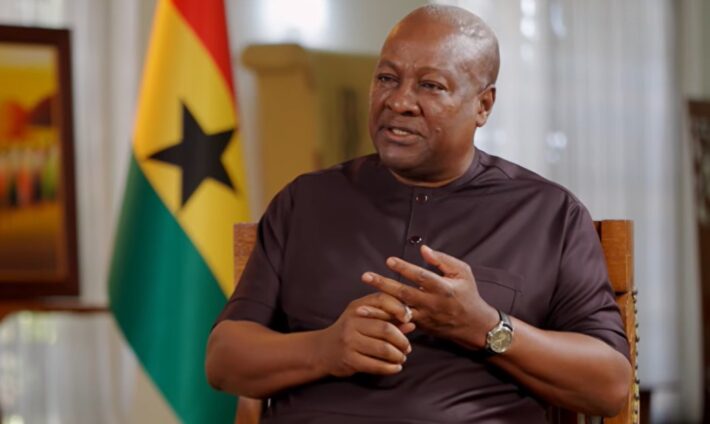
President Mahama made the call in an interview with TRT World on Friday, August 21, 2026, in which he linked Africa’s development challenges to the global order that emerged after the Second World War.
“Well, it’s born out of reality. Eighty years after the Second World War, the new global order was formed based on multilateralism. And it placed Africa in a situation where we have had a dependency syndrome,” President Mahama said.
‘We don’t control our resources’
The President said the imbalance was particularly evident in the manner in which Africa’s natural resources were traded on the international market.
He argued that while African countries continued to depend on assistance from Western nations, they had limited influence over the prices at which their raw materials were purchased and the finished products sold back to them.
“And so we live on the handouts that the West gives us. And then, aside from that, we don’t control our resources. Our resources are bought at prices that are set by the West and exported. And the finished products are sent back to us at prices that are set by the West,” he stated.
He said the situation had implications beyond trade and economic development, extending to critical sectors such as healthcare.
Health sovereignty
President Mahama explained that the push for greater self-reliance was one of the considerations behind the organisation of a conference on health sovereignty.
The initiative, he said, was designed to encourage African countries to strengthen their health systems, increase local pharmaceutical production and assume greater responsibility for health outcomes.
“And so the whole idea of the research started with the issue of health sovereignty and breaking the dependency syndrome. So we convened a conference here and said, look, I mean, we need to pull ourselves up by our bootstraps.
“We must create more resilient health systems. We must produce more of our medications locally in Africa. We must own our health outcomes more ourselves,” he remarked.
He said the health sovereignty debate had subsequently developed into a wider conversation about Africa’s place in the international system.
Partnerships, but on Africa’s terms
President Mahama stressed that Africa was not seeking to isolate itself from the rest of the world or reject international cooperation.
Rather, he said, partnerships should be structured to give African countries a greater say in determining how their resources were utilised and how their development priorities were pursued.
“We don’t reject partnerships, but those partnerships must be on our terms. We must have a greater say in what those resources are used for,” he said.
He said a stronger and more self-reliant Africa would enable the continent to exercise greater influence in global affairs.
“But then it’s gone a step further because it applies to other things, including the whole global order. I mean, Africa cannot continue to be a dependent continent,” he noted.
“There are things we can do so that we’re able to have a better voice in global affairs,” he said.
‘Africa’s prosperity is not a threat’
The President also rejected the notion that Africa’s economic advancement and growing self-reliance could threaten other regions.
He argued instead that a prosperous Africa would create opportunities for the wider global economy and contribute to global development.
“Africa’s prosperity is not a threat to anybody. Indeed, Africa’s prosperity will be a benefit to the whole global economy,” President Mahama said.
He maintained that Africa’s development was ultimately in the interest of the international community, particularly as the continent works to address persistent challenges in healthcare, education and economic growth.
“And so it’s in the interest of the whole world that Africa prospers and that Africa does well and that we’re able to overcome the challenges that we face in terms of growing economies, in terms of providing education for our people, in terms of healthcare and all that,” he added.
Latest Stories
-
NDC walks out as NPP Delegates Conference suffers hours of delay
2 minutes -
PNC cautions NPP against making flagbearer automatic party leader
13 minutes -
Treat healthcare as an investment, not a budget cost – Mahama
40 minutes -
Mahama outlines Ghana’s strategy to expand healthcare and produce medicines locally
44 minutes -
Don’t pay attention to those who will distract you; Ghanaians are already disappointed – LPG tells NPP
47 minutes -
Prof Mike Oquaye praises NPP Minority’s performance in Parliament
47 minutes -
KAAF University vice chancellor urges fresh students to embrace technology, innovation
47 minutes -
Move beyond packaging to produce drug ingredients in Africa – Mahama to pharma industry
50 minutes -
Ghana Medical Trust Fund, Hungary explore partnership to strengthen specialised healthcare
51 minutes -
Manhyia South MP Baffour Awuah pleads not guilty to EOCO charges, granted GH¢10m bail
55 minutes -
NPP conference: We need leaders to complement our efforts in Parliament – Annoh-Dompreh
57 minutes -
Sammy Crabbe steps down from NPP Chairmanship race, backs John Boadu
58 minutes -
NPP postpones constitutional amendments, including proposal on party leadership to next national conference
1 hour -
NDC ‘running into opposition like Usain Bolt’ – Sammy Awuku
1 hour -
Local pharma production can create jobs, strengthen Africa’s health security – Mahama
1 hour