

Audio By Carbonatix
The Ghana Chamber of Mines has welcomed the government’s decision to implement a sliding scale royalty regime in Ghana’s mining sector, but called for further discussions on the specific percentages and other key elements of the regime.
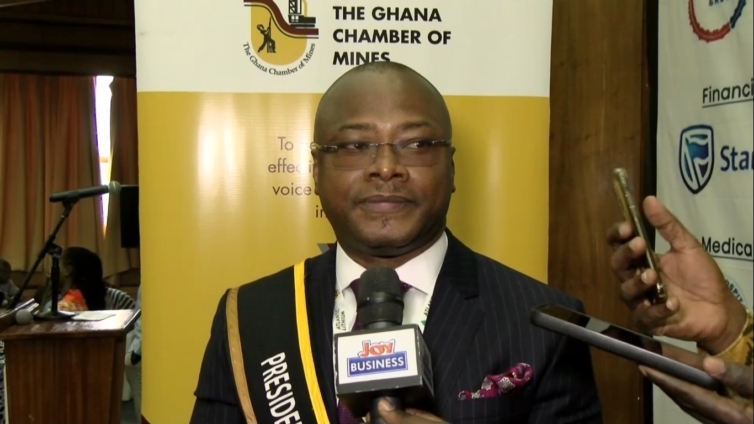
Speaking to journalists at the Africa Extractives Media Fellowship, Michael Edem Akafia, President of the Chamber of Mines, said that while the Chamber supports the introduction of a sliding scale regime, it has reservations about the proposed percentages and the underlying premise for the new regime.
He stated that the Chamber holds a divergent view on the percentages, noting that a rise in global gold market prices does not automatically translate into profit for mining companies.
He said the Chamber is proposing a base rate of 4% and a top-end rate of 8%.
He explained that this proposal was developed following detailed research into other mining jurisdictions, and the Chamber believes its recommendation fairly reflects trends across the continent.
“We are not against a sliding scale, but we believe the range should be between 4% and 8%. In the paper we presented to the Minister, we compared mature mining jurisdictions. In Africa, the only outlier is Mali, which recently introduced 10.5% at the higher end of its scale under a military regime—so we know they don’t listen to industry concerns.
“In virtually every jurisdiction you examine, especially for gold, no country reaches 12%. We therefore believe 4–8% is the most reasonable range. Another proposal we made was the dedication of one percent of profits to community development,” he said.
Michael Edem Akafia also dispelled the widely held perception that a rise in gold prices automatically translates into profit for mining companies.
He explained that while higher prices do enhance revenue generation for mining firms, this does not necessarily translate into profit due to a number of factors.
He noted that during periods of increased revenue, companies often channel funds into other operations to improve efficiency.
He stated that the additional revenue is typically directed toward activities such as in-pit exploration, the purchase of new equipment, the adoption of advanced technology, and other initiatives to ensure the sustainability of the company.
He therefore called for nuanced, non-sentimental discussions around the royalty regime to ensure that companies can fulfill their regulatory obligations without operating at a loss.
Latest Stories
-
Vibes The Movie: Big Ghun’s Ghanaian film earns five nominations at 2026 REFFA
3 minutes -
MamaCare CEO warns unresolved conflicts among health workers could undermine maternal and neonatal care
27 minutes -
Health professionals urged to translate medical knowledge into practice to save mothers
33 minutes -
Conflicts among care providers linked to maternal, neonatal deaths – Expert
2 hours -
GIS marks 10th TIME conference, champions improved teaching practices
2 hours -
BRICS Or Balance? What Ghana’s bid really means
3 hours -
GPRTU wants full TRAFFITECH-GH implementation to start in 2027
3 hours -
Mahama announces plans to import electric wheelchairs for PWDs
3 hours -
KGL U17 Colts 2026: Western beat Prempeh Elite Academy to set up final final with Greater Accra Region
3 hours -
Late Solanke strike salvages 10-man Spurs draw at Man United
4 hours -
Gender Ministry to monitor welfare of Nana Akua Addo’s children amid domestic violence case
4 hours -
Benedict Okyere Yeboah: Ghana’s football problem goes beyond sacking a coach
4 hours -
GPL 2026/27: Darkwah Wiafe’s winner sees All Blacks beat Kotoko
4 hours -
ITF World Tour : Patel Wins Boys’ Singles Final at J100 Accra
4 hours -
Ghana must pursue BRICS partnership if it brings economic benefits – Kpebu
4 hours