

Audio By Carbonatix
The GSMA has today published its annual 'State of the Industry Report on Mobile Money'.
It reveals a dramatic acceleration in mobile transactions during the Covid-19 pandemic as lockdown restrictions limited access to cash and financial institutions.
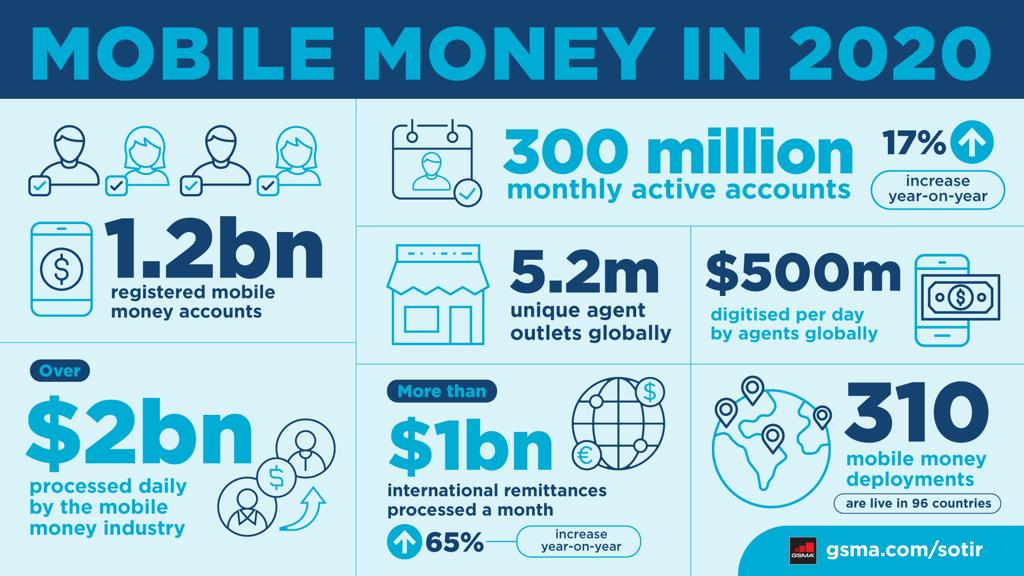
The report found that the number of registered accounts grew by 13 per cent globally in 2020 to more than 1.2 billion – double the forecast.
The fastest growth was in markets where governments provided significant pandemic relief to their citizens.
Providing more opportunities in the formal economy
To minimise the economic toll of Covid-19, many national governments distributed monetary support to individuals and businesses.
The value of government-to-person payments quadrupled during the pandemic, with the mobile money industry working hand-in-hand with administrations and NGOs to distribute social protection and humanitarian payments quickly, securely, and efficiently to those in need.
Facilitating this type of direct income support payments is one example of how mobile money provides a financial lifeline to underserved communities.
Mobile money providers have also provided in-kind support, including the distribution of personal protective equipment (PPE) and hand sanitising gel at agent counters.
"We see that mobile money is a powerful tool for expanding the financial inclusion of women in low- and middle-income countries," said John Giusti, the GSMA's Chief Regulatory Officer.
"This year's report, however, found that across markets women are still 33 per cent less likely than men to have a mobile money account. The GSMA and its members are committed to closing this gender gap by addressing the barriers that prevent women from accessing and using mobile financial services.”
Closing the gap requires a collaborative and concerted effort. Many providers have committed to increasing the proportion of female customers.
One example of an innovative approach to this is launching micro-entrepreneur products that can be used in markets where women represent the majority of vendors and customers.
Increasing global financial equality
For the first time, more than $1 billion was sent and received in the form of remittances globally every month via mobile money.
Despite early fears that transactions would decline as people worldwide suffered job losses and income cuts during the pandemic, it remains clear that diasporas continue to support family and friends back home.
As a result, the total value of transactions increased by 65 per cent to an annual total of $12.7 billion in 2020.
In working towards achieving the Sustainable Development Goals (SDGs), the GSMA remains committed to reducing inequalities among countries when sending money internationally.
According to GSMA's research, mobile money provides an affordable channel for connecting people to vital financial resources.
The mobile money ecosystem has been strengthened by an increasing number of strategic partnerships established between money transfer organisations and mobile money providers.
Driving regulatory change
As the Covid-19 pandemic negatively impacted people’s lives and weakened economies, regulators responded with a variety of measures aimed at reducing the impact.
The research found that the pandemic gave fresh urgency to the need for regulatory change to facilitate greater digitalisation.
In many markets, transaction limits were increased to allow more funds to flow through mobile money.
Additionally, as demand rose for non-physical payments, some regulators classified mobile money agents and their supply chains as essential services.
Over 50 per cent of mobile money agents were continuously active throughout the pandemic, which was crucial for service continuity and maintaining liquidity.
While some of the regulatory reforms made in response to the pandemic have been positive for customers and providers, the implementation and extension of fee waivers has had a negative impact on mobile money providers' core revenue stream.
Mobile Money providers depend mainly on transactional revenues to sustain their business. Regulators are strongly encouraged to work closely with the industry to ensure sustainability going forward.
Latest Stories
-
Stakeholders demand action against foreign-led illegal mining in Ahafo Region
1 hour -
Ghana handed tricky draw at 2026 Amputee World Cup
1 hour -
2024 Nyankpala election violence: Youth group petitions authorities over slow probe
2 hours -
Ghana, UNICEF strengthen partnership to advance child protection
2 hours -
Day Two of 3rd Republic Bank-JoyNews Habitat Fair ends with great homeownership offers and financing solutions
2 hours -
Guinness Ghana DJ Awards 2026 Pub Fest celebrates Ghana’s DJ culture as Accra turns up the energy
2 hours -
10th woman found dead in South Africa’s string of killings
2 hours -
French Embassy trains Ghana Police CTU in counter-terrorism operations
3 hours -
UPSA uncovers mass results manipulation involving 178 students, over 500 results compromised
3 hours -
ECG announces planned power outages in parts of Tema from Sept. 29 to October 1
4 hours -
Sylvester Mensah urges Latenu FM to promote trade, export opportunities in Ga
4 hours -
Ga language under threat of decline as children shy away from speaking it – Sylvester Mensah
4 hours -
‘Let every Ga child you raise know the Ga language and story’ – Sylvester Mensah
4 hours -
‘We are not deterred’ – Ablakwa responds to backlash over South Africa evacuation
4 hours -
Day Two: Republic Bank-JoyNews Habitat Fair gains momentum at Junction Mall
5 hours