


Audio By Carbonatix
The Bank of Ghana (BoG) says the country’s next digital finance frontier should move beyond sending and receiving money to helping ordinary users access credit, insurance and other financial services through their transaction histories.
Head of Fintech and Innovation at the Bank of Ghana, Elhanan Owureku Asare, says Ghana has made strong progress in financial inclusion, but must now focus on financial health.

He said mobile money wallets should increasingly become a pathway for small traders, informal workers and ordinary consumers to access services that traditional bank accounts have long provided.
“We have to get to a point where if I need funds, just like the way if I have a bank account and I need funds, I can apply for a loan, the woman selling tomatoes by the roadside should be able to say that because I have MTN Mobile Money wallets or Telecel Cash wallets, I will be able to access a loan from there,” he said.

Mr. Asare was speaking in a yet-to-be-aired documentary ahead of the maiden Digital Economy Forum under the theme, “The Trust Crisis: Why Fraud Is Holding Back Ghana’s Digital Economy.”
The thought-leadership platform, an initiative of Hubtel, will air on JoyNews and Joy FM on Wednesday, July 22, 2026, at 8 p.m.
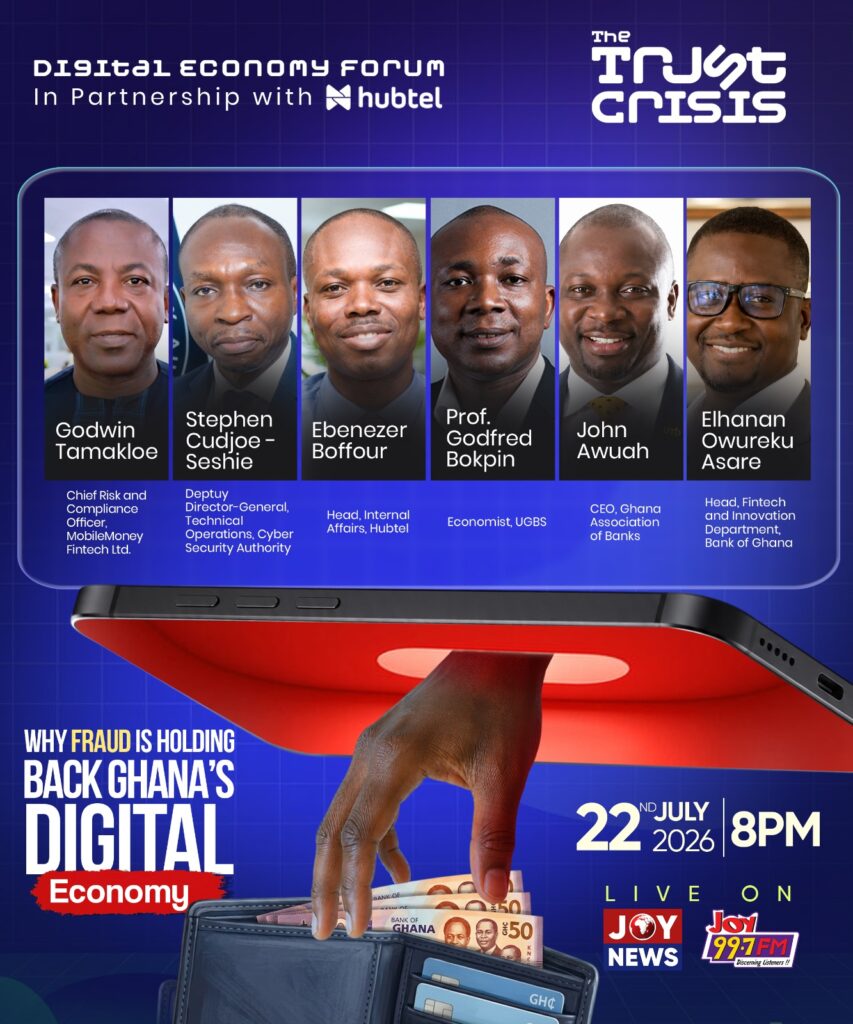
The forum will bring together regulators, banks, fintech companies, telecommunications firms, security agencies and consumers to examine whether Ghana’s regulatory system is keeping pace with the growth of digital finance.
Mr. Asare said the next phase of digital finance must help users build value from the records they create when they transact digitally.
“Will I be able to have insurance? Just like the way your bank, all the benefits that your bank account gives you, that is the way to get to a point where we are moving from financial inclusion to financial health,” he said.
The BoG Head of Fintechs and Innovation believes the current model must evolve beyond basic transactions.
“That is where I see in the next five years. It is not 15 years; it is too far. In the next five years, we have to make sure that we move away from financial inclusion to financial health. Otherwise, our transaction will be cash in, cash out.”
“But the person depositing funds in their wallet should be able to have that level of confidence that because of my transaction history, if I need access to funds, I will be able to get it,” he indicated.
He said the same transaction history could also support access to insurance products.
“Because of my transaction history, if there is any form of insurance related to my financial history, I should be able to access it. So I think that is the next frontier, moving from financial inclusion to financial health,” he added.
Ghana’s payment system is already processing transactions on a scale that makes such a transition possible.
The Bank of Ghana’s 2024 Payment Systems Oversight Annual Report shows that payment service providers processed about 8.1 billion transactions valued at approximately GH¢3 trillion in 2024.
This represented a 19 per cent increase in transaction volume from 6.8 billion in 2023 and a 58 per cent rise in value from GH¢1.9 trillion.
The Bank of Ghana’s licence categories also allow dedicated electronic money issuers to offer investment, savings, credit, insurance and pension products, but only in partnership with banks and duly regulated institutions.
That means mobile money wallets can serve as entry points into broader financial services, provided the services are delivered through properly regulated partnerships.
But Mr Asare’s vision depends heavily on trust. Consumers will not build useful digital histories if they withdraw money immediately after every transaction because they fear fraud.
They are also unlikely to keep funds in wallets or use digital channels consistently if they believe the system cannot protect them.
Mr. Asare has warned that trust is central to Ghana’s cash-lite economy. He said customers may return to cash if they lose confidence in digital channels.
Fraud remains one of the biggest threats to that confidence.
The Bank of Ghana’s 2024 fraud report shows that banks, specialised deposit-taking institutions and payment service providers recorded 16,733 fraud cases in 2024, up from 15,865 in 2023.
The total value at risk increased by 13 per cent, from GH¢88 million in 2023 to approximately GH¢99 million in 2024.
Payment service providers accounted for most of the reported cases.
The sector recorded 15,673 electronic fraud incidents in 2024, up from 14,655 in 2023, while the value at risk rose from GH¢16 million to GH¢19 million.
Mr. Asare said customer protection must therefore remain central to the growth of digital finance.
“Customer protection is paramount when it comes to applications and our oversight work. We want to make sure that you have the right tools and the right authentication to protect the customer,” he said.
He said weak customer protection could affect public confidence and broader financial stability.
“If the customer is not protected and almost every time they are being defrauded, it will impact financial stability,” he said.
The Bank of Ghana’s 2024 fraud report directed payment service providers to strengthen authentication, introduce customer-behaviour monitoring technologies, educate customers and intensify monitoring and training of mobile money agents.
The central issue ahead of the Digital Economy Forum is whether Ghana can protect digital users strongly enough to unlock the next stage of financial inclusion.
For many informal workers, mobile money is already the first point of contact with the formal financial system.
The next challenge is to ensure that their digital transaction histories can help them access credit, insurance, savings, pension products and other services without exposing them to greater fraud risks.
Latest Stories
-
Mahama urges African governments to treat healthcare as an investment, not budget cost
34 minutes -
Bawumia congratulates John Boadu and new NPP executives, pledges support ahead of 2028
36 minutes -
‘No talent should be left out’ – Bawumia pledges inclusive NPP campaign for 2028
42 minutes -
Prof. Mike Oquaye recounts how he blocked Special Prosecutor’s attempt to arrest Bawku Central MP
57 minutes -
Make health sovereignty a priority for Africa – Mahama
1 hour -
Dorimon Naa, Wa West DCE lead massive clean-up exercise; threaten sanctions against recalcitrant residents
1 hour -
Photos From Adom FM Y2K Jam
1 hour -
Praye Tiatia steals the show at Adom FM Y2K Jam [Watch]
2 hours -
Boakye Agyarko congratulates John Boadu, pledges support for NPP leadership
2 hours -
Antwi HiMight thrills fans with Antwi ne Antwi hits at Adom FM’s Y2K Jam [Video]
2 hours -
Amb. Edward Boateng congratulates Boadu, Kodua on election wins
2 hours -
John Boadu pledges to rebuild NPP from grassroots and restore ‘winning machinery’
2 hours -
Ashaiman Assembly deploys monitoring system to curb dumping in storm drain
3 hours -
John Boadu must rebuild, unite NPP for 2028 – Edward Boateng
3 hours -
Executive intimidation of opposition undermines separation of powers – Prof Oquaye
3 hours