

Audio By Carbonatix
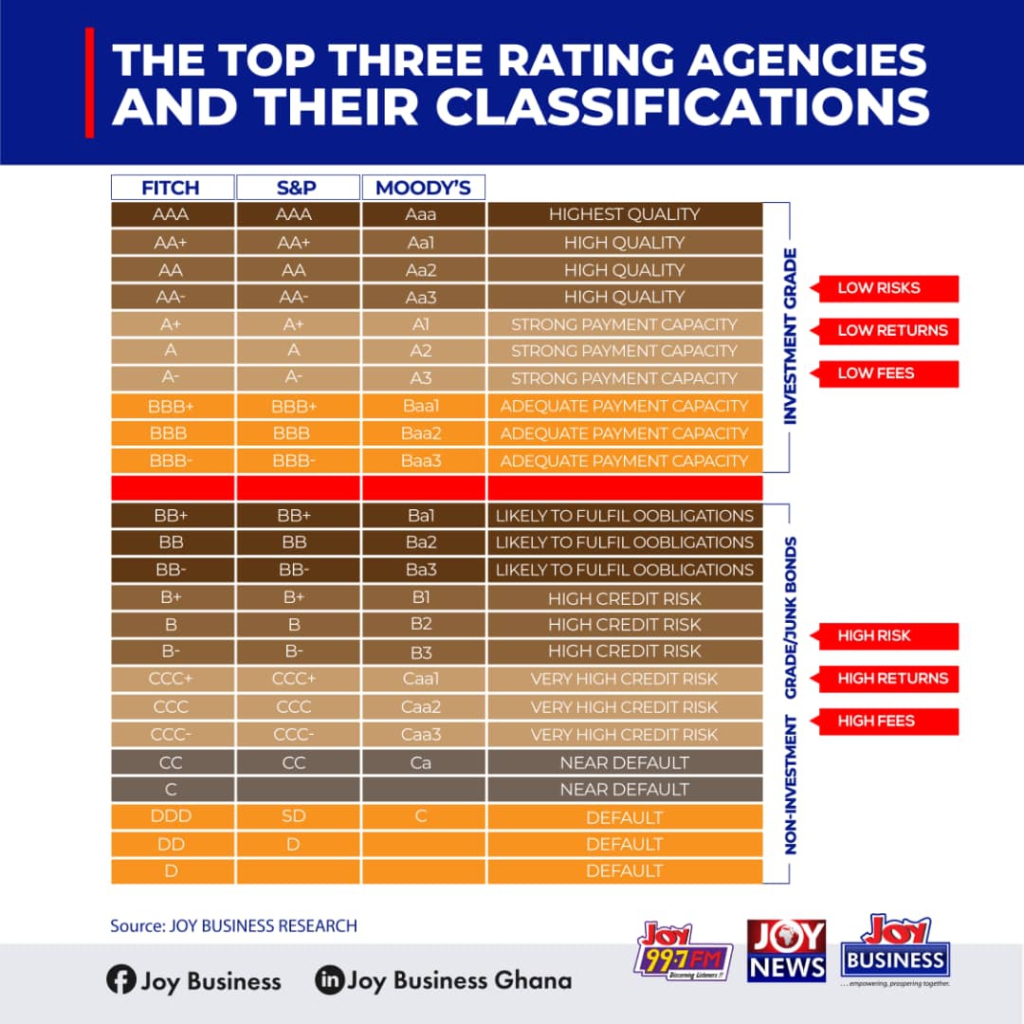
Rating agency, Moody's has downgraded Ghana’s long-term issuer and senior unsecured debt ratings to CAA2 from CAA1 and placed the ratings on review for downgrade.
The rating downgrade to CAA2, it said, reflects the recent macroeconomic deterioration, further heightening the government's liquidity and debt sustainability difficulties and increasing the risk of default.
This follows the recent downgrade of Ghana’s credit rating to ‘CC’ from ‘CCC’ by Fitch.
Despite Ghana's tightening of monetary policy in response to the global price shock, it said inflation continues to rise from high levels and the currency has been under very significant pressure, adding, “combined, a sharp rise in interest rates, high inflation and a rapidly weakening currency exacerbate the government's debt challenges”.
"Without external support, the government's policy levers to arrest a worsening macroeconomic backdrop and heavier debt burden are extremely limited; the government's small revenue base, largely and increasingly absorbed by interest payments, further intensifies the policy dilemma between competing objectives, including servicing debt while meeting essential social needs. As a result, the risk of an eventual default has increased", it pointed out.
The initiation of the review for downgrade is prompted by the ongoing negotiations between the government and the IMF over a funding programme, it underscored, adding, "it may include a condition for debt restructuring to ensure debt sustainability.
"Such a restructuring would likely be considered a distressed exchange and thereby a default under the rating agency's definition.
"The review will evaluate the likelihood of a debt restructuring being a prerequisite to secure sufficient and durable financing from official sources to avert a fiscal and balance of payments crisis that is already unfolding".
Concurrent to the rating downgrade, Moody's has also downgraded Ghana's bond enhanced by a partial guarantee from the International Development Association (IDA, Aaa stable) to CAA1 from B3, reflecting a blended expected loss consistent with a one-notch uplift on the issuer rating.
The rating has also been placed on review for downgrade given the review initiated on all unsecured debt ratings of the government.
Finally, Moody's has lowered Ghana's local currency (LC) and foreign currency (FC) country ceilings to respectively B2 and B3, from B1 and B2.
Non-diversifiable risks are captured in a LC ceiling three notches above the sovereign rating, taking into account relatively predictable institutions and government actions, limited domestic political risk, and low geopolitical risk; balanced against a large government footprint in the economy and the financial system and external imbalances.
The FC country ceiling one notch below the LC country ceiling reflects constraints on capital account openness and fiscal policy effectiveness against robust foreign exchange reserve buffers and average monetary policy effectiveness.
In February 2022, Moody’s downgraded Ghana’s long-term issuer and senior unsecured debt ratings to CAA1 from B3 and changed the economic outlook to stable from negative.
The downgrade to Caa1 reflected the increasingly difficult task the government faces in addressing its intertwined liquidity and debt challenges.
Latest Stories
-
Martin Kpebu explains when EOCO can arrest Manhyia South MP after securing court warrant
16 minutes -
EOCO’s reasons for seeking Manhyia South MP arrest warrant not justified – Kpebu
19 minutes -
MTN Ghana warns SMEs against sharing PINs amid digital fraud risks
21 minutes -
Yendi nursing students warn restricted access to skills lab could affect their training
21 minutes -
Minority awaits formal notice of arrest warrant for Manhyia South MP – Annoh-Dompreh
24 minutes -
LTIF announces 2026 Pan-African edition in Accra from October 6-7
24 minutes -
Mfantsipim needs broader funding partnerships to bridge infrastructure gap – Prof Baiden
25 minutes -
MP status must not shield anyone from law enforcement – Kwakye Ofosu
34 minutes -
EOCO had tactical team ready to arrest Baffour Awuah – Felix Kwakye Ofosu
54 minutes -
Afoko can unite NPP’s factions, says Charles Owusu Juanah
1 hour -
Guardiola backing Man City after guilty verdicts
1 hour -
Annoh-Dompreh questions EOCO’s claim that Manhyia South MP was unavailable for questioning
1 hour -
Djokovic wins first match since Wimbledon at China Open
1 hour -
KAIPTC, National Peace Council move to bridge civilian-security trust deficit to counter violent extremism
2 hours -
Infantino should have no place in future of football – Pinto
2 hours