

Audio By Carbonatix
Last Saturday, I came face-to-face with a discovery that left me in awe and disgust. A big disappointment with the city authorities.
Ordinarily, discoveries invite awards, rewards and appreciations. They are mostly linked to innovations or something worth promoting and celebrating.
However, my discovery of last week is none of the above. It is rather shocking, abysmal, detestable, and a huge insult to those constituents who line up in the sun simply to vote for a representative in the people’s Parliament to plead their needs on their behalf.
For decades, I have lived and worked in Accra, with so many visits to the famous arts and crafts centre, the Arts Centre, located on the John Evans Atta Mills High Street. I never imagined that the craft shops were only a façade, hiding a sprawling and unsightly community behind them.
Abandoned community
As our vehicle drove down, navigating through narrow passageways in between homes and shops, I wondered where we were going. I asked colleagues in the minibus if people lived there permanently.
The unknown was revealing itself – a community of makeshift settlements. Was this another Agbobloshie, an unlawful, controversial and seemingly forgotten community in the heart of the city?
After a few bends, steering carefully through some homes, sometimes stores, and dirty, choked gutters, we finally came to our destination: an open space provided for our Church’s evangelism programme.
The number of adults, youths and children who had come out to register for the programme and also take advantage of the free medical screening and National Health Insurance registration shocked me, but perhaps not surprisingly. Not surprising because there are still some of our folks who cannot afford even the premium and are awaiting some benevolence to come their way.
Quite a heavily populated settlement, it was difficult to comprehend how city authorities could have looked on as the unlawful settlement grew to that proportion, more like an accepted community within the city of Accra. Definitely not after the nuisances of Agbobloshie and others like them.
For a moment, it felt like one had walked into a different part of the country. If pictures of the settlement were posted on social media, asking people to take a guess, one wonders how many would have guessed it was the area behind the Arts Centre, which has for years been boarded up along that section of the High Street.
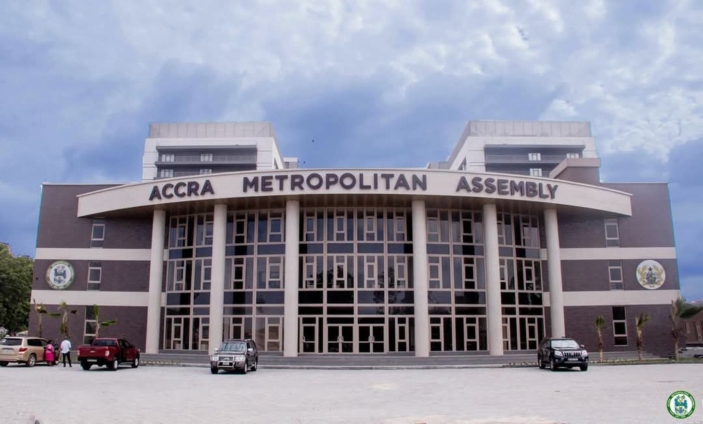
Accra Metropolitan Assembly
Without any doubt and equivocation, one can say that the Accra Metropolitan Assembly (AMA) has a huge charge to keep.
Whatever neglected development the cordoned stretch is scheduled for, it is not going to be easy to clear what looks like generations of a community settlement.
One is saying this due to the pushback the authorities have suffered over the years with similar settlements, such as Old Fadama in the heart of Accra.
From my encounter last Saturday, the slum that has been created with what is going on behind the arts and craft shops needs urgent attention by the AMA. The longer the action is delayed, the more difficult and costly the final ejection will be.
Street market
The other charge for AMA to keep is dealing with the sprawling street market that has virtually taken over the pavements behind the Assembly’s plush head office near the Accra City Hotel.
Did one not hear right when, only a few months ago, the Accra mayor declared, on authority, that he had given all street hawkers one month to vacate the streets of Accra? What happened to that bold declaration, with even the AMA’s own vicinity overrun with open markets? Was it just rhetoric, wanting the bosses that be to see that there is indeed a new “Sheriff” in town?
Pedestrians are now walking in the street, with pavements stretching to the ECG offices and heading towards the CHRAJ office, under the watch of street hawkers. Now the area, which used to be mainly a food market, has metamorphosed into a variety of goods, with items common to supermarkets. Suitcases, clothes, shoes, and some appliances are sold on the pavement.
As it stands, if the Assembly does not devise ways to curtail the level of pavement sales in the city, Accra pavements will be covered not only by markets, but also by chop bars and spare part dealers, who will join the fray and capture their share of space as well.
Where do we go from here? The question is: will Accra ever be the same beautiful city, with less congested roads, greater orderliness, and less littering, as the capital city that some of us grew up in?
AMA indeed has a charge to get us there, and we are waiting.
******
The writer can be reached via email at vickywirekoandoh@yahoo.com
Latest Stories
-
Ghana explores centre of excellence for hearing, communication and cochlear implant care
1 hour -
Schizophrenia-related disorders lead mental health cases recorded in Ghana
1 hour -
Dutch authorities enlist Ghana in hunt for fugitive drug lord Bolle Jos
2 hours -
Ghana housing finance conference adopts communiqué to improve affordable housing access
6 hours -
Special Initiatives Minister urges Wa Technical Institute to enrol more girls as EU-backed solar training lab opens
7 hours -
In the matter of my first year at the Bar
7 hours -
ActionAid Ghana calls for an end to child marriage, greater investment in girls’ rights
7 hours -
Newsfile to tackle World Cup visa scandal, beach demolitions, education strikes, BRICS bid
7 hours -
UK-Ghana Trade & Investment Summit: Trade Resource Centre to help businesses maximise UK-Ghana trade opportunities
8 hours -
Embassy of Denmark celebrates World Maritime Day
8 hours -
Linking LEAP to productive inclusion could cut extreme poverty by 2030 – UNICEF
9 hours -
Trade Ministry backs use of creative arts to rehabilitate prison inmates
9 hours -
Negotiations with government to continue despite strike suspension – GNAT
9 hours -
‘Ghana cannot afford to waste public resources; every cedi has a job’ – Ato Forson
9 hours -
Ghana expects economic boost as World Assemblies of God Congress brings 10,000 delegates to Accra
9 hours