


Audio By Carbonatix
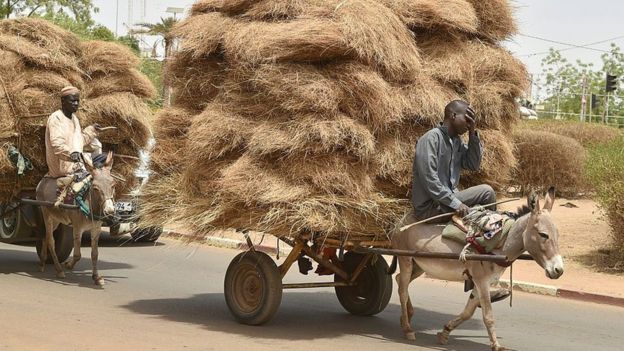
Niger has banned the export of donkeys, warning that a three-fold increase in trade, mainly to Asian countries, is threatening its donkey population.
"If the export continues the animals will be decimated," a government official has told the BBC.
China imports many donkey hides, using the gelatin in medicinal tonics, aphrodisiacs and anti-ageing creams.
In August, neighbouring Burkina Faso banned the export of donkey skins on similar grounds.
"About 80,000 donkeys have been exported so far this year compared to 27,000 last year," Atte Issa, at Niger's livestock ministry, said.
The government has also banned the slaughter of any donkeys within Niger.
The BBC's Baro Arzika in Niger's capital, Niamey, says the trade in donkeys has become so profitable that livestock sellers are abandoning other animals for the donkey trade.
A donkey now costs between $100 (£75) and $145, when it used to cost about $34.
A similar price hike in donkey skin was witnessed in Burkina Faso where the animal's hide rose from about $4 (£3) a few years ago to $50.
In both countries donkeys are commonly used to transport goods, though some communities eat their meat.
The ban was issued through a joint decree by Niger's ministries of farming, finance and internal affairs and trade.
Why China can't get enough donkeys: By Fuchsia Dunlop, BBC News
Gelatin made from donkey skin is highly prized in China as a medicinal tonic, thought to nourish the blood, boost the immune system and act as a general pick-me-up. It is sometimes referred to as one of the "three nourishing treasures" (zi bu san bao), along with ginseng and the antlers of young deer.
The most famous donkey gelatin is produced in Dong'e County in north-eastern Shandong Province, where it is traditionally made with the local well-water.
Donkey gelatin is sometimes mixed with walnuts, goji berries and other tonic foods and sold in dark, gummy slabs that can be eaten as a snack.
Health and longevity is a Chinese national obsession, and tonic foods like this are often lavishly packaged and presented as expensive gifts.
Aside from gelatin, donkey meat is a delicacy in some Chinese regions, especially in the north of the country.
Here, the lean meat is often simmered in a richly-spiced broth, and then cooled, sliced and served with a refreshing dip of chopped garlic and vinegar. The meat has a fine, dense texture and a marvellous flavour that's a little reminiscent of beef.
In northern Hebei province, one famous snack is the lu rou huo shao, in which chopped, spiced donkey meat is mixed with fresh green chilli and stuffed into a layered pastry - its name is sometimes translated into English as a "donkey burger".
Donkey meat may also be made into soups and stews.
As the Chinese middle classes have grown richer, demand for donkey gelatin and other tonic delicacies has soared - in January the New York Times reported that a shortage of donkey gelatin had encouraged a boom in imitation products.
Latest Stories
-
NCA announces major voice and data disruption across Northern Ghana due to fibre cuts
8 minutes -
Photos: Housing solutions take centre stage at Day 2 of the 3rd Republic Bank-JoyNews Habitat Fair
40 minutes -
Video: Immunity should be exercised without creating classism – Inusah Fuseini on cocaine bust
1 hour -
Ghana Air Force passes out 293 recruits after six months of intensive training
1 hour -
EOCO vrs Baffour Awuah: EOCO should have secured warrant before arrest attempt at court – Inusah Fuseini
1 hour -
Triple fibre cuts disrupt telecom services across Northern, Oti regions – Sam George
1 hour -
Politicisation could undermine parliamentary probe into cocaine seizures – Dr Osae-Kwapong
2 hours -
EOCO chases MP: Can Section 41 cure lacuna in EOCO Act? – Inusah Fuseini asks
2 hours -
GNFS, GWL inspect fire hydrants in Ministries enclave; 23 found faulty
2 hours -
Gov’t directs release of 50,000 bags of grain to ECOWAS
2 hours -
Ghana, Germany deepen cooperation on railways, labour mobility
2 hours -
Huge crowds greet Pope in Paris for open-air Mass
2 hours -
Ghana’s Charles Amofah Elected Vice President of African Bowling Federation
2 hours -
‘I never said I’ll declare a state of emergency’ – President Mahama on galamsey
3 hours -
Bobby Banson condemns EOCO’s attempted arrest of Nana Agyei Baffour Awuah
3 hours