

Audio By Carbonatix
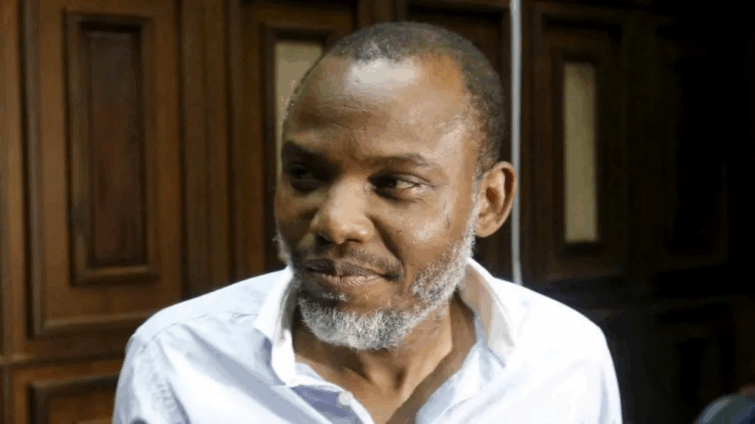
A court in Nigeria has found separatist leader Nnamdi Kanu guilty of terrorism 10 years after he was first arrested.
The court said it was satisfied that Kanu had made a series of broadcasts to incite violence and killings, as part of his campaign for a separate state in south-east Nigeria, known as Biafra.
Kanu has so far been convicted on six of the seven charges he faced, with the judge continuing to deliver his ruling.
Once a relatively obscure figure, Kanu's popularity surged in 2009 when he started Radio Biafra, a station that called for an independent state for the Igbo people broadcast to Nigeria from London.
Though he grew up in south-eastern Nigeria, where he attended the University of Nsukka, Kanu moved to the UK before graduating and acquired British nationality.
In 2014, he set up the Indigenous People Of Biafra (Ipob), a movement demanding independence.
Ipob was banned as a terrorist organisation in 2017. Its armed wing - the Eastern Security Network - has been accused of killings and other acts of violence in recent years.
Delivering his judgement, Judge James Omotosho said: "Mr Kanu knew what he was doing, he was bent on carrying out these threats without consideration to his own people.
"From the incontroverted evidence, it is clear that the defendant carried out preparatory act of terrorism.
"He had the duty to explain himself but failed to do so."
In court ahead of the verdict, Kanu insisted that proceedings could not continue because he had not yet filed his final written address, accusing the judge of bias and not understanding the law.
The judgement was delivered after Kanu had been forcibly removed from the courtroom for unruly behaviour.
He was first arrested in October 2015 but he jumped bail in 2017 and left the country after a military raid on his home. The court later revoked his bail in March 2019 and he was re-arrested in 2021 in Kenya.
The calls for Biafran independence date back many years.
In 1967 Igbo leaders declared a Biafran state, but after a brutal civil war, which led to the deaths of up to a million people, the secessionist rebellion was defeated.
Latest Stories
-
Baffour Awuah: EOCO effected an arrest, detained MP after hours of waiting, questioning – Afenyo-Markin
7 minutes -
EOCO court warrant authorised search of Baffour Awuah’s law firm, not residence – Afenyo-Markin
23 minutes -
NPP delegates conference: 3,000 to 4,000 police personnel deployed for security in Kumasi – Anthony Karbo
25 minutes -
KGL Foundation commits $200,000 to support juvenile football for the next two years
40 minutes -
UNDP invites Mahama Ayariga to Northern Peace Conference in Tamale
45 minutes -
Afoko can give NPP ‘new identity’ ahead of 2028 to overcome NDC – Political scientist, Dr Amakye-Boateng
60 minutes -
2 injured amid gunshots during raid at Nawara Mining office at Nsuapemso
1 hour -
St Augustine’s College retains 2026 National Investment Quiz title
1 hour -
KNUST Nursing and Midwifery School staff recognised at 2026 Health Ministry Excellence Awards
1 hour -
JoyNews’ Esther Esi Nkrumah selected for UK Media Excellence for Emerging Technology Fellowship
1 hour -
Five NDC youth organisers in Western Region pay courtesy call on Armah-Kofi Buah
2 hours -
NACOC demands tighter port controls to prevent Tema Harbour drug trafficking
2 hours -
Ghana’s startup ecosystem must build sustainability into innovation – Ghana Hubs Network
2 hours -
Friday’s beachfront demolition was carried out at Labadi Beach Hotel’s request, not for flood mitigation – Stan Dogbe
2 hours -
LA 2028: Mukarama returns to Black Queens squad for Olympic Games qualifiers
2 hours